
Can You Paste Customer Data Into ChatGPT Without Breaking GDPR?
Pasting customer data into ChatGPT isn't illegal by default, but it depends on your plan, your legal basis, and whether you can anonymize. A no-hype guide.

Your team has been pasting things into ChatGPT for weeks: customer emails to draft a reply, an order sheet to pull a summary, the contact list to clean it up. It works, it’s fast, and nobody has stopped to ask whether that’s allowed. And then someone asks.
The short answer: technically you can paste whatever you want, legally it depends, and in practice you should almost never do it with the free version. It’s not that GDPR bans using ChatGPT with customer data. It’s that the most common way to use it (the free account, with real names and emails inside) is also the easiest way to turn it into a problem. Here I explain what it really depends on and what you can do this week. A heads-up right away: this is not legal advice, it’s a guide so you know which questions to ask.
What counts as “customer data”?
Any information that identifies a person, or that can be used to identify one, is personal data. And that covers more than it seems. The name and the email, yes, but also the phone number, the address, an order number tied to a person, the text of a support ticket where the customer describes their case, or even a review with their name on it. If you can read it and say “this belongs to so-and-so,” it’s personal data and GDPR applies.
This matters because it draws the line. Asking ChatGPT to draft a generic welcome template touches no personal data at all. Pasting the real email of a customer with her name, her order, and her complaint does. Same tool, two completely different legal situations.
Does ChatGPT learn from what I paste?
It depends on the plan you use, and this is the distinction almost nobody has clear. On the consumer version (the free account and ChatGPT Plus), OpenAI can use your conversations to train its models unless you turn that off in the settings. On the business plans (ChatGPT Team/Business, ChatGPT Enterprise, and the developer API), OpenAI does not train on your data by default.
What does “train” mean in plain terms? That the content you write can become part of the material the model improves on. It’s not that an OpenAI employee reads your customer sheet in the morning. It’s that the data enters an automated pipeline from which, in the worst case, something could resurface indirectly later on. For an identifiable piece of customer data, that risk isn’t worth it.
| Plan | Trains on your data? | Retention | Contract (DPA)? |
|---|---|---|---|
| Free / Plus (consumer) | Yes, unless you turn it off in Settings | Until you delete the history | No |
| Team / Business | No, by default | 30 days for abuse monitoring, then deleted | Yes |
| Enterprise | No, by default | Configurable; zero retention available on request | Yes |
| API (developers) | No, by default | 30 days for abuse monitoring, then deleted | Yes |
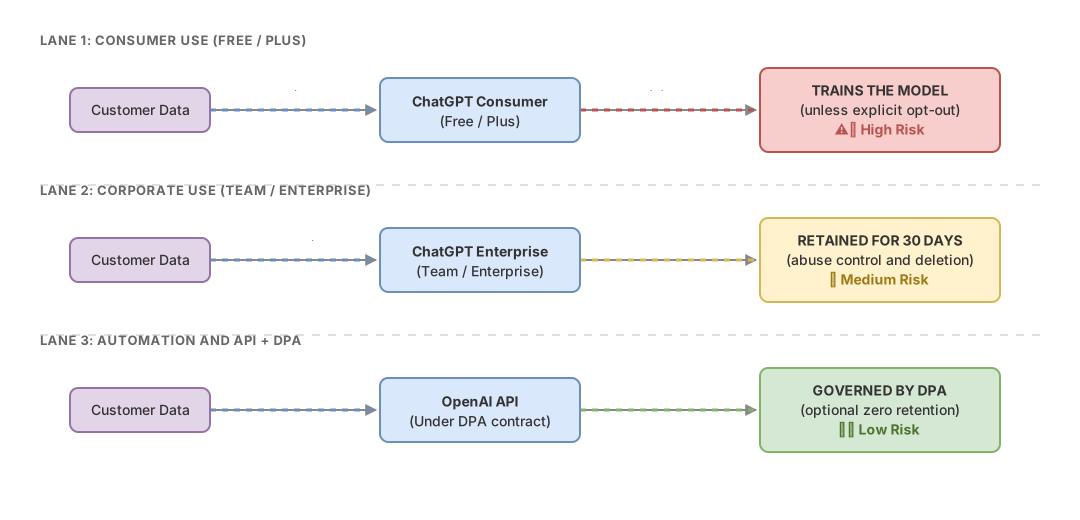
A plan not training on your data doesn’t mean you have nothing left to worry about. It means you’ve closed one of the three risks. The other two remain, and those are the ones GDPR sets.
GDPR doesn’t ban AI, it asks you for three things
GDPR doesn’t say “don’t use ChatGPT.” It says that, if you’re going to process personal data, you meet three conditions. The first is having a legal basis: a valid reason to process that data, from the list the regulation sets out in Article 6. “It was handy for going faster” isn’t one of them. The person’s consent, the performance of a contract with them, or your well-justified legitimate interest can be, depending on the case.
The second is transparency. The person whose data you process has the right to know what you do with it, and “I put it into a third-party AI tool” is exactly the kind of thing your privacy policy should reflect. The third is the contract. When you let another company process personal data on your behalf, that company is what GDPR calls a data processor, and you need a contract with it that sets the rules. That’s Article 28. OpenAI offers it as a DPA (a data processing agreement) for its business plans, not for consumer accounts.
The difference between controller and processor is simple if you think of it this way: you are the controller because you decide what data you process and why; OpenAI is the processor because it handles the data following your instructions. The one responsible for getting all of this right is you, not the tool. That’s why the European Data Protection Board, which brings together the EU authorities, published a report on ChatGPT[1]: the doubt is real and so is the scrutiny.
The cheapest way out: don’t upload the identifiable data
The best way to avoid a data problem is not to upload the data. It sounds obvious, but it’s the option almost nobody considers before jumping to “I need the Enterprise plan.” Most of the tasks your team uses ChatGPT for (drafting, summarizing, classifying, fixing the tone) don’t need the customer’s real name at all.
If you ask it to rewrite a support reply, you can swap “Dear Ana Martínez, about your order 48213” for “Dear [customer], about your order [number]” and paste only that. The model drafts just as well. This is anonymizing: removing the data entirely. Or pseudonymizing: swapping it for a label only you can turn back. It’s the cheapest, fastest measure, and the one that depends least on reading anyone’s fine print.
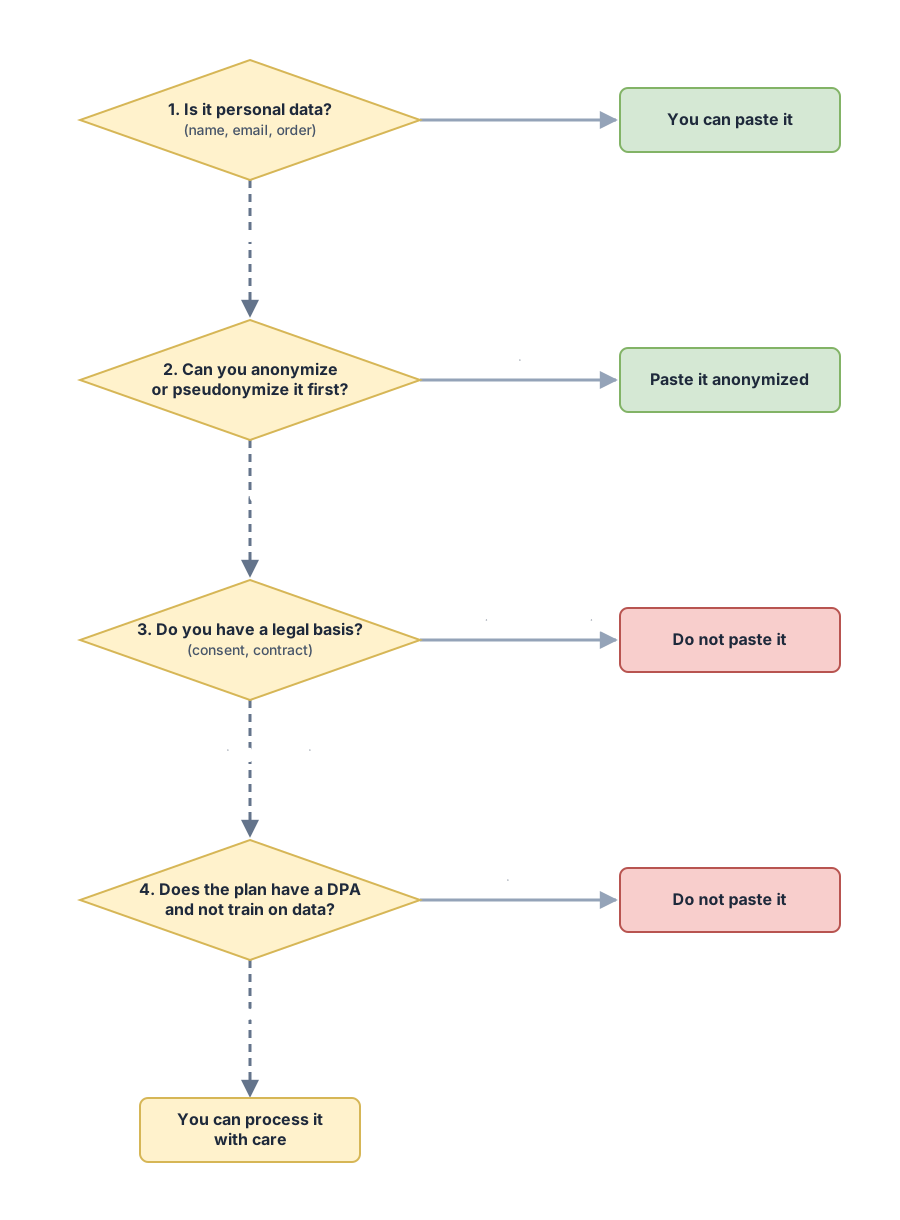
Working through this part with judgment (when a piece of data is truly needed, how to set up a simple policy for what can and can’t be pasted) is exactly what we do in the no-hype AI course: using these tools with your head, buying neither the hype nor the fear. For the full legal framework, with GDPR and the AI Act together, there’s the guide to AI, GDPR and the AI Act for companies.
What to do this week
You don’t need a six-month project to cut the risk sharply. These steps cover the essentials.
- While you’re still on consumer accounts, go into Settings and turn off using your conversations to train the model
- Move the team to a business plan (Team, Enterprise, or the API) if it’s going to handle customer data regularly
- Sign the DPA that OpenAI offers for that plan and file it with the rest of your vendor contracts
- Write a clear internal rule: which data is NEVER pasted (names, emails, phone numbers, health or financial data) without anonymizing first
- Teach the team to pseudonymize in thirty seconds before pasting, with a couple of real examples
- Check that your privacy policy mentions you use AI vendors to process data
If you want to dig into exactly what happens when data leaves toward a third party, I develop it in data to third parties and AI models, and the general overview of GDPR and artificial intelligence gives you the full context.
Sources
- European Data Protection Board, report of the ChatGPT taskforce. Supports that the EU authorities have examined ChatGPT’s GDPR compliance.
- OpenAI, business data privacy. Supports that OpenAI does not train on Team, Enterprise, or API data by default, the 30-day retention, and the availability of the DPA.
Frequently Asked Questions
Is it illegal to paste customer data into ChatGPT?
It’s not illegal by default. What GDPR says is that, if you process personal data, you need a legal basis, transparency with the affected person, and a contract with whoever processes that data on your behalf. With the free version you don’t have that contract, and on top of that your conversation can be used to train the model, so the risk there is high. With a business plan and anonymized data, the risk drops a lot.
Does ChatGPT keep the customer data I give it?
It depends on the plan. On the business plans (Team, Enterprise, and the API), OpenAI retains inputs for up to 30 days to control abuse and then deletes them, and does not use them for training. On the consumer version, your history is kept until you delete it and can be used for training unless you turn that option off in the settings.
What is a DPA and why do I need it?
A DPA is the data processing agreement that GDPR requires (Article 28) when another company processes personal data on your behalf. It sets what it can do with the data, how long it keeps it, and what security measures it applies. OpenAI offers it for its business plans. Without that contract signed, processing customer data in the tool leaves you exposed.
Isn’t it easier to just anonymize?
In many cases, yes. If you swap names, emails, and numbers for generic labels before pasting the text, you’re no longer processing identifiable personal data and much of the problem disappears. Most drafting or summarizing tasks don’t need the real data. It doesn’t cover every scenario, but it’s the cheapest measure and the first one you should apply.
Does the AI Act change any of this?
The AI Act mainly regulates which AI systems can be used and with what obligations depending on their risk, while who is allowed to touch your customers’ data is still governed by GDPR. The two coexist. For the full map of both rules applied to a company, see the guide to AI, GDPR and the AI Act for companies. And remember: this is general guidance, not legal advice; for your specific case, consult whoever handles your data protection.
Related articles

AI, GDPR and the AI Act: what your business needs to know in Europe
If your business uses third-party AI, the AI Act barely applies to you, but the GDPR does. A hype-free guide for decision-makers: what you can do, what you can't, and what gets you fined.
GDPR and artificial intelligence: what you can and can't do with data
GDPR doesn't ban you from using AI. It governs what you do with people's data. A hype-free guide for decision-makers: when you can put data into an AI and when you can't.

What happens to the data you send to an AI model
When your team types something into an AI tool, that text leaves your company. What the provider does with your data and what to demand before approving the tool.