
Training your team in AI (without gurus): where to start
Where to start training your team in AI without getting sold hype: what each role needs to know and how to tell serious training from guru promises.

The first decision about AI in your company is not which tool to buy. It is building the judgment of whoever will decide. Buying AI before you understand it is one of the most expensive ways to burn a budget, because you end up paying for something nobody in the company knows how to evaluate. Here I explain where to start training your team in AI without gurus: what each role needs to know and how to tell serious training from hype.
Why start with training and not with the tool?
Start by training yourself and then your team, before signing any contract. The reason is simple: if you do not understand the basics of how this technology works, you cannot judge what a vendor is selling you. And when you cannot judge, you decide out of trust or out of fear of falling behind. Both are poor advisors when there is a budget on the table.
An LLM (a language model, the engine behind tools like ChatGPT) is not a program that always gives the same answer to the same question. It is a system that predicts likely text. That has two consequences a decision-maker has to absorb before buying anything: sometimes it is brilliantly right, and sometimes it invents facts with complete confidence. That confident invention is called a “hallucination”, and it is not a flaw that gets fixed in the next version. It comes with the technology.
Building judgment means exactly this: understanding what AI does well, what it does badly, and what questions to ask whoever wants to sell it to you. Without that judgment, your company is at the mercy of the most confident person in the room, who is rarely the one who knows the most.
What separates serious training from guru hype?
Serious training also teaches you the NO. It tells you when AI is not the answer, what it really costs, and what risks you are taking on. Guru hype does the opposite: it promises transformation, teaches four tricks for writing instructions, and avoids any uncomfortable conversation about limits, data or money.
There are fairly reliable signals to tell one from the other.
| Signal | Serious training | Guru hype |
|---|---|---|
| What it teaches | Judgment to decide, with real cases from your sector | Tricks for writing “magic prompts” |
| How it talks about risk | Explains errors, cost and legal limits | ”AI changes everything, get on board or get left out” |
| What it promises | That you will make better decisions | Spectacular results in days |
| What you practice with | Problems from your own company | Generic, flashy examples |
| What happens afterward | Ongoing review and adjustment | One talk and off you go |
Writing good instructions for a model is useful, but it is the easy part and the one that goes obsolete first. What is valuable is the judgment to know when a result is reliable, when it needs review, and when you simply should not use AI for that task. That judgment is built slowly, with real examples, and it is exactly what a guru in a hurry cannot give you.
What should each role know?
Not everyone in the company needs the same training. Training everyone in the same thing wastes time and money. Management needs judgment to decide; the operational team needs practice with their tasks; and IT or legal need control over data and compliance. Splitting the training well is half the work.
| Role | What they need to understand | What they do NOT need |
|---|---|---|
| Management | Which decisions AI enables, real cost, risks and limits, how to judge a vendor | Technical details of how a model works inside |
| Middle management | Which tasks in their area are good candidates and which are not, how to supervise the result | Programming or configuring tools |
| Operational team | Using the approved tools in their daily work, spotting when a result smells off | The general theory of AI |
| IT and legal | Where the data goes, what can be uploaded and what cannot, what the regulation requires | Becoming experts in every model on the market |

The most important row is usually the first one. If management does not get trained and hands all the judgment to an outside consultant or to the most enthusiastic employee, the company makes decisions it cannot answer for. When someone asks why customer data was uploaded to an uncontrolled tool, “it was recommended to me” is not an answer that will hold up.
What minimum concepts do you need to understand to decide?
Anyone deciding about AI should handle four ideas, and none of them requires a technical background:
LLM (language model). The system that generates text by predicting what is likely to come next. It does not consult a database of truths. It writes what sounds right based on what it has seen before.
Hallucination. When the model invents a fact, a citation or a figure and presents it as true. It does not warn you that it does not know. That is why any result with consequences needs someone to review it.
Determinism (or the lack of it). A calculator is deterministic: the same sum always gives the same result. An LLM does not. You can ask it the same question twice and get different answers. That rules out using it as-is for processes that demand identical, auditable results.
Context and data. The model only works with what you give it in each query and with what it learned during training. What information you hand it, and above all what information you should not hand it, is a business and compliance decision, not a minor technical detail.
With these four ideas, a director can sit across from a vendor and ask the right questions. Without them, all they can do is nod.
How do you set up a realistic training plan?
An AI training plan that works starts at the top and lands on your own cases. The usual mistake is the reverse: a generic course is bought for the technical team, management is assumed to figure it out on its own, and six months later nobody can explain where the money went.
An order that does work:
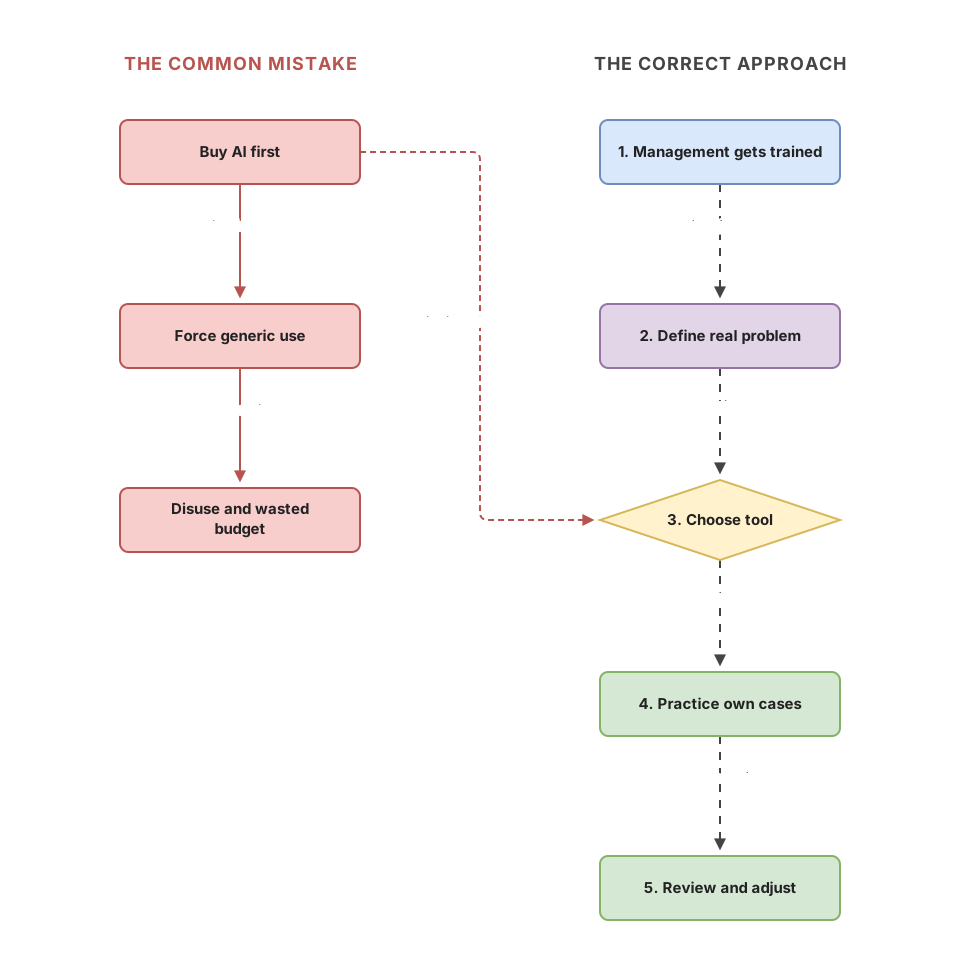
- Management gets trained first, even if it is a short version with no jargon.
- You define which real company problem you want to tackle, before choosing a tool.
- The training uses those own cases, not catalog examples.
- You agree on a basic usage policy: what can be uploaded to an AI and what cannot.
- After a few weeks you review what is actually being used and what stayed in theory.
- You adjust the plan, because the first version always falls short somewhere.
That judgment to decide what to automate, with what safeguards and what limits, is exactly what we work on in the AI without hype course: built to help you decide with a clear head, not to sell you that AI solves everything.
Training is not a one-off event. It is part of the same problem you solve with an internal AI usage policy and with control over shadow AI, the use of AI tools by your people without anyone having approved them. If you train well, you have less shadow AI, because people know what they can use and why. All of this is part of how AI gets governed in a company, the subject of the pillar on AI, GDPR and the AI Act.
How much does it cost and how long does it take?
The real cost of AI training goes well beyond the course invoice. It is mostly the time of your team applying it to real cases, which is where the learning actually happens. A two-hour talk is cheap and changes nothing. Building judgment takes weeks of practice on your own problems, and that time has to be budgeted just like the course.
I am not going to give you a made-up figure, because it would depend on your size, your sector and what you want to achieve. What I can tell you is that the cost of not training is usually higher: expensive decisions made badly, tools bought and abandoned, and sensitive data circulating without control. Compared to that, training the people who will decide is one of the most profitable things you can do with AI.
There is also a compliance reason. The European AI Regulation (the AI Act) introduces an “AI literacy” obligation: organizations must ensure their staff have a sufficient level of knowledge to use these systems with judgment. Training your team is not just a good idea, it is starting to become a regulatory expectation. This is not legal advice; if the regulation affects your case, check the details with a professional.
Common mistakes when training in AI
Training only the technical team. This is the most expensive mistake. It leaves the decision-makers unable to judge what they buy, and shifts all the judgment onto people who should not be carrying business decisions.
One talk and on to the next thing. A single-day session generates enthusiasm and zero change. Without practice on your own cases and without review, in a month nobody remembers anything.
Teaching only how to write instructions. Writing good prompts is the part that goes obsolete first. If that is the whole training, you have paid for a skill with an expiry date and no judgment behind it.
Handing judgment to the vendor. Having an expert advise you is fine. Having them decide for you without anyone in your company understanding the decision is how you sign contracts you cannot defend.
Generic training with no own cases. A catalog course teaches concepts that never land. Training sticks when you practice with the real problems of your company, not with textbook examples.
Checklist for training your team in AI
- Management gets trained before buying any tool
- Each role has a distinct, clear training goal
- The training uses real company cases, not generic examples
- Everyone understands what a hallucination is and why results must be reviewed
- It is clear which data can be uploaded to an AI and which cannot
- There is a review after a few weeks to see what is really being used
- The plan gets adjusted instead of being treated as finished
Frequently asked questions
Do I have to get trained too, even though I run the company?
Yes, and you are probably the one who needs it most. Not to program or configure anything, but to have judgment when deciding and when assessing proposals. If you hand all the knowledge to others, you decide blind about something that affects your budget, your data and your legal responsibility.
Do you need a technical background to lead AI training?
No. You need business judgment and an understanding of four basic concepts: what a language model is, what a hallucination is, why AI does not always give the same answer, and which data is sensitive. The technical part can come from your IT team or an advisor. The decision of what to train and why is yours.
Is it better to train internally or hire someone external?
It depends on whether you have someone inside with the judgment and the time to prepare it. A good external trainer speeds up the start, especially for management. What you must not do is outsource the judgment: the vendor trains, but the decision of what to use and with what limits has to stay in-house.
And if I have no budget for training?
Start small and with what you have. Gather the people who decide, pick a concrete problem in the company, and spend a few hours understanding whether AI fits there and with what risks. An honest session about a real case is worth more than an expensive course full of promises. Critical AI training for companies does not require a big budget, it requires time and the willingness to look at the limits head-on.
Related articles

AI, GDPR and the AI Act: what your business needs to know in Europe
If your business uses third-party AI, the AI Act barely applies to you, but the GDPR does. A hype-free guide for decision-makers: what you can do, what you can't, and what gets you fined.

Shadow AI: Your Team Already Uses AI Without You Knowing
What shadow AI is, why your team already uses AI tools without permission, and how to govern it by sorting each use into allow, condition, or prohibit.

Internal AI use policy: a one-page template
Write an internal AI use policy that fits on one page: allowed tools, forbidden data, human review, training and an owner. Template ready to copy.