
What Is an AI Hallucination and Why It Is Inevitable
What an AI hallucination is, why it comes from the model's own mechanism, and what it means for your business before you trust it with a task.

An AI hallucination is when the system states something false with total confidence. No warning, no hesitation, no drop in tone. The invented answer sounds exactly as convincing as the correct one. And this is not a flaw that “they’ll fix in the next version”: it comes from how the tool works underneath.
If you are thinking about bringing AI into your company (customer support, drafting documents, summaries, internal search), this is the first thing you need to understand. Not to scare you off using it. To use it while knowing where it can cause you trouble.
What exactly is an AI hallucination?
It is a plausible, false answer. The system hands you a fact, a quote, a figure, or a policy that does not exist, and it does so with the same poise it uses for something true.
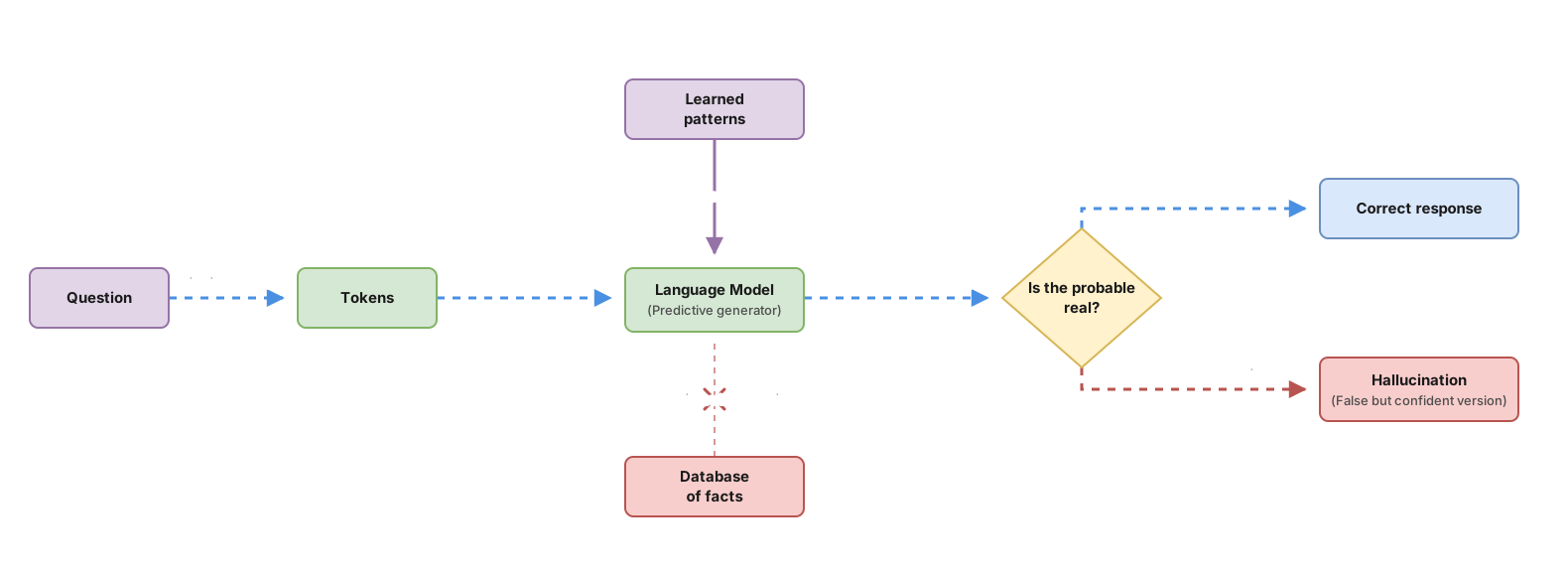
Before we go on, two words you will read constantly. An LLM (large language model) is the engine behind tools like ChatGPT: a program that generates text. A token is each small piece of text that engine handles, roughly a word or part of a word. When you type a question, the model splits it into tokens and produces the answer token by token.
The key is in how it produces it. The model does not look up the answer in any file, nor check it against a database of facts. What it does is calculate, at each step, which word is most likely to come next, based on the patterns it learned by reading enormous amounts of text. It is a statistical continuation engine, not an encyclopedia with a search box.
Almost always this produces correct answers, because what is most probable statistically tends to match what is true. But not always. When the most probable pattern does not match reality, the model writes the probable version just as calmly. That is a hallucination.
Why it is inevitable
Think of an exam where leaving questions blank is forbidden. It does not matter that you do not know the answer: you have to write something, and something that sounds good. A student in that situation does not say “I don’t know.” They fill in whatever seems most reasonable and move on.
A language model works this way by design. It always generates the most probable continuation, because generating probable text is literally the only thing it knows how to do. It has no internal button for “I have no record of this.” It does not tell apart “I truly know this” from “this fits the pattern.” For the mechanism, both are the same thing: text that flows plausibly.
That is why hallucinations are not a fault you can fully patch. They come from the very nature of the tool. A model that never invented anything would have to know, in every answer, where its reliable knowledge ends and guessing begins. And that is exactly what its way of working does not let it do with any guarantee.
A fair caveat here, because this is a no-hype blog and I am not going to sell you disasters. Today’s models hallucinate quite a bit less than those from a couple of years ago, and there are techniques that greatly reduce the problem on specific tasks. Reducing is not eliminating. As long as the engine is prediction of the probable, the chance that it invents something with the face of truth is still there. If you want the detail of how the model generates text underneath, I explain it in how generative AI works.
Two real cases that ended up in court
You do not need to imagine the problem. It has already cost real organizations money and grief.
In February 2024, a court in Canada ruled for a customer against Air Canada. The automated assistant on the airline’s website had misdescribed a bereavement fare policy, telling him he could request the discount after buying the ticket. That was not true. The airline argued it should not answer for what its assistant said. The court did not accept that: the information was on its site, the customer relied on it in good faith, and the company was held responsible. It had to compensate him.[1]
The second case is even more striking. In 2023, in the United States, some lawyers filed a brief that leaned on several prior court decisions. The problem: those decisions did not exist. ChatGPT had generated them, with case names, citations, and docket numbers that looked perfectly credible. When the other side and the judge went looking for them, they were nowhere to be found. The judge sanctioned the lawyers. The case, known as Mata v. Avianca, has become the reference example of what happens when someone trusts an AI answer without verifying it.[2]
Notice the common pattern. In both cases the AI did not fail in an obvious way. It failed convincingly. Nobody grew suspicious in time because the invented answer looked exactly like a good one.
What does not fix the problem
Waiting for the next model version helps, but it does not close the matter. Each generation hallucinates a bit less, and even so none reaches zero. Buying the most expensive, most powerful model is no guarantee either: a better model gets it wrong less often, but when it does, it does so with the same confidence. Sometimes more, because it sounds even more professional.
Nor does politely asking it not to lie solve it. You can write in the instructions “do not invent anything, if you do not know, say so.” The model will obey many times. But since it has no reliable way to know when it is inventing, that instruction is not a lock. It is a suggestion it follows some times and ignores others.
What truly reduces the risk is changing how you use it, not which model you buy. And that part is in your hands.
What you can do as a business leader
The important decision is not about using AI or not, but about which task and with what safety net you use it for. The risk of a hallucination is not the same everywhere: it depends on how costly a mistake is and on whether someone reviews before the error reaches the customer.
| Hallucination risk | Typical tasks | Why |
|---|---|---|
| High | Legal or financial data, medical advice, your company’s policies, figures going into a contract | An invented fact has real, direct consequences, sometimes legal ones |
| Medium | Automated customer support, summaries someone forwards without reading, answers published as-is | The error can slip through to the customer if nobody reviews it first |
| Low | A first draft a human will rewrite, brainstorming, rephrasing something you already know | You are the filter; the AI proposes and you correct before it goes out |
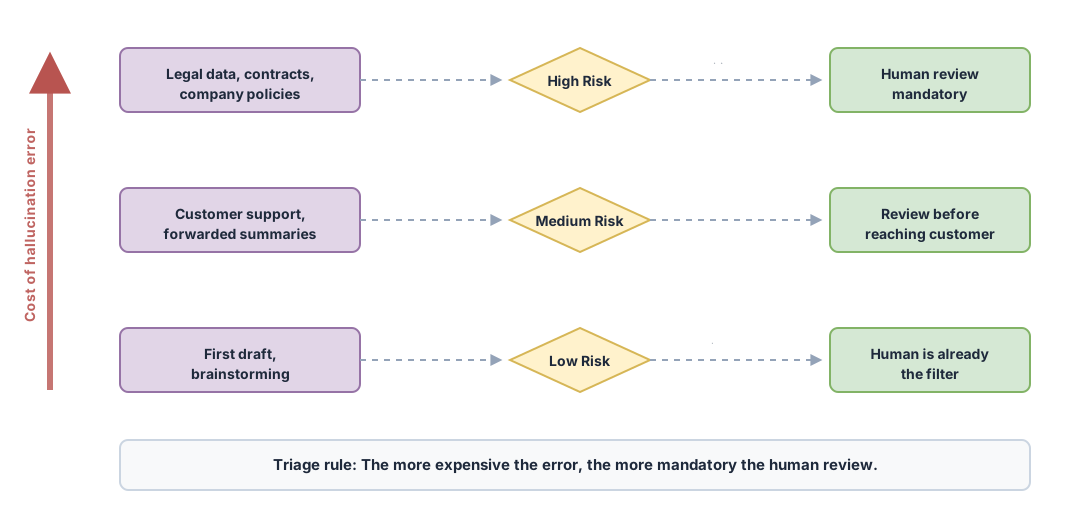
A few practical rules come out of that table. First: the more costly the error, the more mandatory it is for a human to review before publishing or sending. Second: narrow the ground. A system that only answers from your own documents (your catalog, your policies, your manuals) invents far less than one you ask anything and everything. Third: be especially wary of concrete data that sounds very precise, like dates, proper names, amounts, or legal references. That is exactly where a hallucination does the most damage and where it is easiest to catch if someone looks.
None of this is about technology. It is about judgment: knowing which task it is reasonable to delegate to AI, what review each case needs, and when the answer absolutely must pass through a person. That judgment is trainable, and it is exactly what we work on in the no-hype AI course: using these tools with your head on, knowing where they genuinely help and where they can burn you.
To understand the root of the problem better, two nearby reads will help: why AI gets things wrong, which goes beyond hallucinations, and AI determinism explained, on why the same question can give you different answers.
Sources
- BC Tribunal Confirms Companies Remain Liable for Information Provided by AI Chatbot (American Bar Association): ruling on the Moffatt v. Air Canada case (February 2024) holding the company responsible for the wrong information from its automated assistant.
- Mata v. Avianca, Inc. (Wikipedia): summary of the 2023 case in which a New York judge sanctioned the lawyers for filing nonexistent court decisions generated by ChatGPT.
Frequently asked questions
Is an AI hallucination the same as a lie?
No, even if the result looks similar. Lying means knowing the truth and saying something else on purpose. The AI does not know it is getting it wrong: it generates the answer that seems most probable and does not tell apart what is true from what merely sounds good. So it is more useful to think of it as an unintended invented fact than as a deception.
Can hallucinations be eliminated entirely?
Not with current technology. They can be reduced a lot by narrowing the topic, giving the AI good sources to start from, and reviewing the important answers, but not brought down to zero. As long as the system works by predicting the most probable text, there is always a chance it invents something with the appearance of truth.
What is an AI hallucination in one sentence to explain it to my team?
It is when the tool gives you a false answer with the same confidence it would give a correct one, and with no sign to warn you. That is why the practical rule is simple: any data that will have consequences (an amount, a date, a clause, a promise to a customer) gets reviewed by a person before it is used.
Do more expensive models hallucinate less?
They tend to get it wrong less often, yes, but they do not stop doing it. And when they do get it wrong, a more advanced model tends to sound even more professional and sure of itself, which makes the error harder to spot. Paying more reduces the frequency, it does not remove your need to review.
Related articles
How generative AI works, explained without the jargon
Generative AI doesn't look up truths: it predicts the most plausible word. That mental model explains why it hallucinates, why it changes, and where it fails.
Why AI Gets Things Wrong With Such Confidence
Generative AI states made-up facts with a confident tone because it predicts plausible text, not verified facts. Where it fails and how to protect yourself.

AI Determinism: Why It Gives Different Answers
Traditional software returns the exact same result; generative AI does not. What determinism in AI means and where it fits in your business.