
How generative AI works, explained without the jargon
Generative AI doesn't look up truths: it predicts the most plausible word. That mental model explains why it hallucinates, why it changes, and where it fails.

How does generative AI work? The honest answer fits in one sentence, and it isn’t the one an agency usually sells you. It doesn’t look up the correct answer somewhere and hand it back to you. It predicts, word by word, the most probable continuation of what you’ve written to it, leaning on the patterns it saw across enormous amounts of text.
Think of your phone’s autocomplete when it suggests the next word, but taken to a dizzying level: instead of one word, it composes a whole email, a contract, a summary of a meeting. That’s it. And understanding that detail, that it predicts rather than looks up, is what stands between you and an expensive headache when you bring it into your company. Behind it there is no magic and no mind that knows things, just a very good prediction engine. Let’s look at what that really means for anyone who has to decide whether or not to trust it.
What generative AI is and what it isn’t
Generative AI is a type of program that produces new content (text, images, code) instead of merely classifying or finding what already exists. When you ask it for an apology email to a customer, it doesn’t reach into a drawer to pull out an email written by someone else. It fabricates it right then, from scratch, tailoring it to what you told it.
It’s worth contrasting it with two things you may already know, because it resembles both and is neither.
Your company’s traditional software (payroll, the point of sale, the spreadsheet) follows fixed rules. The same input always produces the same output. If you add 2 plus 2, you get 4 today, tomorrow, and a year from now. It’s predictable by design. Generative AI doesn’t work that way, and in the section on non-determinism you’ll see why that matters.
A search engine isn’t the same thing either. When you search on Google, the system retrieves documents that already existed and ranks them for you. The information was there before you asked. Generative AI doesn’t retrieve: it drafts an answer that didn’t exist until you asked for it. That’s why it can help you write something original, and also why it can state with total ease something that no one ever wrote because it simply isn’t true.
If you want the definition in depth, with more examples of what does and doesn’t fall into this category, you’ll find it in what generative AI is. Here I’m interested in the following: where it got everything it seems to know.
Where does it get what it says? Training without the math
Imagine a brilliant intern you’ve let read for months a huge portion of everything published on the internet: books, articles, forums, documentation, conversations. Normally it doesn’t memorize the pages or recite an entire article back to you verbatim, though with text that appeared very often in its training it can end up reproducing near-literal fragments; that’s one of the reasons behind the copyright lawsuits against these companies. What it does is absorb how words usually fit together: how an invoice typically continues, what tone a complaint email has, how a rental contract is structured.
That process of “reading and absorbing patterns” is training. The result, that fully formed intern, is what we call a model. When the model works specifically with language (text), the industry calls it an LLM, short for large language model. You don’t need to remember the acronym. Hold on to the idea: it’s a system that has learned language patterns by reading a huge amount, not a file with the truth neatly ordered inside.
This is the point that generates the most misunderstanding, so let me make it clear. Inside the model there is no database of facts it can look up. There’s no table with “capital of France: Paris” that it opens to answer you. What there is, is a statistical intuition, finely tuned, about which words tend to follow which others. That it gets the capital of France right is because that combination appeared so many times in what it read that it became the most probable continuation. It’s right by frequency, not by lookup. The distinction seems subtle. It’s the one that explains almost everything.
Predicting the next word: the plausibility engine
The heart of all this is simpler than its reputation suggests: the model generates the answer one piece at a time, calculating at each step which word would most probably come next, and repeating the process until it’s done.

A technical nuance that saves you confusion later: internally it doesn’t work with whole words but with tokens, which are chunks of words. “Billing” can be split into several pieces. For what matters to us at the business level, you can think of tokens as syllables or word pieces; they’re also the unit providers bill you by for usage. The mechanics don’t change: probable piece, next probable piece, and so on until the final period.
Here’s the idea everything else hangs from, and it deserves to be said out loud: the most probable thing to say is not the same as what’s true. They coincide a great many times, luckily. The most plausible thing to write after “the capital of France is” turns out to be the true thing too. But there’s no law guaranteeing that coincidence. When the topic is obscure, when it lacks data, when the question is unusual, the most plausible and the true come apart. And the model, which only knows how to chase the plausible, carries on as if nothing were wrong.
This is a plausibility engine, not a truth engine. All its usefulness and all its risks come out of that single sentence. The three quirks people mention (“it gives me different answers”, “it makes things up”, “it doesn’t know about last week”) aren’t loose bugs someone forgot to fix. They’re direct consequences of how it works. Let’s look at them one by one.
Why it gives you different answers to the same question
You ask it the same question twice and it answers different things. With a calculator that would be a serious defect. Here it’s normal, and it has a name: generative AI is not deterministic. Deterministic means the same input always produces the same output, like that calculator that gives 4 every time you add 2 and 2. The model doesn’t give you that guarantee.
The reason is that, when choosing each word, it doesn’t always take the most probable one rigidly. A pinch of randomness is deliberately introduced so the text sounds natural and varied instead of robotic and repetitive. That deliberate randomness, useful for writing, is what makes two runs of the same request take slightly different paths and end up in different answers.
For your business this has a concrete consequence. You can’t treat the model’s output as a reproducible calculation you can trust blindly. If two employees ask it the same query, they may get answers that don’t match. For tasks where that doesn’t matter (drafting, summarizing, brainstorming) nothing happens. For processes that demand accuracy and repeatability, you need to build control around it: verification, rules, review. The model won’t give you that on its own. If you want to understand this property well and how it gets tamed, I develop it in determinism in AI, explained.
Why it makes things up with total confidence
Every so often, the model states with poise something that is simply false. The name of a law that doesn’t exist, an invented figure, a quote that was never said. This is a hallucination: a statement that sounds plausible and is false.
The important part, and where almost everyone gets it wrong, is this: the hallucination is not a bug that gets fixed in the next version. It’s inherent to a plausibility engine. When it lacks data about something, the model doesn’t go quiet or tell you “I don’t know” by default. It does the only thing it knows how to do: keep generating the most probable continuation. And an invented answer that sounds believable is, to its way of calculating, perfectly plausible. It isn’t failing in that moment. It’s doing exactly its job.
The real danger is that it’s wrong with the same confident tone it’s right with. There’s no little red light that turns on when it goes from firm ground to invented ground. The fake invoice sounds just as convincing as the real one. That’s why the damage arrives when someone trusts it without checking.
You can reduce the risk, though not eliminate it entirely. Connecting it to your own data so it answers by leaning on your documents instead of on its general intuition helps quite a bit. And a person who reviews what matters before it goes out the door is, today, irreplaceable. Neither of those two things makes hallucinations disappear. They lower the frequency and contain the damage. If you want the detail of why they happen and what triggers them, it’s in what an AI hallucination is.
What you can control: context, data, and tools
Up to here it may sound like this is a dangerous toy. It isn’t, and here comes the turn. The base model, as is, is a brilliant intern with amnesia and no access to your company: it knows a huge amount about how things are written in general, and it knows absolutely nothing about your business in particular. The difference between that and a useful tool lies in what you give it.
The first thing is context: everything you paste into the conversation itself. If you give it the customer’s email, the returns policy, and the order history, it drafts the answer leaning on that and gets it right far more often than if you ask it “write a reply to an angry customer” flatly. The model doesn’t guess what you don’t tell it. The better you lay the problem out in front of it, the better it works.
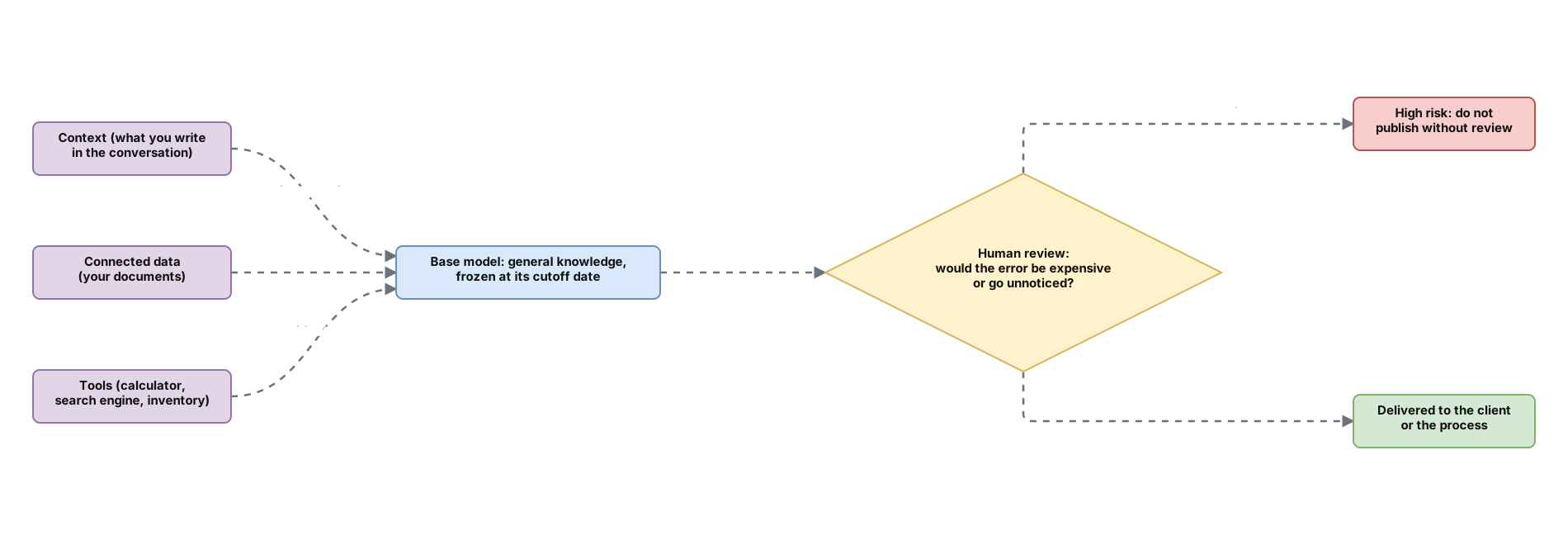
The second thing is your data. Instead of pasting the information by hand every time, you can connect the model to your documents so it consults them before answering: your manuals, your catalog, your contracts. This is RAG: having it look at your papers before answering instead of pulling from its general intuition. That way an answer about your warranty policy comes out of your real policy, not out of what “a warranty usually says.”
And then there are the tools. A model can be given permission to use a calculator when there are numbers to crunch, to search the web for something current, or to check your inventory in real time. Instead of making up the stock, it looks it up. Instead of estimating by eye, it actually calculates. This is what separates a cute demo from something that holds up in production.
None of this is a button that turns on by itself. Deciding what context to give it, what data to connect, and where to put the human control is judgment, and judgment is trained. It’s exactly what we work on in the AI without the hype course: using these tools while knowing what they do under the hood and where they can trip you up.
What it doesn’t know: the cutoff date
There’s a limit almost no one warns you about, and it dismantles the myth that AI “knows everything and is always up to date.” Every model has a cutoff date: its knowledge freezes at the moment it finished training. It knows nothing of what happened afterward, unless you supply it.
Think of it as an employee who was reading everything up to a certain day and then went off on a trip with no signal. Anything before that date it handles. Anything after it simply hasn’t reached it. This quarter’s prices, the regulation that changed last month, your catalog from last week, yesterday’s news: on its own, it doesn’t know them. And from what you already saw earlier, if you ask it anyway, it may make up an answer that sounds believable instead of admitting it can’t reach that far.
Here the circle closes with the previous section. Tools and your data are precisely what compensates for the cutoff date: if you connect the model to your catalog or let it search the web, it stops depending only on what it learned and starts looking at what’s current. Without that, you’re assuming it’s up to date at your own risk.
So what is it actually good for in a company?
The right question isn’t “is it good or bad?” but “where does it fit and where doesn’t it?”. And with the mental model you now have, the answer becomes almost obvious.
It works very well for producing drafts that a human polishes, summarizing long documents, reframing a text for another tone or audience, and classifying or sorting information. Also for a first customer-service contact that an employee supervises. Notice the pattern: in all those cases, the result is reviewed easily and an error is caught in time and cheaply. There the plausibility plays in your favor, because it’s right most of the time and the occasional slip gets corrected without drama.
It becomes dangerous right where that pattern breaks. Decisions that go out without anyone reviewing them. Exact figures used without verification. Any process where an expensive error goes unnoticed and reaches the customer, the tax office, or a signed contract. In those places, the same confident tone that makes it comfortable is what makes it treacherous.
From that comes a mental rule you can apply without being technical: use it where a human reviews cheaply and the error gets caught; be wary where the error is expensive and silent. With that you’ll decide the vast majority of cases well.
And that’s the complete mental model, in a sentence you can now repeat to your team. Generative AI predicts the most plausible continuation of what you write to it instead of consulting a file of truths. From that come, unsurprisingly, that it gives you different answers to the same question, that it makes things up with poise, that it depends so much on the context and data you give it, and that it knows nothing after its cutoff date. Once you see it that way, it stops looking like unpredictable magic and starts looking like a tool with a clear instruction manual. From there, deciding where to put it is a matter of judgment.
Frequently asked questions
Does generative AI “think” or “understand”?
Not in the sense a person does. It has no intentions, no consciousness, no comprehension of what it says. It predicts the most probable continuation of a text from statistical patterns. The result resembles reasoning so closely that it’s tempting to attribute a mind to it, but inside there’s no one understanding anything. Treating it as a very capable statistical tool, and not as a colleague who knows things, is what leads you to use it well.
Does it make fewer mistakes with each new version? Will hallucinations disappear?
The general trend has been to hallucinate somewhat less with each generation, but it isn’t a law: in 2025 several latest-batch models hallucinated more than their predecessor. Don’t take for granted that the next version will be more reliable without checking it yourself. And in any case, hallucinations aren’t going to disappear entirely, because they aren’t a manufacturing defect but a consequence of predicting the plausible instead of consulting the true. As long as the mechanism is that one, it will always be able to state something false with total confidence. That’s why it’s worth designing the process assuming it will happen, with review where it matters, instead of waiting for the version that fixes it.
Is my data used to train the model?
It depends on the provider and the plan you contract. Many enterprise plans commit contractually not to use your data to train their models, while in some free or consumer versions the terms are different. Don’t rely on hearsay: it’s a point you read in the specific terms of your provider and your plan before feeding in sensitive information. If you handle customer or confidential data, this question comes first, not later.
Do I need programmers to use this in my company?
Not to get started. Anyone can get value out of drafts, summaries, or ideas from day one; the technical people are only needed when you want to connect it to your data or integrate it into your processes. The judgment of where it fits and where to review is yours, not the technical team’s.
Is generative AI the same as ChatGPT?
Not exactly. Generative AI is the general category of technology that produces new content. ChatGPT is a specific product, one among several, built on a model of that type. It’s like the difference between “spreadsheet” and “Excel”: one is the idea, the other is a brand that implements it. There are other models and other products, from different companies, doing similar things with their own differences.
Related articles

What Generative AI Is (and What It Isn't)
What generative AI is in plain business terms: how it differs from the automation you already have, what it can NOT do, and what it's actually good for.

AI Determinism: Why It Gives Different Answers
Traditional software returns the exact same result; generative AI does not. What determinism in AI means and where it fits in your business.

What Is an AI Hallucination and Why It Is Inevitable
What an AI hallucination is, why it comes from the model's own mechanism, and what it means for your business before you trust it with a task.