
What Generative AI Is (and What It Isn't)
What generative AI is in plain business terms: how it differs from the automation you already have, what it can NOT do, and what it's actually good for.

Generative AI is a type of program that produces new content (text, images, code, or audio) by predicting the most plausible continuation from patterns it has learned across enormous amounts of examples. In short: it’s autocomplete taken to the extreme. And here comes the part almost nobody explains in the meetings where the budget gets approved: it’s an engine that predicts what sounds right. It doesn’t reason like a person and it doesn’t consult a base of truths, and that distinction decides what it’s useful for and where it’s going to land you in trouble.
What generative AI is, in plain business terms
Generative AI is software that creates content that didn’t exist before, instead of just classifying or searching what you already had. That’s the difference from almost everything you’ve called “AI” until now. A spam filter classifies: this is spam, this isn’t. A search engine retrieves: here’s the document you asked for. Generative AI produces: it writes you a whole email nobody had written.
The best way to understand it without jargon is your phone’s autocomplete. You type “thanks so much for your” and the keyboard suggests “help”, “time”, “message”. It doesn’t know what you mean. It has seen millions of sentences and calculates which word tends to come next. Generative AI does exactly that, but with a vastly greater capacity: instead of suggesting the next word of a short message, it chains thousands of predictions in a row until it drafts you a report, generates an image, or proposes a plan.
When people in this world talk about a “model”, that’s what they mean: the program that has learned those patterns and makes the predictions. And “generating” is nothing more than choosing, one piece after another, the most probable continuation based on what it has seen. If the content is text, that model has a specific name, a language model or LLM, which is exactly the engine behind ChatGPT. If you want the detail of how it predicts piece by piece under the hood, I cover it in how generative AI works. To decide whether to bring it into your company, one idea is enough: it’s a machine for predicting patterns.
It predicts what’s plausible, it doesn’t consult the truth
This is the point marketing keeps quietest. Generative AI produces what sounds right according to its patterns, even when it doesn’t match the facts. There is no moment where the model stops to check whether what it’s about to say is true. It only calculates which continuation is the most plausible and writes it with total confidence.
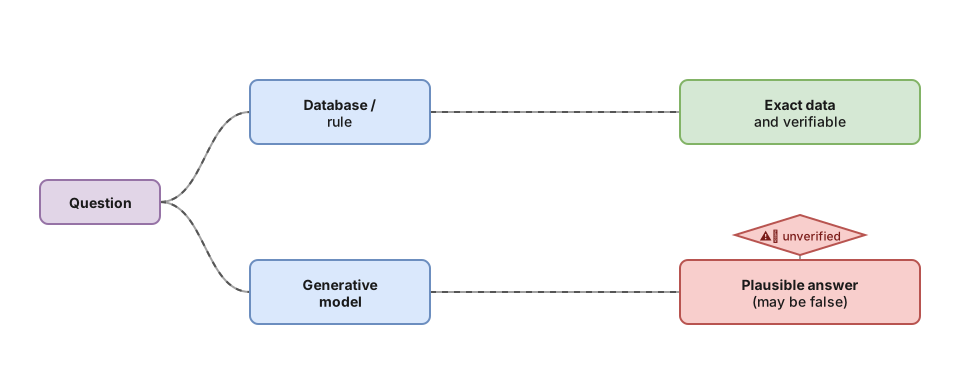
Most of the time, “the most plausible” matches “the correct”, because in the examples it learned from, true things appeared more often than false ones. That’s why it works so well and why it fools you so much. But when you ask it something it isn’t sure about, it doesn’t tell you “I don’t know”. It gives you the answer that best fits the pattern anyway, even if it’s false. And it gives it to you with the same confident tone as when it’s right.
That phenomenon has a name: a hallucination is when generative AI confidently states a fact that is false. It invents a figure, a quote, a section of a law, a customer that doesn’t exist. It’s not a bug that’ll be fixed in the next version. It’s a direct consequence of how it works: an engine that predicts the plausible produces, every so often, something plausible but false. A better model hallucinates less, but none hallucinate zero.
At its core, it all comes down to this: generative AI reconstructs a plausible answer by probability every time you ask. That’s where almost everything that can go wrong comes from, and also almost everything that sets it apart from the automation you probably already have.
How it differs from the automation you already have
Classic automation follows rules someone wrote by hand; generative AI recognizes patterns and predicts. That’s the line separating what you already used from what’s new, and understanding it saves you from buying the latter when the former was enough.
Good old automation is deterministic: if X happens, do Y. If the invoice is over 1,000 euros, send it for approval. If the form has no email, reject it. You write the rule once and it holds the same way every time, whether you run it today or a year from now. You can audit it: when something fails, you open the rule and see exactly why it did what it did.
Generative AI doesn’t work like that. You don’t write it rules, you give it examples and it learns patterns. That makes it flexible for tasks you could never cover with an “if X happens”: summarizing a contract you hadn’t seen, drafting a reply to an angry customer, adapting a text into another language. The price of that flexibility is that it’s probabilistic. Given the same question it can give you one answer today and a similar but different one tomorrow, and you can’t always explain why it chose one and not the other.
| Classic automation (rules) | Generative AI | |
|---|---|---|
| How it decides | Fixed rules a person wrote | Predicts from learned patterns |
| Repeatability | Same input, same output, always | The same question can give different answers |
| Transparency | Auditable: you see the rule that applied | Opaque: hard to explain why it answered that |
| Where it fits | Repetitive, well-defined tasks with clear rules | Open and creative tasks: writing, summarizing, translating, brainstorming |
| Main risk | Rigid: only covers what you anticipated | Hallucinates: can state something false with total confidence |
Neither one is “better”. They’re tools for different jobs. Putting generative AI where a deterministic rule was enough means paying more for less control. And using rigid rules where you need flexibility is a project that never quite covers every case. The useful question isn’t which is more advanced, but which fits the task in front of you.
What generative AI is NOT
Expensive mistakes with generative AI almost never come from the technology, but from believing four things that sound good but are false. These are the myths worth dismantling before you sign anything.
It doesn’t reason or “understand” like a person
When the model writes something coherent and well-argued, it’s tempting to think it reasoned. It didn’t. It chained together predictions that, put together, look like reasoning because in the texts it learned from, reasoning had that shape. It imitates the structure of thinking without thinking. The practical consequence: don’t delegate decisions that require real judgment to it without a person reviewing the result, because the confidence with which it answers doesn’t mean it understood anything.
It doesn’t consult a database of facts
A lot of people imagine that the model, when you ask it, goes somewhere to look up the correct answer. There is no such place. The information was diluted into the patterns it learned, spread across the whole model like a statistic, with no concrete records to open and consult. That’s why it can mix two true facts and produce a false one. If you need answers anchored to your real data (your catalog, your prices, your regulations), that has to be built separately and carefully. It doesn’t come out of the box.
It doesn’t replace your team
This one’s blunt: generative AI produces fast drafts, not reliable final results. Someone who knows the subject has to review, correct, and decide what stays. It changes your people’s work, it doesn’t eliminate it. Whoever expected to lay off half the staff usually ends up with the same staff reviewing twice as much generated material.
It doesn’t learn on its own from your company
The most dangerous myth for a decision-maker. By default, when you close the conversation, the model doesn’t “remember” what you told it or become an expert in your business for next time. The tool you use tomorrow is the same one as yesterday. Having a system use your data continuously and under control is a project you design, with its own privacy rules and costs. It doesn’t happen magically from using it a lot.
What it’s actually good for in a company (and what it isn’t)
Generative AI shines when the output is a starting point a person is going to review, and it becomes dangerous when its output is executed or published without anyone checking it. That’s the whole rule. If you internalize it, you’ll get 90% of the decisions about where to use it right.
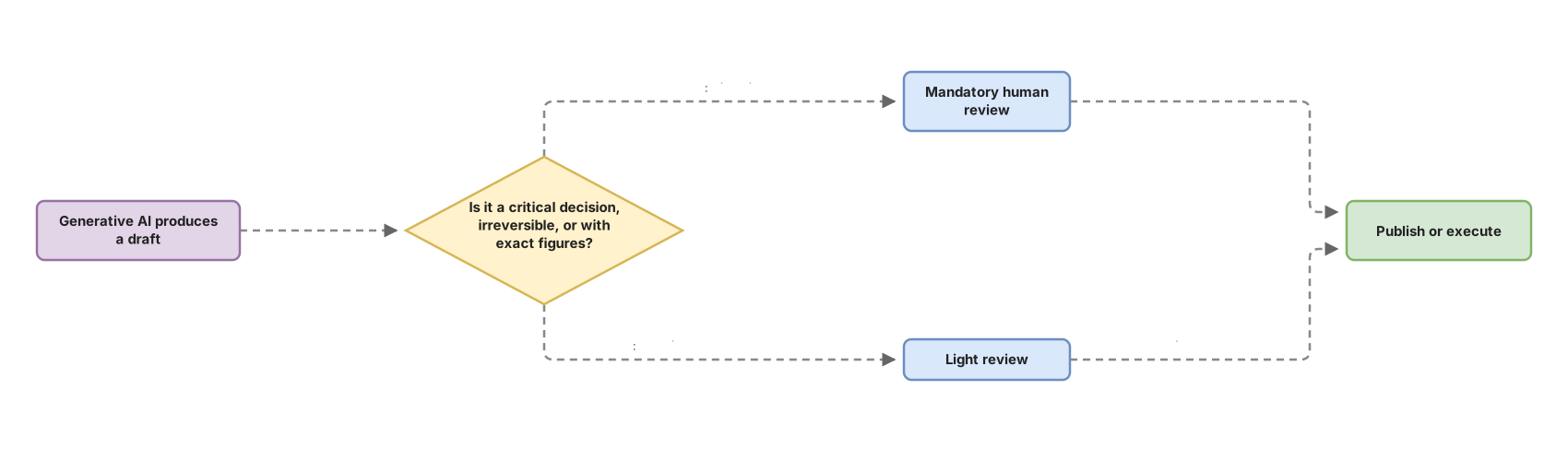
Where it adds real value at low risk:
- First versions of almost anything. A draft email, a sales proposal, a script, product copy. The blank page disappears and your team edits instead of starting from scratch.
- Summaries and synthesis. Feed it a long document, a meeting transcript, or an email thread and pull out what matters in minutes. Even so, for decisions that hinge on the summary, someone confirms nothing important was left out.
- Customer support with supervision. Answer the frequent questions and escalate anything unexpected to a person. Set up well, it removes repetitive work. Set up badly, it promises a customer something you can’t deliver.
- Translating and adapting content. Move material between languages or adjust the tone for another audience. Fast and surprisingly good, always with a human glance before publishing.
Where it’s dangerous without strict control:
- Critical or irreversible decisions (approving a loan, a diagnosis, a firing). The engine of the plausible is not an engine of the fair.
- Anything with exact figures: prices, accounting, financial data. There, a hallucination isn’t a typo, it’s money.
- Legal compliance, contracts, regulated texts. A made-up fact dressed as a section of a law truly exposes you.
The difference between a project that works and one that blows up on you isn’t in the model you pick, but in whether you designed where a human has to review. Understanding this with judgment, without buying the “transform your business” hype, is exactly what we work on in the IA sin hype course. And if you’re going to bring ChatGPT into your daily operation, in ChatGPT for businesses I take this down to the concrete.
Before approving a generative AI project
- You’re clear on whether the task needs flexible prediction or a deterministic rule was enough
- There’s a point where a person reviews the output before it’s executed or published
- No critical, irreversible, or exact-figure decision runs without oversight
- You know the system doesn’t learn from your company on its own, and you’ve planned (or ruled out) that separate work
- You’ve assumed it will hallucinate every so often, and the process holds up without disasters
- The expectation you’ve sold internally is “speed up the team”, not “replace the team”
Frequently asked questions
Does generative AI always tell the truth?
No. It generates what sounds plausible according to its patterns, not what’s correct according to the facts, so it can confidently state false information. That’s a hallucination, and it’s not a flaw that gets fixed: it’s a consequence of how it works. A better model hallucinates less, but none hallucinate zero. That’s why, for anything that matters, someone reviews what it produces.
Is generative AI the same as ChatGPT?
Not exactly. Generative AI is the general category: any technology that creates new content by predicting the most plausible continuation. ChatGPT is a specific product that uses that technology for text. It’s like the difference between “electric car” (the category) and a particular car model. There are many other generative AI systems besides ChatGPT, for text, images, or audio.
How does it differ from the automation I already have?
Your current automation follows fixed rules someone wrote: if X happens, do Y. It’s deterministic and auditable, it always does the same thing and you can see why. Generative AI doesn’t follow rules, it predicts from patterns, and that’s why it’s flexible for open-ended tasks but also probabilistic: given the same question it can answer differently. One fits repetitive, well-defined tasks; the other, creative tasks where you can’t anticipate every case.
Can it replace my team?
No, and whoever sells you that is selling you hype. It produces drafts and fast first versions, but someone who knows the subject has to review them, correct them, and decide what stays. It shifts your team’s work toward reviewing and directing instead of producing from scratch, and you usually need the same people to supervise the greater volume of material now being generated.
Related articles

How generative AI works, explained without the jargon
Generative AI doesn't look up truths: it predicts the most plausible word. That mental model explains why it hallucinates, why it changes, and where it fails.

What Is an LLM, Explained Without Jargon
An LLM doesn't look up the truth: it predicts the next most plausible word. That mental model is enough to decide with good judgment where to use it in your company and where not to.
ChatGPT for business: what it can and can't do
What ChatGPT does well for a business (drafts, summaries, ideation) and where you can't trust it: private data, exact figures, and the privacy warning.