
What Is an LLM, Explained Without Jargon
An LLM doesn't look up the truth: it predicts the next most plausible word. That mental model is enough to decide with good judgment where to use it in your company and where not to.

An LLM is a program that predicts the next most plausible word, over and over, until it composes an entire answer. That is all it does, and at the same time it is surprising how far it gets with that. If your phone has ever suggested the next word while you were typing a message, you have already seen the small version of the idea. An LLM is that same mechanic scaled up enormously: instead of suggesting one word, it drafts an email, a summary of a meeting or a draft contract for you.
The acronym comes from English, Large Language Model. It is worth taking those three words apart before going on, because each one says something useful for anyone who has to decide whether to bring this technology into their company or not.
What “Large Language Model” Means
“Model” here is not a mock-up or an example to imitate. It is a program that has tuned millions of internal parameters to reproduce a behavior: in this case, continuing a text coherently. Picture a device with a huge number of dials, each one calibrated through practice until the whole thing gets good at guessing which word fits next.
“Language” points to its specialty. It does not calculate delivery routes or keep your books. It works with text: it reads it and produces new text. Anything you can write or read falls within its territory.
And “large” is literal. It has been trained by reading an amount of text that no person could get through in several lifetimes: books, websites, forums, documentation. From that massive reading it has not memorized sentences to repeat them, but rather captured the patterns of the language. Which words tend to go together, how a polite reply is structured, what a legal clause looks like. That is the raw material it works with.
The Core Idea: Predict, Not Look Up
Here is the detail that changes everything, and the one almost nobody explains when they sell you a brilliant demo. When you ask an LLM a question, it does not go to any file to fetch the correct answer and hand it back. It calculates, given the whole conversation up to that point, which word is most likely to come next. Then it adds it and repeats the calculation with that word already included. Word by word, that is how the full answer is formed.
Go back to your phone’s autocomplete. When you type “thank you very much for your”, the phone offers you “help” or “time” because those are the continuations it has seen most often. It does not know what you mean. It bets on what is statistically most frequent. An LLM does exactly that, with a far finer ability to bet and with the whole conversation as context, not just the last few words.
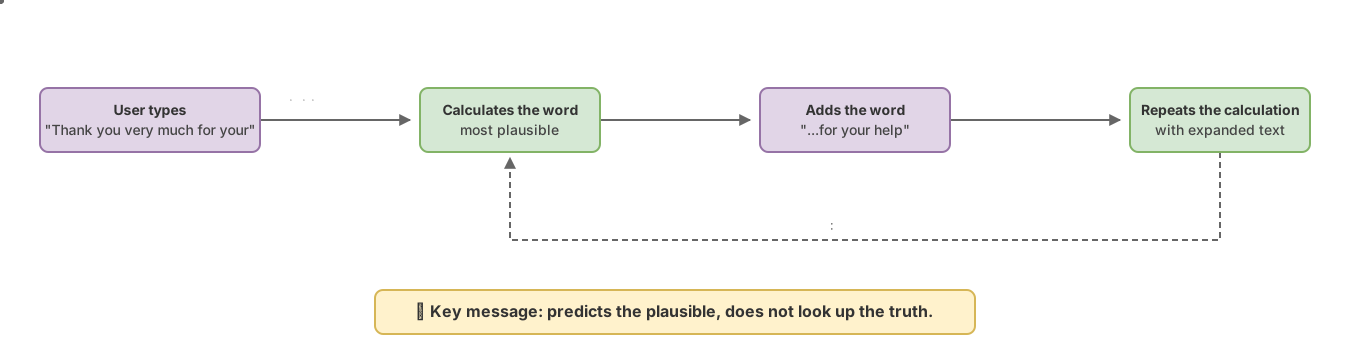
This mechanism has an uncomfortable consequence worth internalizing as early as possible: the goal of an LLM is to sound plausible, not to be truthful. Most of the time the plausible matches the true, because in the text it was trained on the truth was also the most common thing. But when they do not match, the model picks what sounds good. Without warning you. You can see this same mechanism developed in detail in how generative AI works, which is the shared engine behind all of these tools.
Where It Gets What It “Knows”
It is tempting to say that an LLM “knows” things. It answers about history or about commercial law, and it is often right. But what happens inside does not resemble knowing in the human sense.
During training, the model read so much text about a topic that it learned what tends to be said about it. If many people have written that Paris is the capital of France, that association gets so reinforced that the model reproduces it without fail. It has read a great deal. It has not understood anything in the sense that a person who has been to Paris understands it.
This explains two behaviors that otherwise seem contradictory. An LLM can write a flawless essay on a famous topic and, in the same conversation, invent the name of an executive in your sector or cite a law that does not exist. It is not that sometimes it “knows” and sometimes it does not. It is always doing the same thing: filling in with what turns out to be plausible. When the topic is very present in its training, the plausible gets it right. When the topic is rare or specific to your company, the plausible turns into an invention with good wording.
What a “Token” Is and Why You’ll Be Charged for It
At some point, if your company uses one of these models through a provider, you will see the word “token” on an invoice. It is worth knowing what it is before it catches you off guard.
A token is a chunk of text, usually a bit shorter than a word. The phrase “the contract expires” could be split into four or five tokens. LLMs do not read letter by letter or word by word: they cut the text into these units and work with them. For the business, the important part is simple: almost all providers bill by tokens. They count those of the text you send and those of the text the model generates, and that sum determines what you pay.
From there a practical rule follows without needing to look at any figure. The longer what you ask for and the longer its answer, the more each query costs. A one-line summary comes cheap. Processing a fifty-page contract hundreds of times a day, not so much. You do not need to know the exact prices to understand that the cost grows with the volume of text, and that this volume is the variable you control.
Why an LLM Gets Things Wrong So Confidently
You already have the pieces to understand it. Since the model generates the plausible and does so with the same fluency whether it gets it right or not, an error of its own comes with no alarm signal. An unsure intern hesitates when they do not know something. An LLM writes its invention with the same poise it uses to write a verified fact.
That phenomenon is called hallucination: the model produces false information presented as true. It is not a flaw that gets fixed in the next version, but one side of how it works. If its job is to predict plausible text, sometimes the plausible will be false. You have it explained in depth in what an AI hallucination is, and it is probably the concept that saves the most trouble for a company that is just starting out.
What People Believe Versus What Actually Happens
A good part of the wrong decisions with this technology are born from a mistaken mental model. This table sets the common belief against what goes on inside.
| What many people believe | What actually happens |
|---|---|
| It looks up the correct answer and gives it to you | It predicts the most plausible continuation, right or not |
| It remembers everything you have told it | It has no memory of its own between conversations; it only sees what you pass it each time |
| It understands your business | It recognizes patterns of language; it does not know your company unless you explain it |
| It always gives the same answer | It can vary for the same question, because it picks each word with some randomness |
| Once set up, it is free | You pay per use, according to the amount of text that goes in and out |
That “it has no memory of its own” surprises many people. When an LLM seems to remember what you said ten messages ago, in reality the program wrapped around it is resending the whole conversation every time. The model keeps nothing on its own. If you open a new conversation tomorrow, it starts blank.
What All of This Means for Your Company
From this mental model a handful of concrete decisions follow, and none of them requires you to understand the math involved.
The first: where an error is cheap to detect, an LLM performs well. A draft email you are going to read before sending. A first summary of a fifty-page document that only has to orient you before you look at it properly. If something goes wrong, you see it and fix it in seconds. The other side of the same coin: where an error is expensive and goes unnoticed, you have to be very careful. Letting it answer a customer with no one reviewing, or give a figure that someone will later use in a proposal without checking it. There the model’s fluency works against you, because it disguises the mistake.
Working on this with judgment, deciding task by task where the machine comes in and where a person has to stay in the loop reviewing, is exactly what we teach in the AI without hype course. No promises of magical transformation, feet firmly on the ground.
It is also worth not confusing the engine with the car. An LLM is the language engine; ChatGPT and similar tools for companies are products built on top, with their interface, their limits, their data policy and their price. And the LLM is one piece within the broader family of generative AI, which also generates images, audio or code with the same prediction logic.
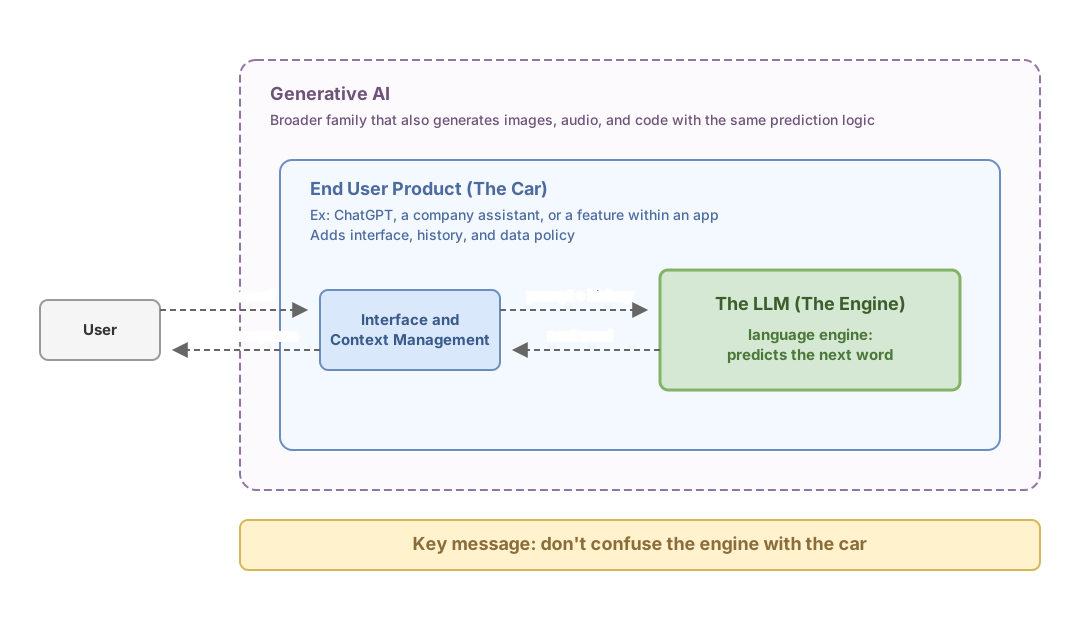
If one thing should stay with you from all of this, let it be the sentence from the start. An LLM predicts the plausible word that comes next. With that idea in your head you understand why it is so useful for drafting and so dangerous for asserting, and you can already sit in a meeting about AI without anyone selling you smoke.
Frequently Asked Questions
Is an LLM the same as ChatGPT? Not exactly. The LLM is the language engine that predicts the text. ChatGPT is an application built on top of an LLM, with its chat, its history and its rules. There can be many different products on top of the same kind of engine.
Does the LLM learn from my conversations? The model itself does not retrain on its own from what you write; it already came trained from the factory. What the provider does with your data under its contract is another matter, and one worth reading closely before feeding it sensitive information.
Why does it sometimes make things up? Because its task is to generate plausible text, not to verify facts. When it has no solid basis for something, it fills in with what sounds good. That is called hallucination and it is inherent to how it works.
Do I need my own LLM for my company? Almost never at the start. Most companies begin by using a provider’s models through a subscription or a connection, without building anything of their own. A proprietary model only makes sense in very specific cases and with resources that most small businesses do not need to commit.
Is it expensive? It depends on the volume of text you move. You pay per use, so short, occasional queries cost little, while processing long documents at scale shows up on the bill. The cost is set by how much text goes in and out, and that is up to you.
Related articles

How generative AI works, explained without the jargon
Generative AI doesn't look up truths: it predicts the most plausible word. That mental model explains why it hallucinates, why it changes, and where it fails.

What Generative AI Is (and What It Isn't)
What generative AI is in plain business terms: how it differs from the automation you already have, what it can NOT do, and what it's actually good for.

ChatGPT for business: what it can and can't do
What ChatGPT does well for a business (drafts, summaries, ideation) and where you can't trust it: private data, exact figures, and the privacy warning.