
Shieldstral: Why a 3B Guard Model Matches a 20B One
Shieldstral turns moderation into a yes-or-no question and returns a confidence score. How it works and when it's worth using.
Need a model to filter content or act as a classifier? A 3B model just tied a 20B one at content moderation, and it also lets us know exactly how confident the model is in each answer, which lets us define our own rules for deciding when that confidence is high enough to act on.
The model in question is Shieldstral, the safety classifier Mistral released on August 4 (Apache 2.0, runs on a 16 GB GPU, text and image) [1]. It’s worth looking at where that tie comes from, because it’s not in the architecture.
In classic guard models, the policy gets defined during training
A guard model is a small model dedicated to one thing: looking at a piece of text or an image and saying whether it violates a policy. It’s the concrete implementation of what I call a guardrail in other posts, applied to content. LlamaGuard and ShieldGemma work this way, and in both the list of harm categories gets defined during training.
That breaks the moment your product isn’t the average product. Text describing how to exploit a known vulnerability is normal content in a pentesting tool and material to block in a teen companion app: the same document, two legitimate verdicts. With categories baked in at training time, adjusting that nuance means relabeling a dataset and retraining.
And retraining every time the policy changes is a cost that’s hard to justify for something that, in the end, is just editing text.
How does Shieldstral turn moderation into a yes-or-no question?
In Shieldstral, like in any modern LLM, you define the moderation policy yourself, in the prompt. It’s framed as a binary-answer task: the model receives a written policy and a question, and answers “yes” or “no”. The prompt has three fields [1].
<Instruct>
You are a moderator for a cybersecurity community. Be strict about
operational instructions targeting specific systems, and permissive
with theory and educational discussion.
</Instruct>

<Query>
Does this message give actionable instructions for attacking someone
else's system?
</Query>

<Document>
[the user's message, the model's response, or an image]
</Document>
<Instruct> sets the context and the bar for strictness, <Query> is the question being answered, and <Document> is what gets judged: text, image, or both at once. With this format, four problems you’d normally solve with four separate models collapse into one: classifying the user’s prompt, moderating the model’s response, detecting whether the model refused to answer, and detecting toxicity [1]. Change the <Query> and you change the problem.
What matters about this design is where your policy ends up living: in the prompt. Adjusting the line between what’s acceptable and what isn’t becomes editing a paragraph and re-running eval, not opening a training notebook.
The score comes from two tokens, not from generated text
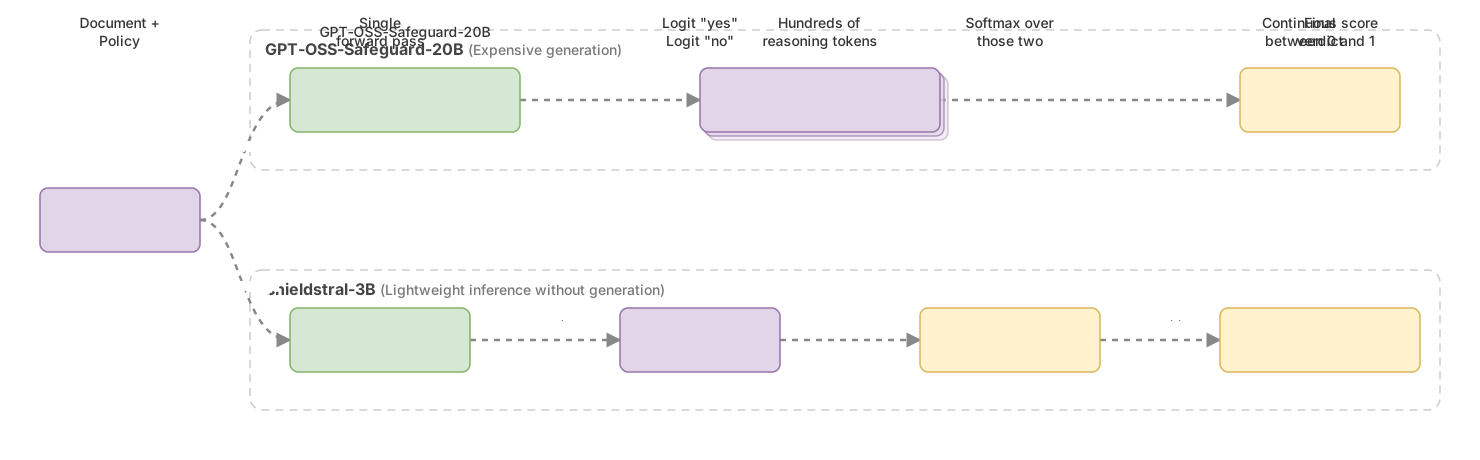
At inference time Shieldstral doesn’t generate text. Since the model can only answer with two different tokens (“yes” or “no”), it’s enough to look at the score it assigns each one and convert that into a number between 0 and 1 [3]. Those raw scores are the logits, and the conversion is a softmax over just those two; in the most likely answer isn’t the correct one I explain what that distribution means.
# Safety score without generating a single output token
# pseudocode; the real snippet with transformers is on the HF model card
logits = model(prompt).logits[-1]          # next-token distribution
z_yes, z_no = logits[tok_yes], logits[tok_no]
score = exp(z_yes) / (exp(z_yes) + exp(z_no))   # softmax over two tokens
unsafe = score > 0.5                       # default threshold
This is what lets us know the model’s confidence in each verdict, instead of getting back a closed label. Coming out of a softmax, the score behaves like a probability (it’s calibrated, with a default threshold of 0.5 [3]), and the threshold becomes a decision that’s ours to make: raise it where a false positive annoys the user, lower it where a false negative costs us an incident, and send only the middle band to human review. With a pure binary label we don’t have that lever.
The obvious comparison is GPT-OSS-Safeguard-20B, which also accepts your policy in the prompt, but produces a full reasoning chain before the verdict. On average across text benchmarks they tie, at a per-call cost that’s an entirely different order of magnitude [2].
| Shieldstral-1.0-3B | GPT-OSS-Safeguard-20B | OmniGuard-7B | |
|---|---|---|---|
| Parameters | 3B | 20B | 7B |
| Average text F1 | 84.9% | 84.9% | not reported in the paper |
| Multimodal F1 | 83.8% (state of the art) | text only | 77.6% |
| How it emits the verdict | ”yes”/“no” logits in one forward pass, continuous score | generates a reasoning trace, then the label | label |
| Where the policy lives | in the prompt | in the prompt | training taxonomy |
| License | Apache 2.0 | Apache 2.0 | check its model card |
A 3B model matching a 20B one at a task like this isn’t explained by the architecture or by more inference-time compute: it’s explained by how they built the dataset.
Contrastive pairs: the same document, opposite verdicts
The most interesting part of the technical paper is how they generated the data so the model learns which specific policy is being violated, rather than a plain safe/unsafe binary. They trained on roughly 54.1M examples, of which 4.4M are synthetic contrastive pairs [2].
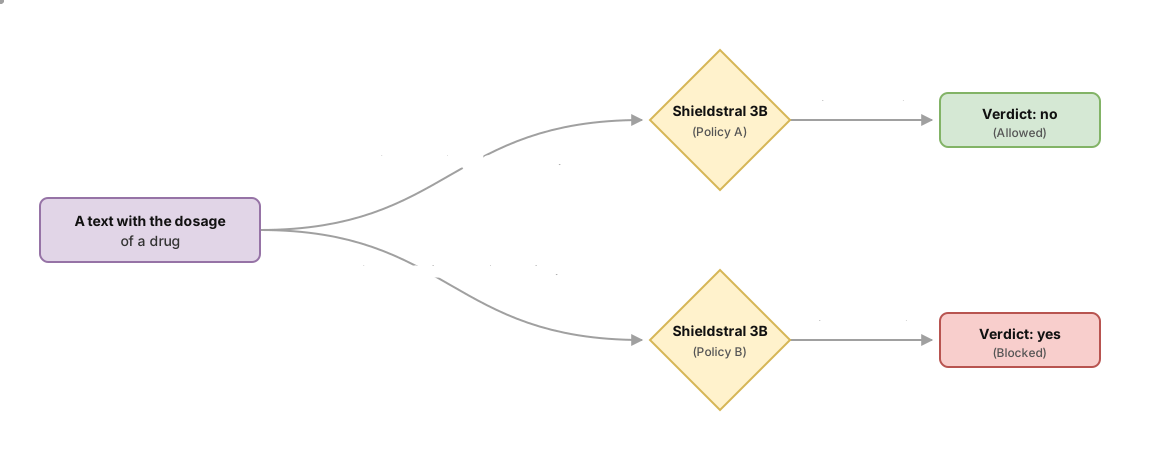
A contrastive pair is the same document evaluated twice against two sibling-category questions: for one, the correct answer is “yes”, and for the other it’s “no”. A text about drug dosing can violate “unsupervised medical advice” without violating “promotion of illegal substances”. If the model only sees examples labeled toxic or non-toxic, it learns a general notion of toxicity and misses the distinction. If it sees the same paragraph with opposite verdicts depending on the question, it has no choice but to read the <Query>.
They validated it against an evaluation taxonomy deliberately different from the training one, which is the only honest way to measure whether the prompt’s policy is actually being used. Without the synthetic data, 61.1% F1; with it, 84.4% [2]. That’s more than twenty points of improvement that don’t come from adding parameters — they come from the data.
The final checkpoint is a merge of three models
Shieldstral isn’t the direct result of one training run: it’s a weight merge of three models. Model merging means interpolating the weights of several checkpoints to get a new one without any further training, and here they used SLERP (spherical interpolation between weights, not a linear average) with 0.6 from the checkpoint trained on synthetic data, 0.3 from the one trained on public data, and 0.1 from the starting instruct model [2].
The blend outperforms any of its ingredients on their own: adapting to new taxonomies goes from 84.4% to 88.7% F1, and those extra points come from an algebra operation on the weights, with no further training.
There’s one more data point from the paper that can save you money if you end up adapting this to your domain: LoRA (training a handful of small matrices added to the model instead of all its weights) performs almost identically to full fine-tuning on this task [2]. The gap is seven-tenths of a point of F1, for a fraction of the cost.
When it’s worth it, and when it isn’t
Shieldstral makes sense when you have your own policy and volume. The cost per call is a forward pass on a 3B model that fits on a 16 GB GPU [1], so the economics change compared to billing reasoning tokens for every incoming comment. If you’re also moderating images, it’s state of the art at multimodal moderation [2].
Where it falls apart is low-resource languages, and the paper itself publishes it. In Indonesian, prompt classification drops to 55.5% F1 while response classification in that same language scores 94.1% [2]. Same model, same language, and nearly forty points of difference depending on what you ask it to do.
That’s the key takeaway for your decision: an average is just an average. Before putting this in front of real users, look up your language and your specific task in the appendix tables.
And there’s a broader lesson that applies to all of us: we’re still obsessed with finding out which model is most powerful, and we end up using them for narrow tasks that a small model, with well-built data, solves just as well or better.
Common mistakes
Picking the guard model by size
It’s the natural instinct, and it doesn’t work here. The “more parameters, better results” curve applies to open-ended tasks; on a narrow task like deciding whether a document answers “yes” to a question, what moves the needle is the data. The contrastive-pairs ablation is worth more than multiplying the model by seven.
Trusting the average F1
If the appendix’s language breakdown shows 55% for your primary language and you decided based on the headline average, you’ve deployed a moderator that fails nearly half the time in your market. Read the breakdown before the headline.
Retraining a classifier when the policy fits in the prompt
This is the expensive one. A team with its own classifier in production handles every policy change by opening up the training pipeline, because that’s what it knows how to do. With a model that reads the policy from the prompt, that same change is editing the <Instruct> block, running your eval set, and comparing. From weeks down to an afternoon. The condition is having that eval set: without it, editing the prompt is changing behavior blind.
Paying for a reasoning trace on every message
A judge with explicit reasoning is a great tool for ambiguous cases, quality reviews, or auditing questionable decisions. Using it for 100% of the traffic on a high-volume platform means paying for an explanation nobody reads. Reserve the reasoning for the middle band of scores.
Checklist before putting a guard model in production
- You have your own eval set, with content from your product and labeled against your policy
- You’ve read the per-language, per-task breakdown for the model you’re going to use, not just the average
- The policy is written in the prompt and versioned in the repo, not scattered across the team’s heads
- The threshold is set per product and per surface, not inherited unthinkingly from the default value
- There’s a middle score band that routes to human review or to a reasoning model
- You measure false positives in production, not just the benchmark F1
Sources
- Shieldstral — Mistral AI — official announcement from August 4, 2026: the three-field format, the four problems covered, running on a 16 GB GPU, and the claim of matching models up to seven times its size.
- Shieldstral — arXiv:2607.25857 — technical paper on the multimodal safety classifier: text and multimodal F1, dataset volume and composition, the contrastive-pairs ablation, SLERP merge weights, LoRA vs. full fine-tuning, and the per-language breakdown.
- mistralai/Shieldstral-1.0-3B — Hugging Face — model card: Ministral-3B base, Pixtral’s vision encoder, the score calculation from “yes”/“no” logits, a default threshold of 0.5, and the list of supported languages.
Frequently Asked Questions
What is a guard model, and how is it different from a regular LLM?
A guard model is a model trained to classify content against a safety policy, not to converse or write: it receives a document and returns a verdict on whether it violates a rule. In Shieldstral, the output is a probability between 0 and 1 derived from two logits, without generating a single sentence, which comes out far cheaper than asking a general-purpose model the same question.
Does Shieldstral replace moderation APIs like OpenAI’s or Azure’s?
It depends on whether your policy fits theirs. Managed APIs moderate against provider-defined categories and don’t require you to maintain infrastructure; Shieldstral requires you to serve the model yourself, but in exchange you write the policy in the prompt and your content never leaves your network.
If your criteria are standard and your volume is low, the API comes out cheaper in engineering time.
What does it mean for the score to be calibrated?
It means you can treat the number as a confidence level and set your own cutoff: above 0.8 you block automatically, between 0.4 and 0.8 you send it to human review. The default threshold is 0.5 [3].
Can I fine-tune Shieldstral with my own policy?
You can, but try editing the prompt first: the model is trained specifically so the policy lives there. If you still need to adapt it after that, the paper measures LoRA against full fine-tuning on this task and the gap is seven-tenths of a point of F1 [2], so start with LoRA.
Does it work in Spanish?
Yes. Spanish is among the supported languages on the model card [3], alongside English, French, German, Italian, Portuguese, Dutch, Chinese, Japanese, Korean, Arabic, and Russian. That said, the paper’s per-language breakdown shows large differences across languages and tasks, so evaluate it with your own Spanish-language content before trusting the global average.
Related articles

What Is an AI Guardrail? Definition, Types, and Examples
An AI guardrail is an external check that keeps an agent from deleting data, leaking information, or looping forever. Clear definition, types, and real examples.

Why AI Agrees With You: The Probable, Not the Correct
Why AI agrees with you even when you're wrong: how it predicts the next token, why your question changes the answer, and how to ask better.

Why AI Gets Things Wrong With Such Confidence
Generative AI states made-up facts with a confident tone because it predicts plausible text, not verified facts. Where it fails and how to protect yourself.