
How Much Does It Cost to Implement AI: Demo vs Production
How much it really costs to implement AI in your company. Why the demo is almost free and production costs far more, and which hidden line items eat the budget.
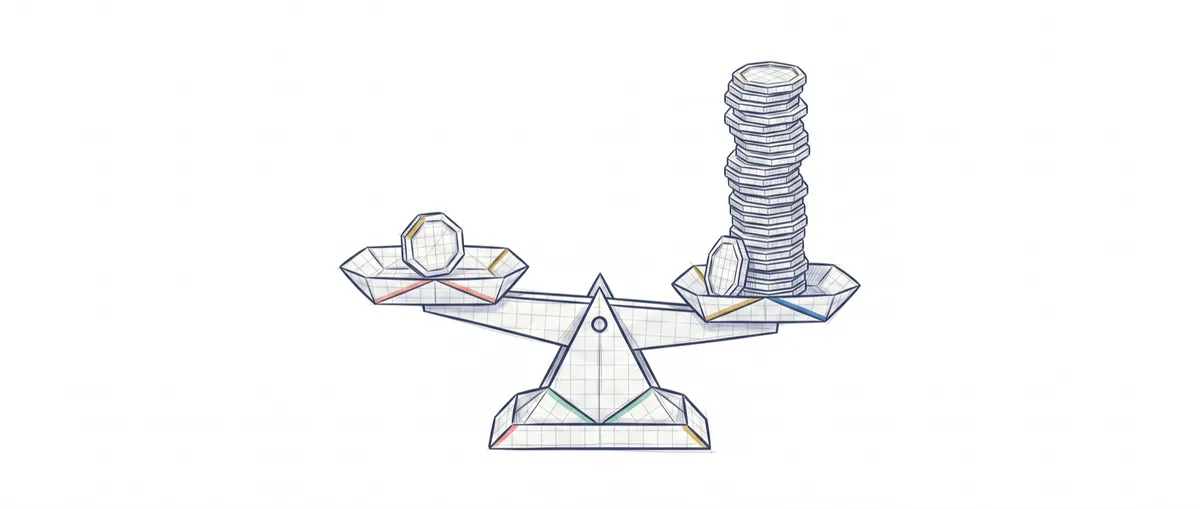
Someone showed you a demo and it worked. An assistant answering customer questions, a system writing reports on its own, something that in thirty seconds did what takes your team an afternoon. The logical question after that moment is how much it really costs to implement AI in your company. And the honest answer starts with a warning: that demo you fell in love with cost almost nothing to build, and putting it to work day to day costs one or two orders of magnitude more.
Not because the vendor is padding the budget. The reason is that the demo hides six cost line items that only show up when the system stops being a party trick and starts touching your real operation.
Why the demo is so cheap (and so misleading)
A demo works in a laboratory world. The data it uses is clean and hand-picked by whoever built it. There are no real users asking odd questions. And above all, nothing happens if it fails, because nobody is making a business decision based on that answer.
That is the ground where an AI looks like magic. You show it three nice examples, it answers all three correctly, and the room applauds. Building that takes days and a laughable cost, because almost all the heavy lifting was already done by the company that trained the model. If you want to understand why the model itself is not the expensive part, I explain it in how generative AI works.
The problem arrives the day you open the door. Your customers ask things nobody anticipated. Your data is messy, incomplete, and spread across five places. And suddenly it matters a great deal that the system fails, because behind every answer there is money, an angry customer, or a decision that cannot be undone.
The six line items that appear when you move to production
When the demo becomes something real people use every day, the cost does not grow a little. It changes in nature. Six line items appear that were worth zero in the demo.
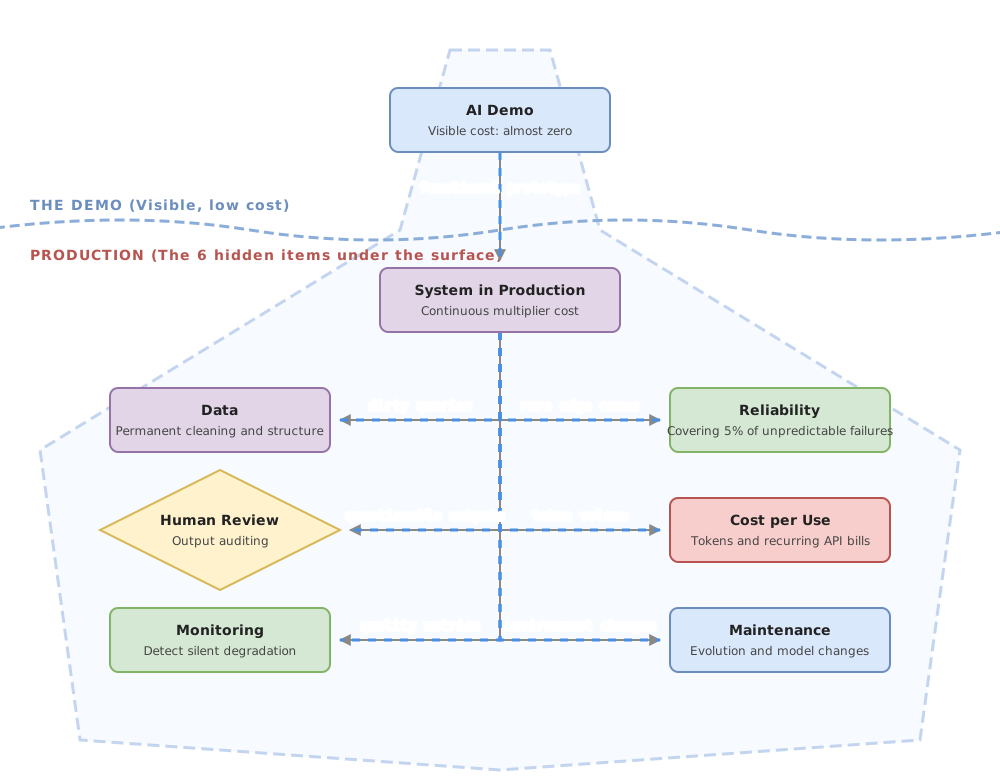
Data
In production, the AI is only as good as the data it reads, and your data is almost never ready. It lives in scanned PDFs, in spreadsheets with different criteria per department, in an email someone sent back in 2019. Before the system does anything useful, you have to gather that data, clean it, give it a common structure and, what almost everyone forgets, keep it that way forever. A product catalog changes every week. If the system reads the version from three months ago, it answers with confidence and gets it wrong.
This is usually the largest line item and the most invisible. The demo skipped it because you handed over the data already chewed.
Reliability
Something working 95% of the time sounds fine until you think about the other 5%. An assistant that makes up an answer one time in twenty is a charming anecdote in a demo and a potential lawsuit in customer service. When money or customers are on the line, closing that gap between “works almost always” and “works well enough to trust without looking” is expensive work. Sometimes it is the most expensive part of all.
Human review
In almost every serious case, someone has to review what the AI produces before it goes out. Not because the technology is bad, but because an AI can be wrong with total poise, in the same confident tone it uses when it is right. That confident-looking invention has a name: hallucination. And it gives no warning when it happens. So you budget hours of a person who validates the outputs. That cost does not disappear over time. It can be reduced, but it rarely reaches zero.
Monitoring
An AI system degrades without warning. The world changes, your customers ask new things, the vendor updates the model underneath, and suddenly the answers that were good yesterday are mediocre today. Nobody gets an error. It simply gets worse in silence. Catching that in time requires setting up monitoring: measuring the quality of the answers continuously and raising an alert when it drops. It is the cost most people skip, and the one that costs the most when you find out too late.
Cost per use
Here is the most important mental shift. Every time someone uses the system, it costs money. Every question to the model is paid for. In the demo you ran ten queries and never noticed. In production it is thousands a day, and that bill arrives every month, whether your business grows or not. It is not a license you buy once. It is a meter running every second the system is on.
Living with the system
And then there is the cost of living with the thing once it is built. The model you use today will stop being sold. Your business will change and the system will have to change with it. Cases nobody foresaw will appear. Keeping an AI in production is closer to tending a garden than to hanging a picture: if you stop watering it, it dies.
One-time cost vs recurring cost: the most expensive mental mistake
Most AI budgets are done wrong for one reason: they are treated like buying a machine when they are closer to hiring someone.
When you buy a machine, you pay once and you own it. When you hire a person, you pay a salary every month, you train them, you supervise them, and you assume they will sometimes get it wrong. An AI system in production lives in the second world. The cost of getting it started (setting up the data, building the first version) is real, but it is usually the small part. The big part is the monthly drip: cost per use, human review, monitoring, and maintenance.
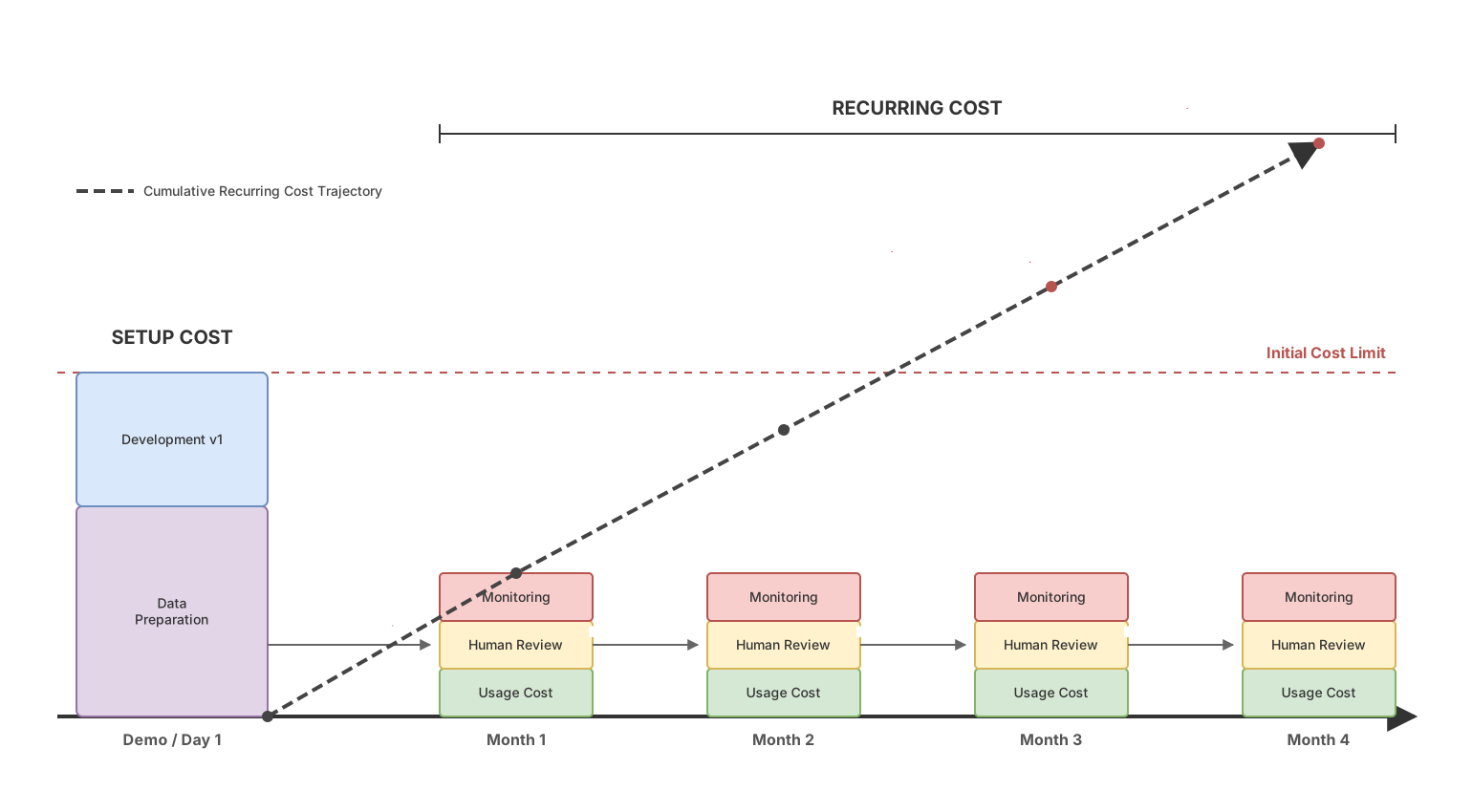
That is why a fixed quote at demo prices is a trap. It gives you a startup figure that looks affordable and hides the monthly salary that comes behind it. Before deciding how much of this you build yourself and how much you buy ready-made, it is worth understanding that choice well, and I develop it in buy or build AI.
A note on the numbers. In this article I speak deliberately in orders of magnitude and not in euros. Anyone who gives you an exact figure without knowing your data, your volume, and your tolerance for error is selling you something. What is honest is a range, and the range depends almost entirely on those six line items.
Demo vs production, at a glance
| Demo | Production | |
|---|---|---|
| Data | Clean, hand-picked | Messy, has to be gathered and maintained |
| Users | None or fake | Real customers with unpredictable questions |
| If it fails | Nothing happens | Money, customers, or a decision at stake |
| Cost | Low and one-time | Mostly monthly and recurring |
| Monitoring | Not needed | Someone measures quality continuously |
| Who tends it | Whoever built the demo, briefly | A person or team, forever |
The table sums up the core idea: you are not buying the same product, bigger. You are buying a different thing.
How to tell if an AI project is going to cost you dearly
You do not need to be technical to smell an unrealistic quote. You just need to ask the right questions and watch whether the vendor has answers or only enthusiasm. These are the ones that separate a serious proposal from a demo with a bow on it.
- How much does each query cost and how many queries a month do we estimate? (if they do not know, they have not thought about the recurring cost)
- What state is my data in and how much work is it to get it ready?
- Who reviews the outputs before they reach the customer, and how many hours does that take?
- How do we find out that the system has gotten worse?
- What happens when the model we use stops being available?
- Does the budget separate the startup cost from the monthly cost?
If half of these questions get an awkward silence, you already know where the money is going to leak. This kind of judgment, knowing what to ask without needing to program, is exactly what we work on in the AI without hype course: understanding what you buy, what you pay every month, and where the real limits are.
Cost, moreover, is only half the equation. The other half is what it gives back, and that is where the ROI of AI in the company comes in: an expensive system can turn out profitable and a cheap one can be a money pit, depending on what it actually solves.
Frequently asked questions
How much does it cost to implement AI in a company, in numbers?
It depends so much on your data and your volume that any fixed figure would be a lie. What is useful is to think of two separate numbers: a startup one, to build the first version, and a monthly one, which almost never goes away. In many projects the monthly cost ends up exceeding the startup one once the system has been running for a while. Be wary of anyone who gives you a closed price without having looked at your data.
Doesn’t AI get cheaper over time?
The cost per query to the model has indeed dropped and will probably keep dropping. But that is only one of the six line items, and not the largest in many cases. Data, human review, and maintenance depend on your company, not on the price of the model, so they do not drop on their own. A cheaper model does not clean your data for you.
Can I start cheap and grow later?
Yes, and it is usually the most sensible approach. Starting with a small, contained case, one where a failure is not serious, lets you measure the real cost before committing a big budget. What does not work is starting cheap thinking the price of that first trial will hold when you open it up to the whole company. That is where the six line items appear.
Is it better to buy a ready-made tool or build my own?
For most companies, buying something ready-made is cheaper and faster if a tool exists that fits what you need. Building custom only pays off when your case is particular enough that no tool on the market will do. I develop this in more detail in the guide on buy or build AI.
Does the cost of AI count as a one-time investment on the balance sheet?
Mostly, no. The startup part may resemble an investment, but the bulk of the cost is a recurring expense, like a salary or rent. Budgeting for it as a one-off purchase is the mistake that leaves many AI projects half-finished: the startup money arrives, the money to keep the system alive does not.
Related articles

How generative AI works, explained without the jargon
Generative AI doesn't look up truths: it predicts the most plausible word. That mental model explains why it hallucinates, why it changes, and where it fails.
Buy or Build AI: How to Decide Without Overspending
Buy AI SaaS, build custom, or wait. An honest framework to decide how to acquire AI in your company based on real cost and vendor dependency.
The ROI of AI: How to Measure If It's Worth It
How to measure AI ROI without the hype: real total cost, a baseline before you start, and when it is NOT worth investing.