
Buy or Build AI: How to Decide Without Overspending
Buy AI SaaS, build custom, or wait. An honest framework to decide how to acquire AI in your company based on real cost and vendor dependency.
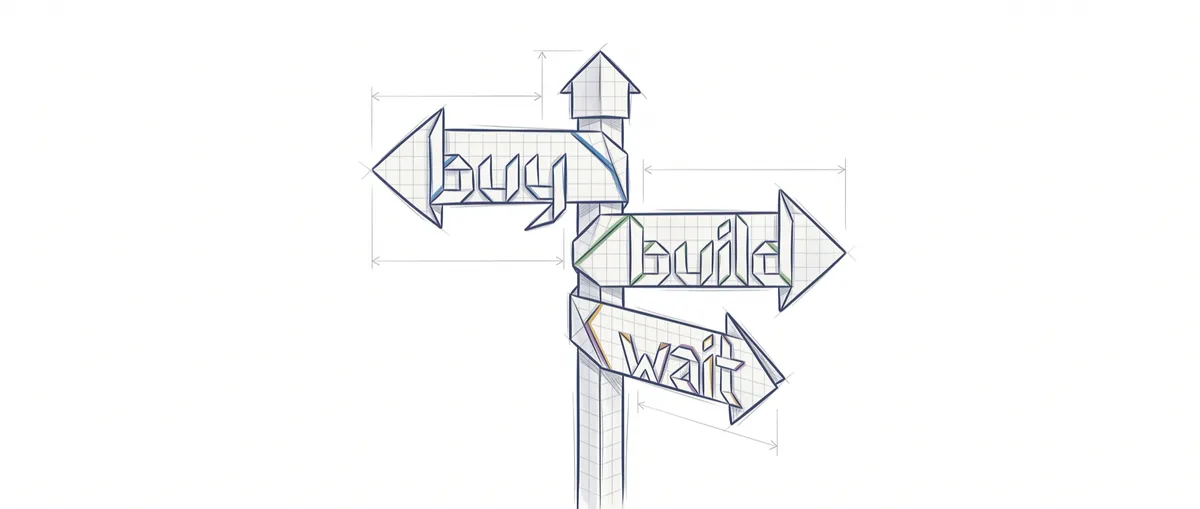
Most companies looking to “add AI” do not need to build anything. The right answer is almost always to buy a tool that already exists, pay for it by subscription and forget about maintaining it. Sometimes the right answer is even more uncomfortable: wait. And only in a handful of cases is it worth commissioning custom development.
If you are deciding how to acquire AI for your business, you have three paths: buy, build or wait. This article is a framework for choosing without overspending or tying yourself to a vendor who raises your price tomorrow. There is no single recommendation. There is a well-framed question for each situation.
Buy, build or wait: what each option means
Before deciding, it helps to pin down the three words, because almost nobody uses them the same way.
Buy means contracting a ready-made tool, usually on a monthly subscription. Someone built it, maintains it, updates it and sells it to many companies at once. You pay to use it. It is the equivalent of renting a furnished office instead of putting up a building.
Build means commissioning custom development for your company. There is an expensive misunderstanding worth clearing up right away: building AI today almost never means training a model from scratch. Training your own model costs a fortune and almost no company needs it. What actually gets built is a layer around models that already exist (the same ones behind the well-known tools), connected to your data and your processes. It is still a software project with its cost, its maintenance and its risk. But it is not rocket science reserved for tech giants.
Wait means staying with your current process and setting a date to look at it again. It is not sitting on your hands. Waiting on purpose means recognizing that right now the cost or the risk do not pay off, and setting when you will re-evaluate.
The trap is that all three options look easy to compare on price, and they are not. The price of buying is transparent: a fee. The price of building is deceptive, and that is where most money is lost.
Why the cheap demo is not the real price
The most expensive mistake when acquiring AI is confusing the cost of the demo with the cost of the product. A demonstration that impresses in a meeting is dirt cheap to put together. A product that works daily with your real data costs one or two orders of magnitude more. It is not the same animal.
Think of the difference between the model of a house and a house you can actually live in. You can build the model in an afternoon: it looks nice, it conveys the idea, it fits on a table. Living inside requires foundations, plumbing, permits, that it survives the winter and does not collapse when twenty people walk in at once. AI works the same way. A demo handles the perfect case you prepared for it. A product in production has to withstand the odd case, the badly written record, the customer who asks something absurd, the usage spike, and a model that every so often invents an answer with complete confidence.
That “inventing things” has a name. In the AI world they call it hallucination: the model produces an answer that sounds convincing but is false. In a controlled demo it barely shows up. In production, with questions you did not anticipate, it does. And managing it (reviewing, setting limits, deciding what happens when the system is not sure) is a huge part of the cost the demo hides from you.
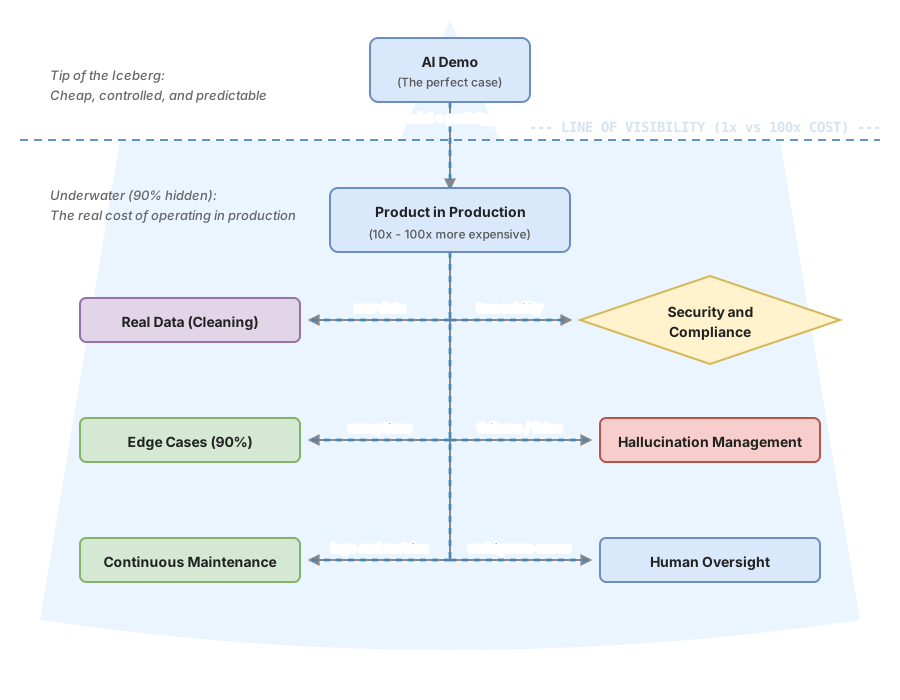
What drives up the bill is not making it work once. It is making it work every time:
- Real data. Cleaning, tidying and connecting your data is usually more work than the AI itself.
- Edge cases. The demo shows the nice part. Almost everything else is exceptions you have to handle one by one.
- Security and compliance. Who sees what, where each thing is stored, what happens with personal data.
- Maintenance. Models change, your processes change, and someone has to keep that running month after month.
- Oversight. A person checking that the system does not slip up on decisions that matter.
When someone shows you a spectacular demo and tells you “we can build this in two weeks,” the right question is not how much it costs to build. It is how much it costs to keep alive for three years.
When buying makes perfect sense
Buy when the problem you solve is not what makes you different from your competition. Most companies share the same baseline problems: customer support, invoicing, document generation, meeting summaries, email sorting. For almost all of them a mature tool already exists, tested by thousands of customers, that costs a monthly fee and you do not have to maintain.
Buying is the default option, and not out of laziness. It is that the vendor spreads the cost of building and maintaining across all its customers. On your own you cannot compete with that for a common problem.
Buying makes sense when:
- The problem is routine and is not your edge over the competition.
- A mature product already exists that does that job well.
- You do not want (nor should you want) a team maintaining software.
- You need results soon, not six months from now.
Buying is not risk-free. You put your data in someone else’s system, you depend on their decisions and you do not fully control what it does inside. That is why buying well has its own discipline: there are concrete things to demand of any AI software vendor before signing, from the portability of your data to what happens if the service fails. Buying cheap and skipping the fine print costs you later.
When building custom really pays off
Build only when the problem you solve is your competitive advantage. If what you want to automate is exactly what makes you better than your competition, and no tool fits, then it does make sense to invest in something of your own. In that case, buying a generic solution would level you with everyone else, and what you want is the opposite.
The typical example: a company with a very particular process, refined over years, that no tool on the market understands because nobody else works that way. There, custom development can turn that know-how into an advantage that is hard to copy.
Now the warning, because this is the path where most people crash. Building costs the entire life of the system, not just the first version. The day the project is delivered the spending does not end, it begins. You have to maintain it, fix it when it fails, adapt it when the models or your business change, and have someone who understands how it is built. Many companies approve the budget for the first version looking only at that number, and forget they will pay maintenance every year from then on.
Building pays off when several of these conditions hold at once:
- The problem is part of your competitive advantage, not a generic process.
- No tool on the market really fits, not even by adapting it.
- You have, or can sustainably pay, someone to maintain it.
- The value you expect justifies not just building it, but sustaining it for years.
If you hesitate on more than one of those conditions, you are probably looking at the wrong option.
When waiting is the most profitable decision
Waiting is the option nobody sells, because nobody is making money while you wait. And even so, it is often the most profitable. Waiting on purpose means acknowledging that today the cost or the risk outweigh the benefit, and setting a date to re-evaluate it.
It makes sense to wait when the current process does not hurt you enough. If something works reasonably well and automating it would save you little, investing now is solving a problem you do not have. Your money goes further elsewhere.
It also makes sense to wait when the market is moving very fast. In technology, being first sometimes means paying the pioneer’s price: immature tools, high prices, things that become obsolete in months. Letting others pay that bill and stepping in once the solution has become cheaper and stabilized is a perfectly valid strategy.
And a third reason, the most common of all: your data is not in order. AI feeds on your data. If it is scattered, badly written or duplicated, no tool is going to work magic. In that case, “waiting” really means doing your homework: tidying the house before bringing in the machinery.
The only kind of waiting that does not count is the one with no date. Saying “we’ll see” without pinning down when is paralysis dressed up as prudence. Put a date on the calendar and stick to it.
What vendor dependency is and why it affects you
Vendor dependency is the risk of getting stuck with whoever sells you the technology. If tomorrow that vendor raises the price, changes the terms, shuts down or moves the feature to a pricier plan, you are left with what you have and very little room to react. In English you will see it as “vendor lock-in,” and it affects both buying and building, because even what you build custom usually leans on a third party’s models.
Avoiding depending on anyone is impossible. What you can do is know how much you depend and reduce the risk before signing. These questions separate a good deal from a trap:
- Can I take my data with me? If the day you want to leave you cannot export your information in a usable format, you are trapped. The ability to recover your own data is a right that in Europe is covered by the GDPR, the data protection regulation. Even so, demand it in writing and test that it actually works, not just that it appears in the contract.
- Who owns what? The data you put in, what the system generates, the configuration you have tuned. Make it clear in writing before you start, not when you want to leave.
- How much does it cost me to switch? Not just in money. In time, in training, in processes to redo. The more expensive it is to leave, the more power the vendor has over you.
- What happens if the vendor disappears? A service can shut down or stop being maintained. Ask what you take with you if that happens and whether you could keep operating without it while you look for an alternative.
This risk deserves a look of its own before committing to anything serious. How to measure your degree of dependency on an AI vendor and how to reduce it is a topic weighty enough to handle separately.
This is not legal advice. Before signing any significant contract, consult a legal professional.
A simple framework to decide
Reduce the decision to a few questions. Answer them honestly and the right option usually becomes clear.
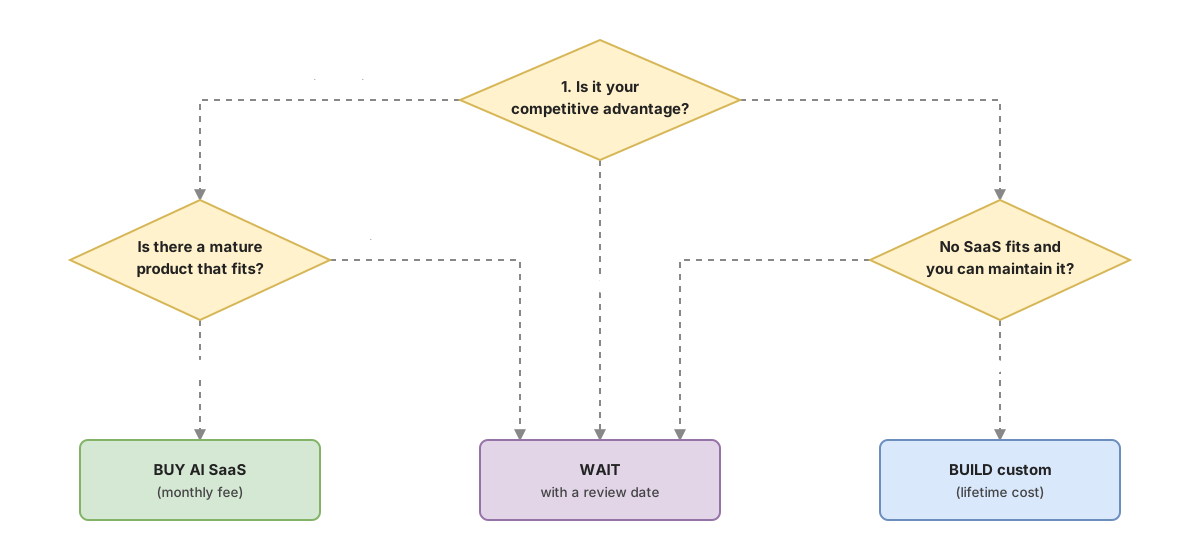
| Question | Buy | Build | Wait |
|---|---|---|---|
| Is it your competitive advantage? | No, it is a common problem | Yes, it is what sets you apart | Either way: not yet |
| Does a mature product exist? | Yes, and it fits | No, or none works | Not yet, or they are immature |
| Who maintains it in 3 years? | The vendor | You, and it costs every year | Nobody for now |
| Where does your data live? | In their system | Wherever you decide | At home, getting tidied |
| The cost that dominates | The monthly fee | Maintenance for life | The opportunity cost |
No company lives in a single column. You will buy most things, build one or two that truly set you apart, and wait on the ones where it does not pay off yet. What matters is that each decision is conscious and not the result of the last demo someone showed you.
This kind of judgment, knowing what to ask and spotting when someone is selling you smoke, is exactly what we work on in the AI without hype course: deciding about AI with your head, without empty promises and without overspending. And if you want to see the full map of where AI fits in a company, the starting point is this guide to AI use cases in companies.
Mistakes that cost dearly
Confusing the cost of the demo with that of the product. We already saw it, but it happens so often it deserves to go first. They approve a budget thinking of the model and discover the bill for the livable house when there is no way back.
Building what already exists better bought. The pride of “ours is special” leads many companies to build custom a process that any tool on the market does better and cheaper. Before building, really look at what there is to buy.
Waiting with no date. We already said it: waiting is valid, “we’ll see” is not. Without a review date, waiting is the perfect excuse to never decide.
Signing without reading who owns the data. The excitement of the first meeting makes people sign fast. Months later, when you want to change vendors or export your information, you find out you cannot. That boring clause is the one that saves you the most money.
Choosing by fashion and not by pain. “Everyone is adding AI” is not a reason to add AI. You need a concrete process that hurts, costs money and you could improve. If you cannot name that pain, it is not time yet.
Frequently asked questions
Does building AI mean training my own model?
Almost never. Training a model from scratch costs a fortune and very few companies need it. When people talk about building custom AI, in practice they are assembling a custom layer around models that already exist, connected to your data and your processes. It is still a real software project, but it is not training anything from scratch.
Is buying AI SaaS always cheaper than building?
Almost always for a common problem, yes, because the vendor spreads the cost across many customers. The exception is when the problem is your competitive advantage and no tool fits: there building can pay off even if it costs more, because it gives you something the competition does not have. Watch out for comparing only the entry price. Compare the cost over three years, maintenance included.
What exactly is vendor dependency?
It is the risk of getting stuck with whoever sells you the technology. If that vendor raises prices, changes terms or shuts down, you have little room to react. You reduce it by demanding in writing the ability to export your data, making clear who owns what, and calculating how much it would cost you to switch before signing.
How much does it cost to take a demo to production?
There is no single figure, and be wary of anyone who gives you one right away. What is reliable is the ratio: going from a demo that works in the meeting to a product that holds up day to day usually costs one or two orders of magnitude more. Most of that spend is not the AI, it is the data, the edge cases, the security and the maintenance.
Isn’t waiting falling behind?
Waiting with no date, yes. Waiting on purpose, no. If the current process does not hurt you, if the market is still immature or if your data is not in order, stepping in now means overpaying for little benefit. Setting a review date and arriving better prepared is usually more profitable than being first.
Related articles
AI Use Cases in Business: Which Ones to Prioritize
A framework for knowing which of your tasks are a good fit for AI and which ones are money down the drain: AI use cases in business, no hype.
AI SaaS: What to Demand Before You Sign
Before signing an AI SaaS, demand five things in writing: what it does with your data, reliability, portability, usage pricing, and model changes.
AI vendor lock-in: the risks and how to reduce them
What AI vendor lock-in is, its three real risks, and a realistic plan to avoid getting trapped with a single provider.