
AI Examples by Industry: What It Does and Doesn't in Your Company
Realistic AI examples in retail, professional services, manufacturing and hospitality, each with its own risk. No hype, no inflated figures.
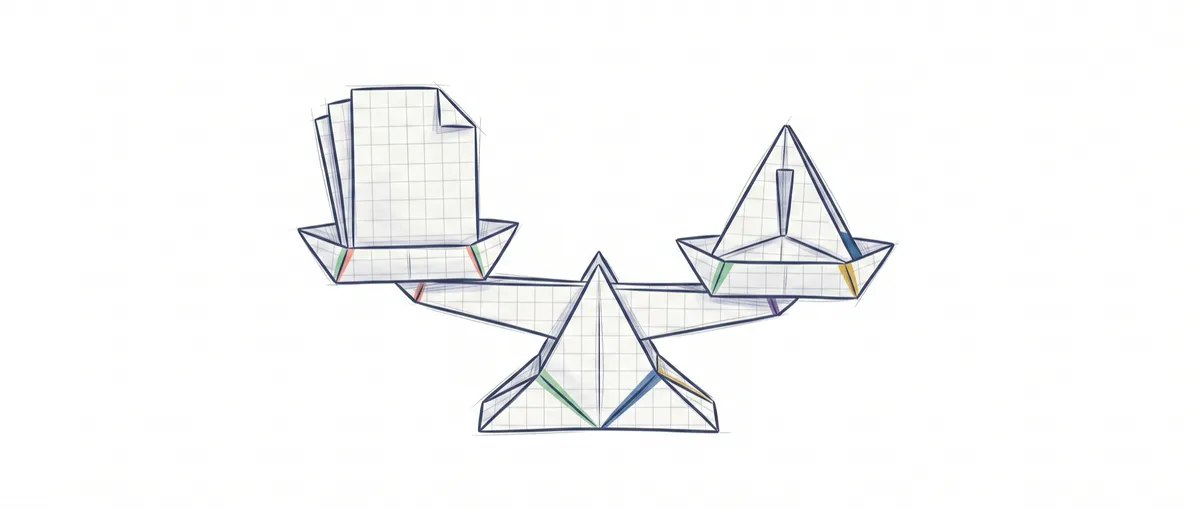
If you run a company, you have spent months hearing that you “have to use AI”, yet almost nobody shows you an example grounded in your own business. The short answer: today AI is good for repetitive tasks involving text, images and classification. Drafting a first version, summarizing a long document, answering frequently asked questions, sorting reviews by topic. Useful, everyday things, not magic.
And here is where the important part starts, the part nobody starts with: what it does NOT do well yet. It does not decide for you, it does not guarantee that a fact is true, and it does not understand your business the way you do. With that in mind, let’s look at concrete examples by sector, each one with the risk that comes underneath it. For a broader overview of where it fits, you have the full map in AI use cases for companies.
What can AI do in a company today (and what can’t it)?
Almost everything you will see uses a language model. A language model (you will see it as LLM) is a program that has read enormous amounts of text and learns to predict which word comes next. That is where its ability to write, summarize or classify comes from. And that is also where its main flaw comes from.
That flaw has a name: hallucination. Hallucinating, in AI, is making up a fact with total confidence. The model does not tell apart what it knows from what merely sounds right; it will give you a date, a price or a legal clause with the same poise whether it is correct or whether it just invented it. That is why the rule running through this whole article is simple: AI produces drafts, not truths.
That does not make it useless. A draft you review in a minute is faster than a blank page. The question is always the same: which task, with what risk, and who signs off on the result.
Retail and shops: catalog, support and returns
In retail, AI shines at the text tasks that repeat a thousand times. Writing a product description from its features, generating variants of a description for different channels, answering the usual questions (“do you ship to the islands?”, “how long does it take?”) and sorting reviews by topic to see what people complain about without reading them one by one.
All of that saves hours of boring work. But look closely at the risk. If you connect an automated assistant to your customer support, that assistant can promise something you later have to honor: a return outside the deadline, a discount that does not exist, a delivery date you cannot guarantee. It has happened to large companies that ended up forced to respect what their own chat had promised. Your assistant speaks in your name, and what it says commits you.
The sensible version is to use AI for the draft of the reply and let a person validate it in the delicate cases, or to limit by design what the system can offer without supervision.
Professional services: summaries and first drafts
In a consultancy, a law firm or an agency, the biggest saving is in the work of synthesis. Summarizing a meeting recording into minutes, producing a first draft of a proposal from your notes, or searching within your own internal documentation without having to remember which folder that contract was in. AI gives you a starting point in minutes instead of in an afternoon.
There are two risks here that go together. The first is confidentiality: if you paste a client’s data into a free tool on the internet, you do not always know where it ends up or whether it is used to train the system. In a sector with professional secrecy, that is a serious problem before it is a technical one. The second is the error slipped in as truth: a model can cite a law that does not exist or miscalculate a deadline, and present it with confidence. In legal or accounting work, an invented fact is not a minor slip.
The prudent way to work with this is with judgment, knowing what you can delegate and what you absolutely have to review. That is exactly what we teach in the AI without hype course: using these tools without swallowing the promises or taking on risks you cannot see.
Manufacturing and logistics: inspection, maintenance and forecasting
In manufacturing, the most useful AI is usually the one that looks, not the one that writes. A model trained on photos of good and defective parts can flag on the line which ones are worth checking, prioritize which machine needs maintenance sooner based on its history, or draft the report of an incident from four loose data points. Monitoring and paperwork tasks that tire a person and that a machine does without getting distracted.
The risk changes shape. Here the danger is trusting a prediction as if it were a certainty. If the system learns from dirty or incomplete sensor data, it will give you false positives (for a machine that is fine) or, worse, false negatives (letting a real defect through). A forecast without a margin of error is a trap: it looks like an exact number and it is an estimate. The business question that matters: what happens the day it gets it wrong, and how much does it cost me?
Hospitality and restaurants: reviews, menus and feedback
In hospitality, AI helps with the mountain of text that surrounds the service. Answering reviews in a personalized way without copy and paste, writing the first draft of the descriptions of a menu or a seasonal card, translating it into several languages for foreign customers, or summarizing hundreds of comments to see whether people complain about the wait or the noise.
The risk here is one of tone and of treatment. An automated reply can sound cold or plainly wrong in the face of a sensitive complaint (food poisoning, a problem with an allergy, a bad experience at a celebration). And there is a deeper risk: over-automating exactly what makes a place work. In hospitality the value is the human touch; if the customer notices a template is answering, you lose what sets you apart. AI takes the mechanical work off your hands so you can spend that time in the dining room, not so you can disappear from it.
The common pattern: AI drafts, a person signs
You will have noticed that the same structure repeats across all four sectors. AI does the heavy lifting and a person reviews before it goes out. That has a name: human in the loop. It means the system proposes and a person with judgment approves, corrects or discards before the result reaches the customer, the judge or the machine.
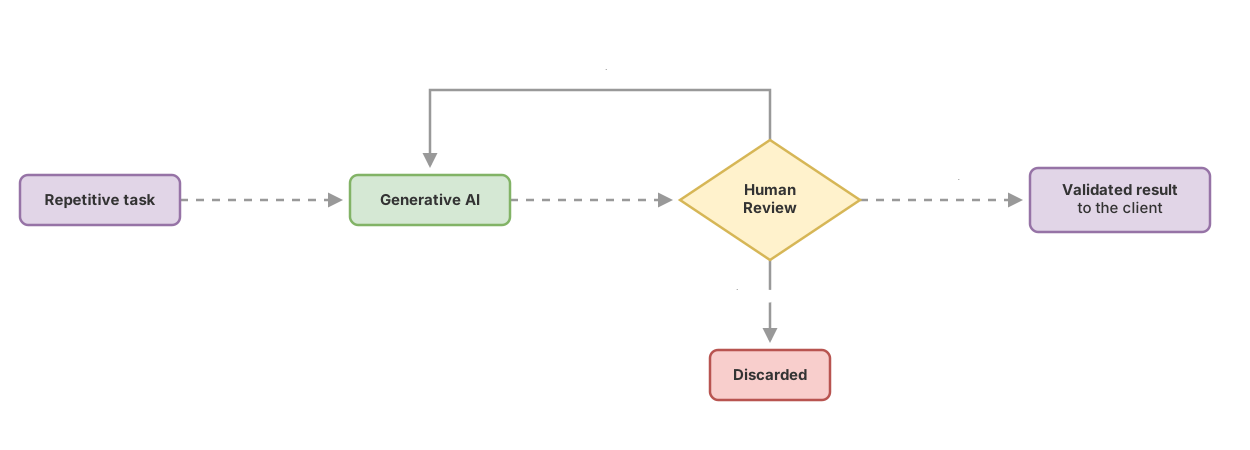
The business decision is where you place that person. The higher the cost of an error, the closer to the end the human review has to be. Answering a trivial question about opening hours can go without supervision. Drafting a reply to a legal complaint cannot. The criterion is not “do I automate or not?”, but “how much does the worst possible error of this task cost me?”.
| Sector | Realistic example | What it doesn’t do well yet | Main risk |
|---|---|---|---|
| Retail | Product descriptions, basic support, sorting reviews | Closing delicate cases without supervision | Promising something you then have to honor |
| Professional services | Minutes, proposal drafts, searching your documentation | Guaranteeing a legal or accounting fact is correct | Leaks of confidential data and errors slipped in as truth |
| Manufacturing | Visual inspection, maintenance priority, reports | Deciding without margin on dirty data | Trusting a forecast that fails silently |
| Hospitality | Answering reviews, menu drafts, summarizing feedback | Handling a sensitive complaint with tact | Wrong tone and loss of the human touch |
What to ask before buying any “AI solution”
Before signing with any vendor, these questions save you most of the headaches. You do not need to understand the technology from the inside; you need to know what to demand.
- Where is my data, and my customers’ data, processed and stored?
- Is my data used to train other people’s systems?
- Who is legally responsible if the AI gets it wrong and harms a customer?
- Can I measure whether it actually works (less time, fewer errors), or do I only sense it?
- How much does it cost to maintain each month, not just to set up?
- What happens if one day I want to leave? Do I take my data with me or am I trapped?
If a vendor cannot answer this clearly, you already have your answer.
Preguntas frecuentes
Is AI useful for a small business?
Yes, and sometimes even more than for a large one, because the time saved on repetitive tasks shows up sooner when the team is small. A shop, a firm or a bar can use ready-made tools without building anything custom. The key is to start with one specific, annoying task, not with “transforming the company”. You have a specific take for small businesses in AI for SMEs.
Do I need programmers to use AI in my company?
For most of the examples in this article, no. Many tools are used from a website or integrate with what you already have without writing code. You will need technical help if you want something very custom or connected to your internal systems, but to start with drafts, summaries or basic support, judgment to choose well and to review what it produces is enough.
Is it legal to use AI with customer data in Europe?
It depends on how you do it. In the European Union the processing of personal data is governed by the GDPR, and the use of AI by the European AI regulation, known as the AI Act. In practice, the essential thing is to know where your customers’ data is processed and with which provider, and not to put sensitive information into tools that offer no guarantees. This is not legal advice: for cases with sensitive data, consult a professional before you start.
How much does it cost to get started with AI?
You can start with very little, because many tools have affordable monthly plans for a small business. The cost people forget is the one to maintain, not the one to start: subscriptions that pile up, the time of the people who review the results and the time to fix things when something goes wrong. Before looking at the price of the tool, work out how much real time it saves you on one specific task.
Related articles
AI Use Cases in Business: Which Ones to Prioritize
A framework for knowing which of your tasks are a good fit for AI and which ones are money down the drain: AI use cases in business, no hype.
AI for small businesses: where to start without burning your budget
A hype-free guide to AI for small businesses: start with a small problem, use tools that already exist before building, and measure before overspending.