
AI for small businesses: where to start without burning your budget
A hype-free guide to AI for small businesses: start with a small problem, use tools that already exist before building, and measure before overspending.

If you run a small business and wonder where to start with AI, the short answer is this: don’t start with the tool. Start with a small, repetitive problem that already costs you time every week, use something that already exists before building anything custom, and measure whether it really saves you work before spending more. AI won’t transform your business overnight. Chosen well, it takes one or two hours of tedious work off your week, and that alone is enough to justify a first step.
This article is about judgment, not trends. There’s no list of “the 10 best tools” here. There’s a way to decide so your first project doesn’t end up being wasted money.
Why do most AI projects in small businesses start badly?
They start badly because they start with the tool and not the problem. Someone sees an impressive demo, subscribes to a trendy application, and then looks for something to use it on. That’s the reverse of what works. The tool is the last decision, not the first.
The second classic mistake is trying to do something big all at once. “Let’s automate the entire customer service operation.” A project like that touches many processes, many people, and much data at the same time. If something goes wrong, and on a first attempt it usually does, you don’t know which part failed or how to fix it. On top of that, generative AI (systems like ChatGPT that produce text) gets things wrong with a naturalness that surprises anyone who hasn’t used it seriously. Sometimes it invents facts with complete confidence. In the jargon this is called a hallucination: the system returns something that sounds perfect but is false. In a small project that failure is annoying. In a big project without oversight it’s a serious problem.
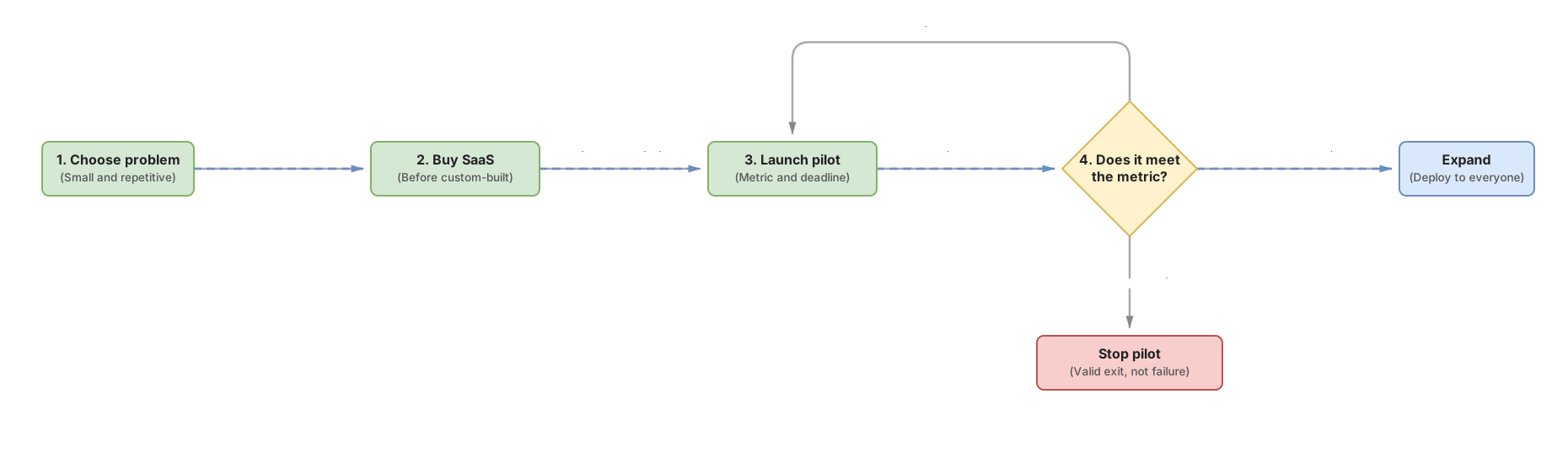
The way that works is the opposite. One concrete problem. One small pilot. One person reviewing. One date to decide. If it works, you scale it up. If not, you’ve lost little.
Which tasks are good candidates to start with?
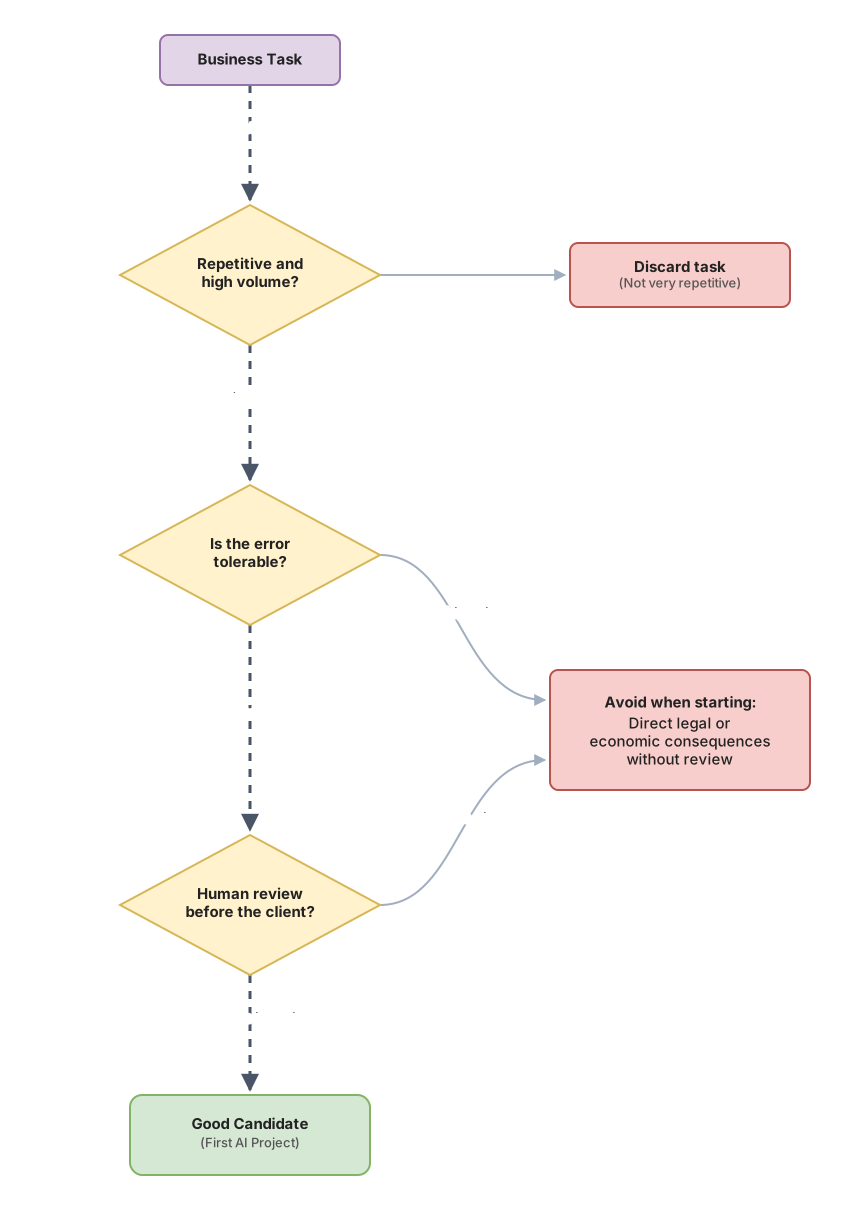
The best candidates meet three conditions: they are repetitive, they have a tolerable error, and someone can review the result before it goes out. Think about the work your team does many times, almost always the same way, and that if it comes out imperfect doesn’t cause a disaster.
Some common examples in a small business:
- Drafting replies to frequent emails, which a person reviews before sending.
- Summarizing long documents, minutes, or contracts to read them faster.
- Turning loose notes into orderly text: a product sheet, a description, an ad.
- Classifying and sorting repetitive entries, such as deciding which area each incoming query goes to.
Notice the pattern. In all of them there’s a human who reviews before the result reaches the customer. That review is mandatory at this first step, because it’s what keeps the error within tolerable limits.
Here it pays to understand well which kind of task fits and which doesn’t, and that’s a business decision before a technical one. You can see the full map of where it helps and where it doesn’t in AI use cases in companies.
What do you avoid at the start? Anything with direct legal or financial consequences and no review: credit decisions, diagnoses, contractual promises to a customer, anything where an invented answer costs you money or reputation. That comes later, with more control, not in the first pilot.
Buy a tool or build something custom?
For almost any small business, the answer is buy first. Building custom means paying someone to develop software for you, maintaining it over time, and accepting that it will take months to see the first result. Buying means subscribing to a tool that already exists (this is what the industry calls SaaS, software by subscription that you use from your browser) and starting this very week.
Most of a small business’s tasks are already covered by reasonably priced tools. It only makes sense to build when your process is so particular that no tool does it, and when that process is important enough to justify the investment. At a first step, that’s almost never the case.
| Criterion | Buy (subscription) | Build custom |
|---|---|---|
| Upfront cost | Low, a monthly fee | High, development up front |
| Time to see value | Days | Months |
| Control over the result | Limited to what the tool offers | Total, you decide everything |
| Dependency | You depend on the provider and its prices | You depend on whoever maintains your software |
| When it makes sense | Almost always when starting | Only if the process is unique and critical |
There’s a nuance worth keeping in mind from the start: when you buy, you depend on a provider. If it raises prices, changes terms, or shuts down, your process suffers. That’s not a reason not to start, it’s a reason not to tie yourself down blindly. Choose tools that let you export your data and avoid building your whole business on a single one.
How much does it really cost to start?
The real cost isn’t the tool’s fee. That’s the visible number and almost always the smallest one. The cost that catches people off guard is the hidden one, and it has four parts.
The first is your team’s time to learn to use it and change how they work. The second is preparing the data: if your documents are messy or scattered, the tool will perform poorly, and tidying them up takes work. The third is human review, that time someone spends checking what the AI produces, which never fully goes away. The fourth is the minimum training so the team understands what it can and can’t ask of it.
I’m not going to give you figures in euros because they depend so much on your case that any number would be made up, and I’d rather not mislead you. The practical rule is this: budget the hidden cost above the subscription, not below it. If you do the math with only the monthly fee, the project will look cheaper than it is and you’ll get a surprise. Before taking the step, it’s worth honestly checking whether your company is ready to absorb that cost, something I cover in digital maturity of the company.
How do you know it worked?
You define the metric before starting, not after. This is the step most people skip and the one that separates a useful pilot from spending with no conclusion. Before touching anything, write down what you’re going to measure and what result would make you continue.
The metric has to be something concrete and small. Hours saved per week on that task. Number of drafts the team approves without changes. Average time to resolve a query. It doesn’t matter if it’s modest. What matters is that you can look at it in three or four weeks and say clearly whether it improved or not.
And set a date to decide. A pilot without a date turns into permanent spending that no one evaluates. Set a short deadline, measure it at the end, and make one of three decisions: I expand, I adjust and repeat, or I stop. Stopping isn’t failing. Stopping in time with data is exactly what makes this approach cheap. When you have the pilot validated and want to make the jump to the next project, I cover the order of steps in AI adoption plan for the company.
This judgment of deciding with data, knowing when the AI gets it right and when it’s slipping you an error, is exactly what we work through calmly in the hype-free AI course, designed for whoever makes decisions in a company and doesn’t want to depend on a consultant’s word.
What about my customers’ data and the law?
Before putting customer data into any tool, check two things: what the GDPR says about that data and what the tool’s terms say. The GDPR (the European Union’s General Data Protection Regulation) requires you to handle personal data with a legal basis and to use only what you need. Many free applications reserve the right to use what you upload to train their models. That means your customers’ data could end up where you don’t want it.
The prudent rule is simple: don’t upload personal or confidential data to a tool whose terms you haven’t read. For a first pilot, you can often work with sample or anonymized data and avoid the problem entirely.
On regulation, besides the GDPR there’s the European Artificial Intelligence Regulation, known as the AI Act. Its approach is to classify AI uses by level of risk and require more controls the higher that risk is. For the kind of low-risk tasks it makes sense to start with, the obligations are light, but it’s useful to know the regulation exists and is serious. This is not legal advice: if you’re going to handle sensitive data or delicate uses, consult a professional first.
Mistakes that keep repeating
These are the stumbles I see again and again when a small business dives in without judgment.
Starting with the tool. You subscribe to what’s trendy and then look for what to use it on. Reverse the order: the problem first.
A project that’s too big. Automating everything at once multiplies the points of failure and leaves you unable to tell what to fix. Start with a single task.
No metric. If you don’t define what you measure before starting, in the end you won’t know whether it worked and you’ll keep paying out of habit.
No human review. Letting the AI talk directly to the customer with no one reviewing is the fast track to an expensive mistake. Always put a person in the middle at the start.
Uploading sensitive data to a free app. It’s convenient and it’s exactly what you shouldn’t do without reading the terms.
Expecting the AI to never get anything wrong. It gets things wrong. The realistic goal is a system whose errors you can detect and correct in time, not one that always gets it right.
Checklist before your first AI project
- You’ve chosen a concrete, repetitive, low-risk problem, not a tool.
- The task’s error is tolerable and there’s a person who reviews before the result reaches the customer.
- You’re going to buy an existing tool before considering building custom.
- You’ve defined a metric and a concrete result that would make you continue.
- You’ve set a date to decide whether to expand, adjust, or stop.
- You’ve checked the GDPR and the tool’s terms before putting in customer data.
- You’ve budgeted the hidden cost (time, data, review, training), not just the fee.
Frequently asked questions
Do I need to hire an expert or consultant to start with AI?
For a first low-risk pilot, usually not. The idea of this approach is that you can take the first step with tools that already exist and your own judgment. A consultant makes sense later, when you want something custom or have complex legal requirements. Starting small also gives you the judgment to know whether what a consultant proposes makes sense or is smoke.
Is AI for small businesses only for large companies with big budgets?
No. In fact small businesses have an advantage: because you start small, the cost of trying is low and decisions are fast. You don’t need a big budget for a first AI project, you need to choose the task well and measure the result. Subscription tools have lowered the barrier to entry a lot.
What’s the minimum budget needed?
It depends so much on the case that giving a figure would mislead you. The honest answer is this: the visible spend (the subscription) is usually modest, and the spend that really counts is your team’s time to learn, prepare data, and review results. Budget that time above the fee and you won’t get surprises.
Is it safe to use AI with my customers’ data?
It can be if you choose the tool well and respect the GDPR, but don’t assume it is. Many free applications use what you upload for their own purposes. Read the terms, use anonymized or sample data in the pilot, and don’t upload sensitive information to a tool whose guarantees you don’t know.
Is the free version of ChatGPT enough for a small business?
For testing ideas and simple tasks without sensitive data, it can be enough to start. For work with customer data or ongoing use you need to look at the paid versions with clear privacy terms, or tools specific to your task. What really decides the result is having chosen the right problem first and being clear about how you’ll measure whether it works, far more than the specific tool you use.
Related articles

AI Use Cases in Business: Which Ones to Prioritize
A framework for knowing which of your tasks are a good fit for AI and which ones are money down the drain: AI use cases in business, no hype.

Digital maturity in your company: the step before AI
Before investing in AI, diagnose your company's digital maturity. Data, processes and up-to-date software are the foundations that decide everything.

An AI adoption plan for your company: the step-by-step roadmap
How to adopt AI in your company without burning through the budget: six ordered steps, from building judgment to scaling. A realistic roadmap, with no guru promises.