
Digital maturity in your company: the step before AI
Before investing in AI, diagnose your company's digital maturity. Data, processes and up-to-date software are the foundations that decide everything.

Before asking which AI to put in your company, there is a more useful question: is your company ready to use it? Most AI projects that get stuck don’t fail because of the technology. They fail because of the starting point. Your company’s digital maturity, meaning how much of your business already lives in systems and not in heads or on paper, decides more than the model you hire.
This is not an article to discourage you. It’s to give you an honest diagnosis: which rung you’re on and what to do before spending a single euro on AI.
What is a company’s digital maturity?
Digital maturity is how much of your daily operation already sits inside computer systems you can query, instead of on paper, in loose emails, or in your employees’ memory. It’s not a certificate or a grade. It’s an informal ladder of rungs.
On the lowest rung, a business runs on phone calls, notebooks, and people’s experience. Nobody can find a two-year-old figure without calling someone. On the highest rung, almost everything that happens (a sale, a support ticket, a clocked hour) gets recorded in some system, and those systems talk to each other.
Most small and mid-sized companies sit somewhere in between. And that’s where the problem lies, because AI does not rest on your good intentions. It rests on what you already have digitized.
The three foundations AI needs
Useful AI stands on three foundations: digitized data, defined processes, and up-to-date software. If one is missing, whatever you build on top wobbles.
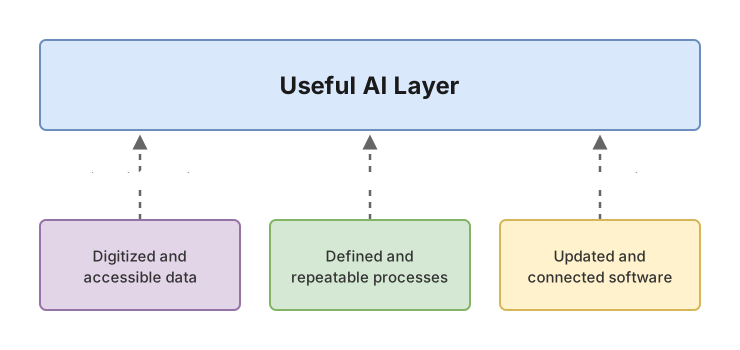
Digitized and accessible data. AI works with information. If your customer data lives in a salesperson’s head, in a notebook, or scattered across twenty different spreadsheets that nobody has ever merged, AI has nowhere to start. Digitized data is data a system can read and search without a person typing it in again.
Defined and repeatable processes. A process is the way you do something over and over: how an order comes in, how an invoice gets approved, how a complaint is handled. If every employee does it their own way and it depends on the day, there’s nothing stable to automate. AI speeds up a clear process. It doesn’t invent the process for you.
Up-to-date and connected software. Your management programs (billing, customers, warehouse) have to be current and, above all, they have to be able to talk to each other. If your sales program can’t pass data to your accounting program without someone copying and pasting, that’s a wall AI won’t jump over on its own either.
These three foundations are what hold up anything smart you want to put on top. Without them, there’s nothing to build on.
Why AI doesn’t fix what isn’t digitized
AI can only work with what exists in digital form. This sounds obvious, and yet it’s where most projects fall apart.
A language model (the kind of AI behind tools like ChatGPT, able to read and write text) needs information to respond. If that information isn’t in any system, the model does one of two things: it tells you it doesn’t know, or it makes it up. When an AI fills gaps with plausible but false data, it’s called a hallucination. And a hallucination dressed up as a serious report is more dangerous than an “I don’t know,” because you believe it.
There’s a second, quieter risk. If you automate a process that was broken, you don’t fix it: you make it faster. A confusing approval chain, automated with AI, becomes a confusing chain that now fails at higher speed and in more places at once. Technology amplifies what you already have, for better and for worse.
That’s why order matters. First you tidy up and digitize. Then you automate. If you skip the first step, you’re paying to speed up the chaos.
”The homework of the last 15 years”
A good part of what holds companies back with AI today is digitization homework left pending over the last fifteen years. Invoices still on paper. Customers who only exist in someone’s address book. Reports assembled by hand every month, copying from here and there.
None of those tasks is glamorous. Digitizing a warehouse or tidying up the customer database doesn’t make headlines. AI does, and that’s why it tempts: it looks like a shortcut that saves you from doing the boring homework. But it’s the other way around. AI rests precisely on that homework. The better you’ve done it, the more it will pay off.
The good news is that this homework is worth it even if you never end up using AI. A company with orderly data and clear processes runs better, decides better, and weathers change better. Digitization is useful on its own. AI is just one of the things you can put on top once the ground is firm.
Quick diagnosis: which rung are you on?
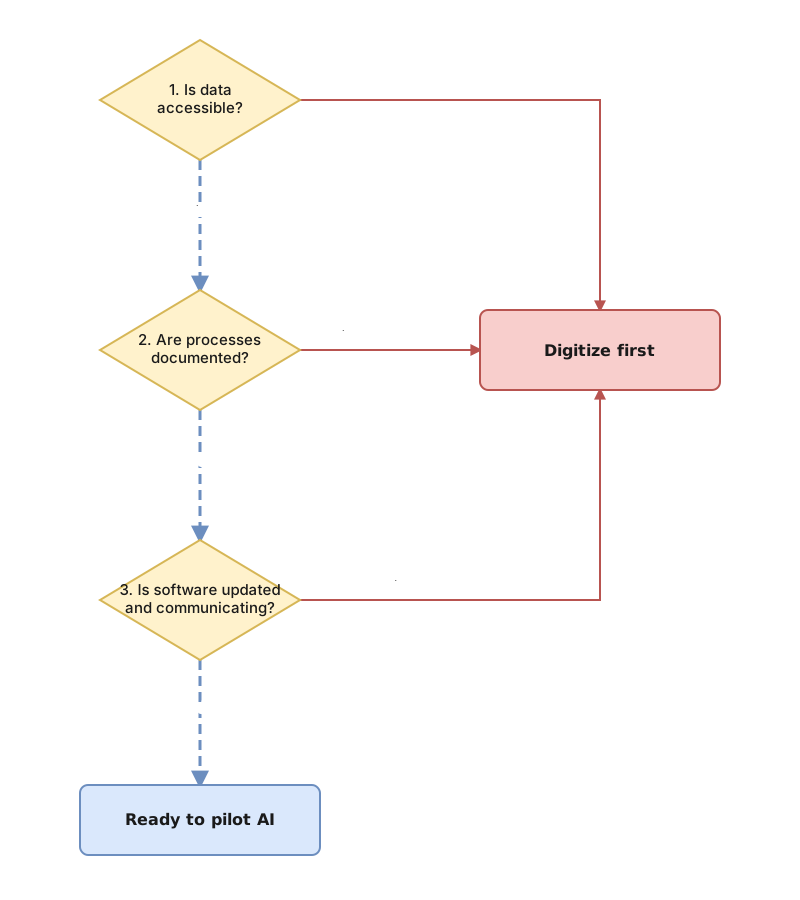
You can run an honest diagnosis with three business questions, without a single technical word. Answer them with your hand on your heart.
- Is your data queryable? If tomorrow you wanted to know how many customers in a given area bought from you last year, do you pull it from a system in five minutes, or do you have to call three people and cross-reference spreadsheets?
- Are your processes written down? If someone new joins, can they follow a clear procedure to handle an order, or do they have to learn by watching a colleague for weeks?
- Is your software updated and connected? Are your programs current and do they pass information between them, or do you spend your time copying data from one place to another by hand?
If you can calmly answer yes to all three, you have the foundations to pilot a first AI project. If you hesitate on one or more, there’s your groundwork. And that’s fine: knowing which rung you’re on is already an advantage over anyone buying AI blindly.
| Rung | How to recognize it | What to do before AI |
|---|---|---|
| Low | Paper, people’s memory, everything depends on who’s in that day | Digitize the basics: customers, sales, inventory |
| Medium | There are systems, but isolated and with a lot of copy-paste | Connect systems and write down the key processes |
| High | Almost everything gets recorded and the systems talk to each other | Pilot AI on a concrete, measurable case |
Learning to read this table about your own company, without kidding yourself, is part of the judgment we work on in the IA sin hype course: business decisions before tools.
When the answer really is AI (and when it’s “digitize first”)
You don’t have to be a perfect company to start with AI. You have to have the minimum foundation for the specific case you want to solve. This matters, because the goal isn’t digital perfection: it’s having enough firmness right where you’re going to build.
An example. If you want an AI that answers frequent customer questions, you need those answers to exist written somewhere. You don’t need the whole company digitized, just that part. On the other hand, if you dream of an AI that “predicts your sales” but your sales history is on paper, the honest answer there is to digitize first. AI can’t predict on data that doesn’t exist.
The practical rule: look at the specific case, not the whole company. Ask yourself what data and what process that case needs, and check whether you have them. Sometimes the answer will be AI. Other times it will be finishing the digitization homework before spending on something you won’t be able to make use of. On when it’s worth stopping and saying no, I wrote about it in when not to use AI; and if you run a small business and want the practical landing, in AI for small businesses I bring it down to real cases.
All of this is part of a bigger idea: understanding the risks of AI in companies before investing, so the excitement doesn’t end up costing you.
Pre-AI diagnosis checklist
- I can pull any key business figure from a system, without calling anyone
- My important processes are written down and anyone can follow them
- My management programs are current and pass data between them without copy-paste
- I’ve identified a concrete case where AI would help, not “AI in general”
- That concrete case has its data already digitized and accessible
- I can tell the difference between “I need AI” and “I need to finish digitizing”
Frequently asked questions
What is a company’s digital maturity?
It’s how much of your daily operation already lives in queryable computer systems, instead of on paper, loose emails, or your employees’ memory. The more digital maturity, the more foundation your company has to support any AI project on top.
Can I use AI if my company isn’t fully digitized yet?
It depends on the specific case you want to solve, not on the whole company. If the specific case has its data already digitized and its process clear, you can start there even if the rest of the business is still on paper. If that case depends on data that only exists on paper or in someone’s head, you need to digitize first.
Why do people say AI doesn’t fix messy data?
Because AI works with what’s there. If the data is incomplete or scattered, AI doesn’t tidy it up by magic: it either warns you it can’t, or it fills the gaps with invented information that looks true. And if you automate a process that was already broken, all you get is for it to fail faster.
Is digitizing before AI wasting money if I don’t end up using AI?
No. Tidying up your data and defining your processes improves your company even if you never add AI: you decide better, you depend less on specific people, and you weather change better. Digitization is useful on its own, and it also leaves the ground ready in case you decide to take the step later on.
Related articles
AI Risks at Your Company: A Guide to Not Crashing and Burning
An honest guide to AI risk in the workplace: where it can go wrong, how to contain it, and what to check before committing budget. No hype.

When NOT to use AI in your company (and when it's just not yet)
When not to use AI in your company: the three zones where it must never decide alone and the 'not yet' case. A clear way to decide, no hype.

AI for small businesses: where to start without burning your budget
A hype-free guide to AI for small businesses: start with a small problem, use tools that already exist before building, and measure before overspending.