
When NOT to use AI in your company (and when it's just not yet)
When not to use AI in your company: the three zones where it must never decide alone and the 'not yet' case. A clear way to decide, no hype.

The short answer: do not let generative AI decide on its own when the result has to be exact, when the error has no way back, or when there is direct legal liability and nobody is going to supervise it. And there is a fourth case, the most common of all: not yet, because you still have digitalization homework to do. In those situations AI does not save you work, it lands you in a well-presented problem.
Notice that the useful question is not “can AI do this?”. Almost always the answer is yes, it produces something. The useful question is “what happens when it gets it wrong?”. Because it will get it wrong, and it will do so with a confidence that deceives. It is worth understanding why before going on, without jargon. When we talk about AI for office tasks we almost always mean an LLM, the text engine behind ChatGPT: a system trained to predict the most likely next word from whatever you type. It does not look up a database of truths, it composes what statistically fits. Two traits follow from that, and they govern this decision. The first is hallucination: the model invents a piece of data and presents it to you with the same confident tone it uses for a correct one, with no warning sign. The second is the lack of determinism: to the same question it can give you two different answers, both plausible. A calculator always gives the same result; generative AI does not.
With those two ideas in mind, the zones where you should stop become obvious.
Never zone 1: when an exact result is mandatory
Invoices, payroll, legal calculations, prices, dosages, quantities. Here something that sounds right is no use to you, you need something that is right, and generative AI gives you the former. It can write an invoice with a VAT figure that looks reasonable and is wrong, and you do not notice because the document looks impeccable. That is exactly the danger: the error does not come with the face of an error, it comes in the format of a correct document.
This does not mean banishing AI from those tasks, it means not letting it decide the final number. Let it prepare the draft, write, organize the information. The exact calculation is done by a spreadsheet, an accounting system, or a person who checks every figure against the source where it really lives before it counts for anything.
Never zone 2: when the error is irreversible
Sending money, deleting data, emailing your entire customer base, publishing something publicly. If the action has no way back, a single failure stops being a nuisance and becomes damage you can no longer withdraw. AI gets it right almost every time, and “almost every time” sounds like a high grade. In a final action, “almost every time” is a disaster waiting its turn: one failure in a thousand is enough for the one that slips through to be the one you cannot undo.
The way out is to add a human confirmation step before the action happens and to keep a copy of everything. AI proposes the send, a person hits the button. If your provider offers you a system that acts on its own in a no-return zone, that is the question you have to ask them: where is the approval step before it executes?
Never zone 3: when there is direct legal liability without supervision
Medical, legal, or financial advice, and any decision that affects a person’s rights: hiring, firing, granting or denying credit. Here it is not only the error that matters, it is who answers when there is one. A model does not sign, does not join a professional body, does not go to court. The liability is still yours and your company’s, even if the answer was written by a machine. “The AI told me so” is not a defense.
In Europe there is also a legal framework, and it is worth looking at it before deploying, not after a scare. The European Artificial Intelligence Regulation, the AI Act (Regulation EU 2024/1689), classifies AI uses according to the risk they pose to people, with stricter obligations the more sensitive the use, and it includes a transparency obligation: if you put AI in front of the customer, you have to warn them they are talking to a machine [1]. And the GDPR, the data protection regulation you already know, still applies in full to the personal data you feed into these tools. None of this is legal advice: it is a reminder that the legal ground exists. Before a decision with legal implications, consult a professional who knows your specific case.
In these three zones AI can still help, but as a copilot that documents or summarizes, never as the one who signs the decision.
| Never zone | Why it is dangerous | What to do instead |
|---|---|---|
| Mandatory exact result (invoices, payroll, prices, calculations) | It gives you something plausible, not guaranteed, and the error disguises itself as a correct document | AI prepares the draft; the final number is validated by a person or a deterministic system |
| Irreversible error (sending money, deleting, mass communication) | A single failure can no longer be withdrawn | A human confirmation step before executing and a copy of everything that is done |
| Direct legal liability (health, law, money, people’s rights) | A model answers to no one when it gets it wrong | The decision is made and signed by a professional; AI only documents or summarizes |
The fourth case: not yet, you have homework left
The three above are “never let it decide alone”. This one is different: the task is not forbidden, but your company is not ready for it yet. And it is the most common case of all.
AI does not tidy up a disorganized company, it speeds it up. If your data is dirty (duplicate customers, misspelled addresses, half-filled fields) and you put an AI to generate answers or decisions from it, you multiply the errors at machine speed, and on top of that with a layer of polished text that makes them look trustworthy. The same goes for processes: if it is not written down who approves a discount, AI is not going to guess it correctly. It will propose something plausible, someone will accept it because it came “from the system”, and you will have automated a decision that was never clear. Automating a confused process gives you fast confusion.
This does not ask you to wait five years until everything is perfect. It asks you to have the house reasonably in order in the specific area where you are going to use AI: knowing where the data comes from, who decides, and what a good result should look like. That is the difference between a “never” and a “not yet”, and confusing them is costly. If that is your case, the prior work is covered in the most common mistakes when implementing AI in a company and in how to tell whether your company has the digital maturity to take the step.
How to decide in your specific case
Combine the four situations into a single question you can ask yourself in front of any task: what happens when this gets it wrong, and is there someone who can review it in time? The tree below walks through it from start to finish.
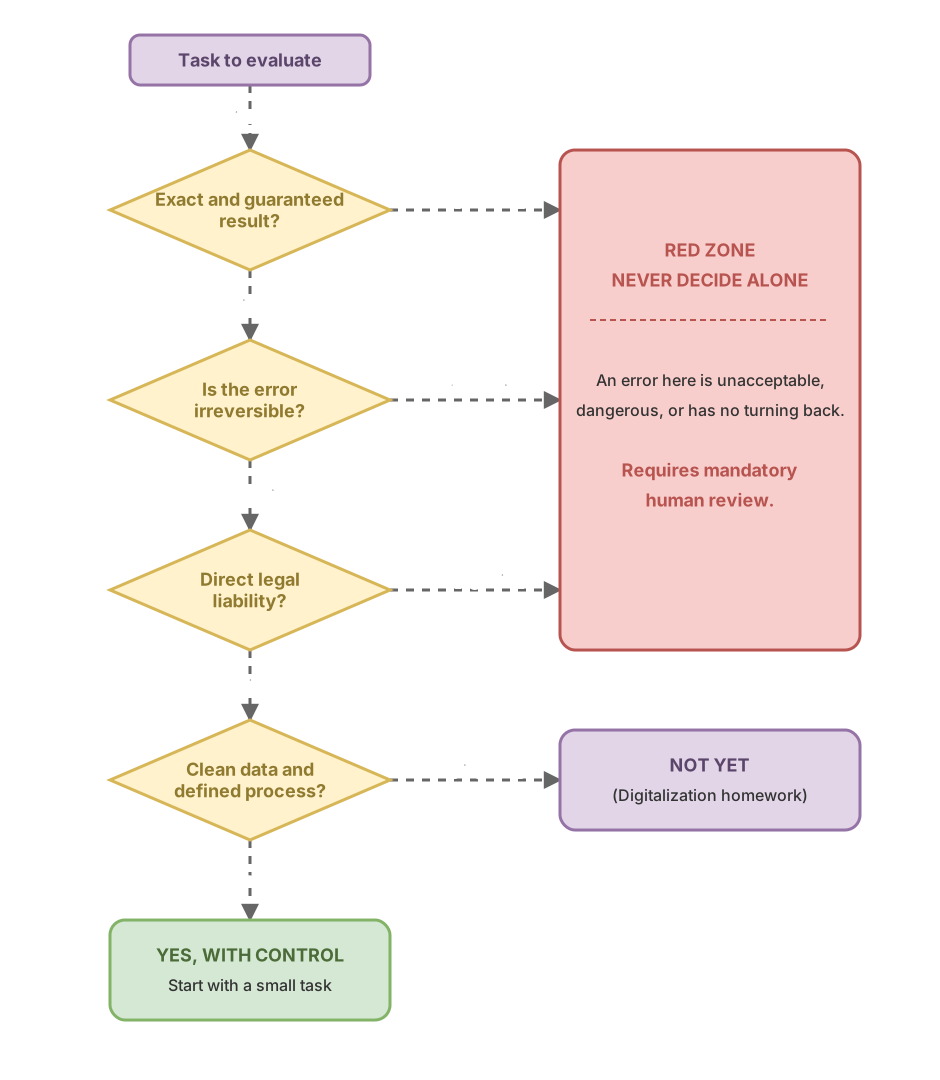
If you fall into one of the three red zones, the answer is not a flat no to AI, it is a no to it deciding alone: you use it with a person reviewing before the result takes effect. If what is failing is the digitalization homework, the answer is to tidy up that area first. And if you do not fall into any of them, go ahead, starting with a small task that is easy to watch.
That work of looking at each task with judgment and deciding where AI comes in, where it comes in with a control, and where not yet, is exactly what we work through step by step in the course AI Without the Hype: designed for whoever decides in a company, no code and no guru promises. And if you want the full picture of where AI can go wrong and how to contain it, the parent guide is the risks of AI in your company.
Sources
- Regulatory framework on AI, European Commission, Digital Strategy. Official name of Regulation (EU) 2024/1689 (AI Act), its classification of AI uses by risk level, and the transparency obligation when interacting with AI.
Frequently asked questions
So can I not use AI for anything in invoicing or accounting?
You can, but not for it to set the final number on its own. AI is useful for preparing drafts, organizing receipts, writing descriptions, or locating a piece of data among many documents. The calculation that has to add up is done by a deterministic system or a person who checks it against the source. The rule is simple: AI prepares, an exact tool or a person confirms.
If I put someone in to review, is that enough for the never zones?
Human review is precisely what turns a “never decide alone” into an acceptable use, as long as it is a real review and not a glance over the top. It has to be a mandatory step between what the AI produces and what takes effect, with real time to catch the failure. If the volume is so high that nobody can really review, you have not solved the problem, you have hidden it.
Does this mean AI is no use to my business?
Quite the opposite. It means it is useful for many tasks and not for all of them, and that knowing which ones is what separates a useful project from a costly problem. Most companies have plenty of low-risk tasks (writing drafts, summarizing, classifying) where AI adds value from day one. Starting there, and not with the most critical thing, is what makes the rest go well.
How do I know if my company is in “not yet” or can already start?
Look at the specific area where you want to use the AI, not the whole company. Ask yourself whether you know where the data it will use comes from, whether it is reasonably clean, and whether it is clear who decides in that process. If the three answers are yes, you can start in that area even if the rest of the company is chaos. If any is no, there is your pending homework before bringing in the AI.
Related articles
AI Risks at Your Company: A Guide to Not Crashing and Burning
An honest guide to AI risk in the workplace: where it can go wrong, how to contain it, and what to check before committing budget. No hype.

Mistakes When Implementing AI in Your Company (and How to Avoid Them)
The most common mistakes when adopting AI are not technical, they are business decisions. Six failures that sink AI projects in companies, and how to avoid each one.

Digital maturity in your company: the step before AI
Before investing in AI, diagnose your company's digital maturity. Data, processes and up-to-date software are the foundations that decide everything.