
Mistakes When Implementing AI in Your Company (and How to Avoid Them)
The most common mistakes when adopting AI are not technical, they are business decisions. Six failures that sink AI projects in companies, and how to avoid each one.

When an AI project goes wrong in a company, almost nobody looks at where it actually broke. The conversation revolves around the model, the vendor, whether the technology “still isn’t mature”. And the failure was almost always much earlier, in a business decision made without much thought: a tool was bought because the competition had one, and it was launched with no owner and no way to measure whether it was any use.
The good news is that these mistakes are predictable. They repeat so often that they can be listed. And because they are decisions and not lines of code, an executive can avoid them without understanding anything about how a model works inside. Here are the six most common ones, with the concrete way to dodge each.
First, two words that will come up. AI here means software that interprets language, images, or data and produces answers that used to require a person. When that AI “makes up” things that sound good but are false, the industry calls it a hallucination: the model fills gaps with something plausible even when it isn’t true. That word comes back later.
Mistake 1: adopting AI for its own sake
The starting mistake, from which almost all the others follow. The company decides to “add AI” and that becomes the goal. Where to fit it is figured out afterward. It is the reversed order: solution first, then let’s see what problem we put in front of it.
A project that starts this way has no way to fail or to succeed, because nobody defined what success would be. A tool gets installed, a nice presentation is given, and six months later nobody uses it. The tool worked fine; what never existed was a real pain to point it at.
How to avoid it: start from a problem that already costs you money or time today, with an owner and a metric. “It takes us three days to answer a quote and we lose clients because of it” is a starting point. “We want to use AI” is not. AI is a tool for a specific job, just like a CRM or a spreadsheet. If the job isn’t clear, no tool fixes it. That decision, whether the case deserves AI or is better solved another way, I develop in when NOT to use AI.
Mistake 2: skipping the risk analysis
This is where the word hallucination comes back. An AI model doesn’t say “I don’t know”. When it doesn’t have the answer, it builds one, and it does so with the same confidence with which it gives you a correct fact. For many uses that is tolerable. For others it is an invoice, a lawsuit, or a lost customer.
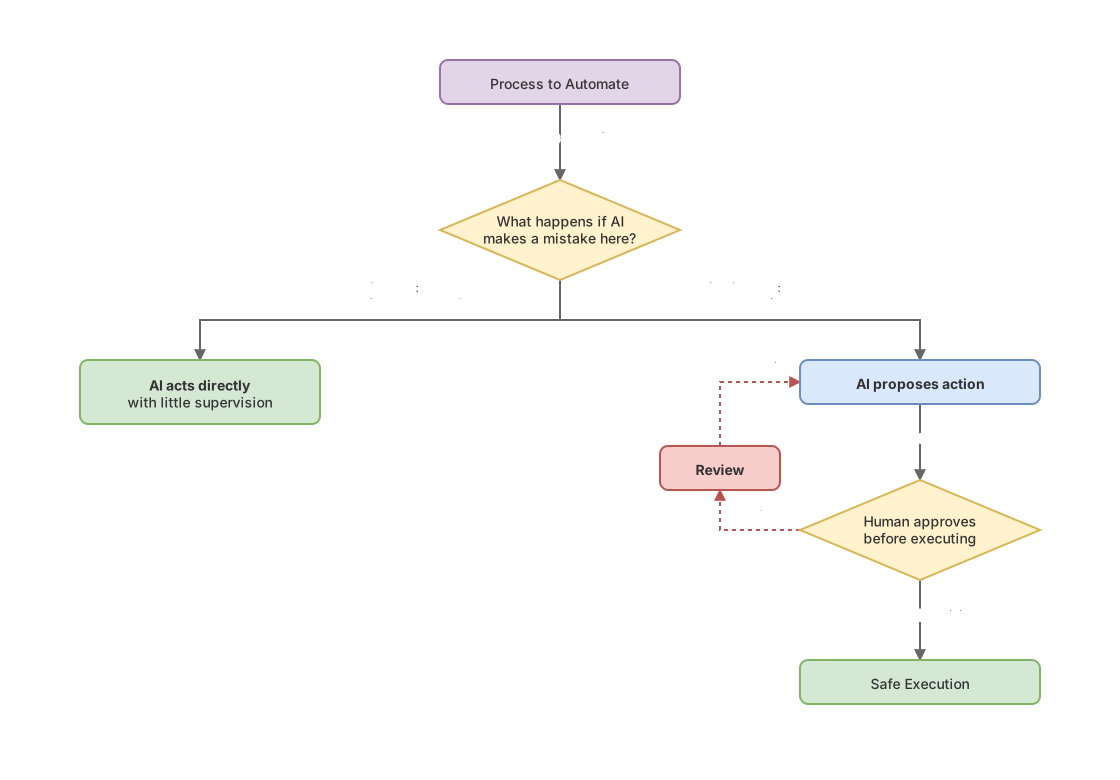
The question almost nobody asks before connecting AI to a process is simple: what happens if it gets it wrong here? If the AI suggests a film and misses, nothing happens. If it drafts a contract clause, or calculates a price, or answers a customer on behalf of the company, a mistake has real consequences and someone has to answer for them.
How to avoid it: before automating a process, classify it by impact. Low impact: a mistake fixes itself or costs little, and the AI can act with little supervision. High impact: a mistake costs money, reputation, or legal compliance, and there the AI proposes and a person approves. You don’t need a committee or a hundred-page document. You need to sit down for twenty minutes and sort your processes into those two boxes. The full map of what can go wrong is in the guide to AI risks in companies.
Mistake 3: running before walking (no data, no AI)
Much of the AI that is useful in a company feeds on that company’s data: your customers, your products, your history, your documents. If that data is scattered across emails and spreadsheets that use different names for the same thing, or lives only in the head of one person who leaves one day, the AI has nothing to learn from or respond to.
This is the mistake that generates the most frustration, because it doesn’t show up in the demo. The tool works beautifully with clean sample data. Then you connect it to the reality of your company and it gets stuck. The model does what it can with a warehouse that was never inventoried.
How to avoid it: look at the state of your data before buying anything. Is it accessible? Is it reasonably clean and up to date? Could a new person understand it without you explaining it? If the answer is no, that is your first project, and it doesn’t involve AI. Organizing the data isn’t glamorous, but it is the foundation everything else rests on. Your company’s digital maturity determines which AI projects are realistic today and which ones to postpone.
Mistake 4: believing the demo
Every demo shows the best possible case. It is prepared, with chosen data, with the questions the system answers well. That is its job: to sell. The mistake is not watching the demo, it is signing based on what you saw in it.
AI shines in the central case and struggles at the edges: the customer who writes with typos and no punctuation, or the discontinued product that still shows up in the system as if nothing happened. Those edge cases are exactly where a real company spends a good part of its time, and they are the ones no demo shows you.
How to avoid it: ask for a test with your data and your hard cases before deciding. Not with the vendor’s example, with yours. Give it the ten most tangled files you have and watch what it does. A serious vendor accepts that test; one who resists is telling you something. And measure the result with numbers, not with the feeling from the meeting: how many hits, how many misses, how many cases needed a person.
Mistake 5: not narrowing the scope
Enthusiasm pushes toward big. If AI is going to help with customer service, let it do so across every channel, in every language, for every product, from day one. It is the most reliable recipe for the project to sink under its own weight before proving anything.
A huge scope has a practical problem: when something fails, and something always fails at the start, you don’t know which part failed. Too many pieces moving at once. You can’t learn, you can’t correct, you can only put out fires.
How to avoid it: choose a small, real, measurable case. One type of query, one department, one language. Make it truly work there, with numbers to back it up, and only then expand. One case that works and can be measured teaches more than ten half-done. It also creates something no grand plan gives: trust inside the company, because people saw something concrete work instead of hearing promises.
This way of narrowing, measuring, and deciding with judgment instead of with faith is exactly what we work on in the AI without hype course: how to tell an AI project that will add value from one that will burn budget.
Mistake 6: launching with no one accountable
The “AI project” that belongs to everyone belongs to no one. Without a named person accountable for the result, the project ends up in no man’s land between the technical department, which says the tool does what it was asked, and the business side, which says it doesn’t do what it needed.
That person doesn’t have to be a technical expert. They have to be someone who understands the business problem, who can decide, and who is accountable for whether the thing works or not. Someone who cares about the result, not the tool.
How to avoid it: before you start, name that person and give them the authority to stop the project if it doesn’t deliver. A project where no one can say “this isn’t working, we’re stopping it” turns into an expense no one dares to cut, because cutting it would mean admitting they were wrong. A person with real authority is what separates a pilot that learns from a pilot that quietly bleeds money.
Starting from the trend or starting from the problem
Almost everything above comes down to a difference in how you start. Done right, the six mistakes are avoided by following a concrete order:
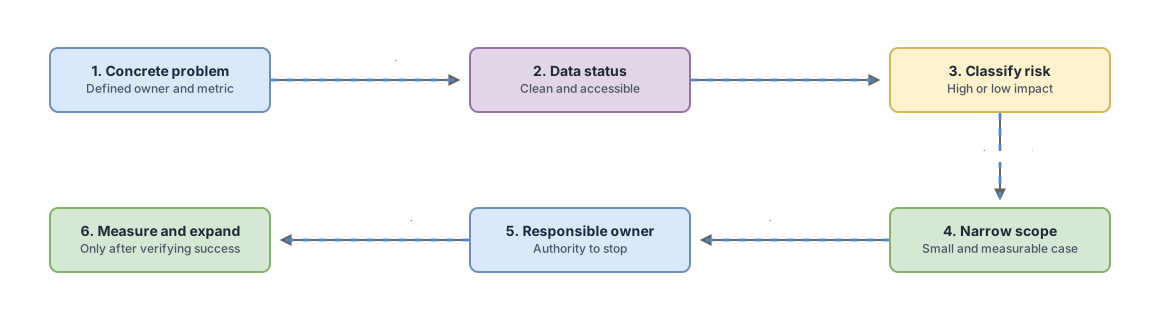
These two paths lead to opposite results:
| Starting from the trend | Starting from the problem |
|---|---|
| ”We have to add AI" | "We take too long on X” |
| Success is not defined | Success is a concrete number |
| No one in particular answers | One accountable person |
| If it fails, no one notices in time | If it fails, it shows and gets fixed |
| An installed tool nobody uses | A real problem solved |
The right-hand column doesn’t need more budget than the left-hand one. It needs to ask the questions in a different order.
Frequently asked questions
How much does it cost to start with AI the right way? Less than people fear, if you start narrow. The cost that sinks projects isn’t the tool. It’s the huge project with no owner that drags on for months. A small, measurable case can be tested with little money and in little time. What’s expensive is getting it wrong on a large scale.
Do I need a data team to implement AI? To start, almost never. You need to know what state your data is in and someone accountable for the project. If your data is reasonably organized, many current tools are used without a dedicated technical team. If it’s a mess, that is the prior work, and there you may indeed need help, but for organizing, not for AI.
What if my competition already uses it? That they use it doesn’t mean it works for them. A good share of rushed rollouts fall into the mistakes on this list. Going one step behind and doing it well usually beats going first and tripping. The rush not to fall behind is, in itself, mistake number one in disguise.
Does European regulation affect me? It might. The European Union has an AI regulation, the AI Act, which classifies uses by level of risk and requires more controls the greater the impact on people. And if you handle personal data, the GDPR still applies. Before connecting AI to a process that touches customer data or decisions about people, check how it affects you. This is not legal advice; for your specific case, talk to a professional.
Related articles
AI Risks at Your Company: A Guide to Not Crashing and Burning
An honest guide to AI risk in the workplace: where it can go wrong, how to contain it, and what to check before committing budget. No hype.

When NOT to use AI in your company (and when it's just not yet)
When not to use AI in your company: the three zones where it must never decide alone and the 'not yet' case. A clear way to decide, no hype.

Digital maturity in your company: the step before AI
Before investing in AI, diagnose your company's digital maturity. Data, processes and up-to-date software are the foundations that decide everything.