
Human in the loop: what it is and when you need it
What 'human in the loop' means for your business, when you need human review before automating with AI, and when it is a cost you can skip.
If you are weighing whether to put AI into some process in your company, sooner or later someone will tell you that you need “a human in the loop”. It sounds like consulting jargon, but the idea is simple: it means a person reviews and approves what the AI does before that output goes out into the world. The question that really matters is not whether you need it, but where and how much. Putting it everywhere slows you down; leaving it out where it counts exposes you. Here I explain how to decide without the technicalities.
What does “human in the loop” mean for your business?
A human in the loop is a person who validates the AI’s work before that work has consequences. The “loop” is the cycle any AI system runs: you ask for something, it generates a response, and that response gets used. The human sits at that last step, the “gets used” step, as a control point. If they approve, the output moves forward. If not, they correct it or discard it.
Think about your company email. A draft the AI writes harms no one while it sits in drafts. The risk appears the moment you hit “send”. The human in the loop is, literally, the one who decides whether that button gets pressed.
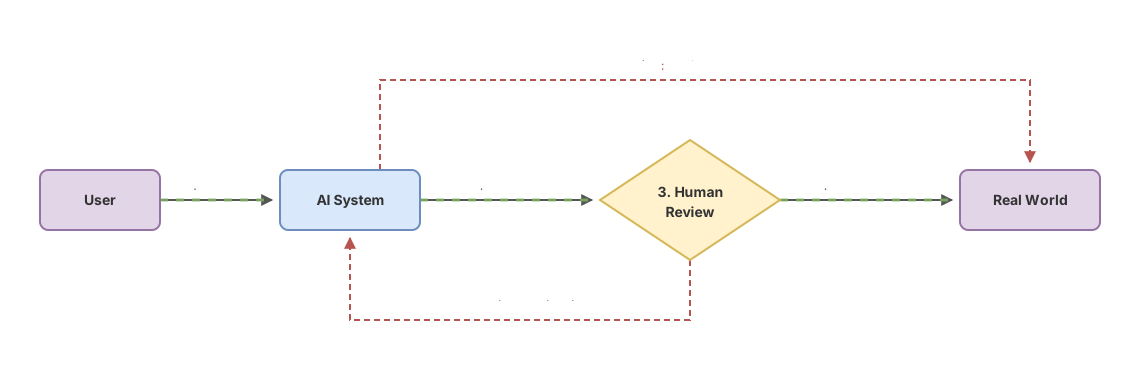
This is not a technology you buy. It is a design decision about your process: at what point you put a person to look, and with what criteria they let the work through or send it back. The same AI tool can have a human in front in one case and run on its own in another. It depends on what is at stake.
Why does AI need a review that ordinary software does not?
Because a generative AI system is not predictable the way traditional software is. A traditional program is deterministic: given the same input, it always gives the same output. Your billing program adds up the same today as tomorrow. If it gets something wrong, it gets it wrong the same way every time, and you catch it.
A language model (what sits underneath ChatGPT and similar tools) works differently. Given the same question it can give different answers, and every so often it produces a hallucination: information that sounds reasonable, is well written, and is false. It does not warn you that it is making things up. It states it with the same confidence as when it is right.
That combination (answers that vary and errors that announce nothing) is the underlying reason. You cannot trust that “if it worked in the demo, it will always work”. That is why a process with AI sometimes needs a human filter where a plain automated process never did. This is one of the brakes covered in the guide to the risks of AI in business, and it is worth understanding before you sign anything.
The four ways to put on a brake
Human review is one of four ways to reduce the risk of AI in a process. You almost never use just one. You combine them based on what is at stake.
1. Human review before it ships. A person approves the output before it reaches the customer, gets published, or is executed. It is the most expensive (it takes someone’s time) and the most flexible: a human spots odd things no rule anticipated.
2. Automated rule-based validation. The system checks on its own whether the response meets clear conditions before letting it through. An example: “if the AI proposes a discount larger than 20%, do not apply it and raise a flag”. It is cheap and fast, but it only catches what you knew to anticipate. It has no judgment of its own.
3. Reversibility. You design the process so you can undo the output if it goes wrong. A draft can be rewritten; a payment made cannot. The easier it is to walk it back, the less prior supervision you need.
4. Limited scope. You restrict what the AI can touch. Let it answer questions about opening hours but not handle complaints. Let it draft, but not send. Shrinking the scope shrinks the possible damage from any error.
Automated validation and human review complement each other: the rules filter the obvious and cheap cases, and the person focuses on the doubtful ones. If you want the full decision framework before choosing, take a look at the four questions before using AI.
How much supervision by level of risk?
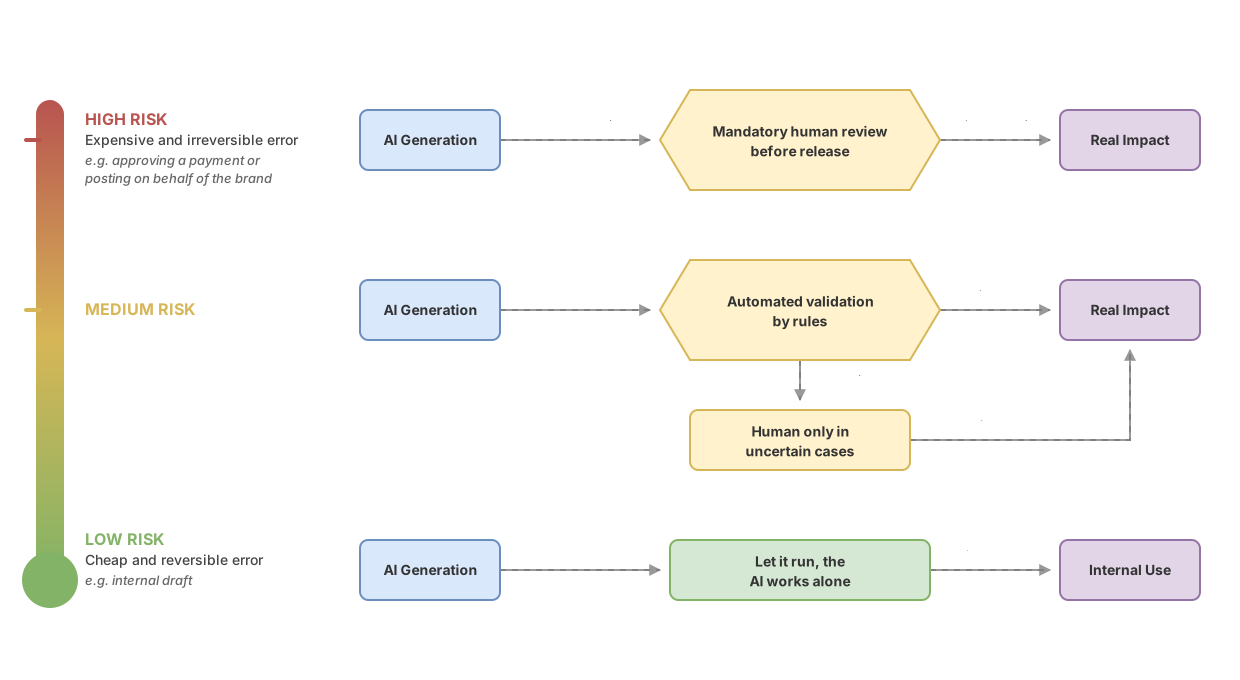
The practical rule is a single one: the more expensive and irreversible an error is, the more human supervision you need before the output ships. When the error is cheap and undone in one click, you can let go of the controls and let the AI work alone.
| Risk level | Example process | Should it ship with no one looking? | Recommended mitigation |
|---|---|---|---|
| High | Replying to a legal complaint, approving a payment, posting on behalf of the brand | No | Mandatory human review before sending, with a very limited scope |
| Medium | Answering a customer’s first question, classifying documents someone later uses | Sometimes | Rule-based validation for the routine, a human for the cases the rules flag as doubtful |
| Low | Writing an internal draft, summarizing a text someone will reread anyway | Yes | Let it run; it is enough that the output is reversible and reviewed by whoever will use it |
Notice that “goes out into the world” is what decides. A summary that only your team reads has a natural human filter: the person who reads it. A message that reaches a customer directly does not, unless you put one there.
This is exactly the kind of decision you work through with good judgment in the AI without hype course: where to put the control and where to remove it, with real business examples and no magic promises.
The cost of over-reviewing
Having a human review everything, just in case, looks like the safe option. It is not. It has two costs almost no one accounts for at the start.
The first is the bottleneck. If every AI output waits for a person to approve it, the speed of your process becomes the speed of that person. You have automated the generation but not the decision, and the decision was the slow step. In many cases you end up slower than before you brought in the AI.
The second is quieter: review fatigue. When someone has to approve hundreds of outputs that are almost always fine, they stop really looking. They start hitting the approve button on autopilot. The control exists on the org chart, but not in practice. The European AI Regulation (the AI Act) itself puts a name to this problem, the tendency to over-rely on what the machine produces, precisely because it knows a token human protects no one.
Under-reviewing exposes you. Over-reviewing slows you down and, worse, creates a false sense of security. The goal is not maximum supervision, but the minimum supervision that covers the real risk.
Common mistakes
Reviewing 100% “just in case”
Putting a human in front of every output sounds prudent, but it turns your process into a bottleneck and breeds review fatigue. Spot it when you see approval queues growing or the person approving in bulk without opening each case. The fix is to filter first with rules and reserve the human eye for what the rules flag as doubtful.
Fully automating something irreversible
Letting the AI carry out on its own an action that cannot be undone (a payment, a shipment, a deletion) is the most expensive mistake. If there is no way back, there has to be a brake beforehand. Never let an irreversible process depend solely on the AI getting it right.
Confusing “someone signed off” with “someone looked”
A human who approves without reading does not supervise: they rubber-stamp. It happens when volume is high and quality is almost always good. You counter it by reducing what reaches review (so only the doubtful cases come up) so that reviewing each one makes sense again.
Putting the review at the very end
It does little good to catch the error once the email has already gone out. The control point has to be before the output takes effect, not after. Place the brake where you can still stop.
How to decide where to put the human
You do not need a committee for this. Run through this list for each process where you use AI and you will know where the control goes and where you can let go.
- What happens if this output goes wrong and reaches the customer or the world? If the answer is serious, there is human review before it ships.
- Can the output be undone easily? If it cannot, there is a brake before executing it.
- Can I write clear rules that rule out the dangerous cases? If so, those rules filter before you spend human time.
- Have I limited what the AI can touch to the minimum the process needs?
- Does the person reviewing actually do it, or do only the doubtful cases reach them?
- Do I know who answers legally if the system gets it wrong? (Hint: it is still your company.)
Frequently asked questions
Is “human in the loop” the same as having support staff?
Not exactly. A support team attends to the customer. A human in the loop validates the AI’s work before that work takes effect. Sometimes they are the same person, for example when a support agent reviews the answer the AI drafted before sending it, but they are two different functions.
Can I remove the human over time?
Yes, and it is usually the sensible plan. You start with human review on almost everything, measure where the AI is consistently right, and let go of the controls in those cases, starting with the reversible, low-risk ones. Removing the human is a decision earned with data, not one you assume from day one.
If a human reviews, am I no longer legally responsible?
Human supervision lowers the risk, but it does not transfer responsibility. Your company still answers for what its system does, with or without a person reviewing. Putting a token human who approves without looking does not protect you before a customer or a judge. This is not legal advice: if you operate in a regulated sector, check it with a specialist.
Does this go against automation?
Quite the opposite. Knowing where a human is needed is what lets you automate the rest with peace of mind. The point is to remove the brake where the error is cheap and reversible, and keep it only where it truly matters.
Does the AI Act require human supervision?
The European AI Regulation requires effective human oversight for the systems it classifies as high-risk, and in some sensitive cases it asks that more than one person confirm before acting. For most everyday uses in a small business that level of demand does not apply, but the underlying principle (a person with judgment watching what matters) is good practice even when the law does not oblige you. A concrete case where all of this shows clearly is AI in customer service.
Related articles
AI Risks at Your Company: A Guide to Not Crashing and Burning
An honest guide to AI risk in the workplace: where it can go wrong, how to contain it, and what to check before committing budget. No hype.

4 questions before rolling out AI in your company
The 4-question framework to approve, condition, or reject an AI project without being technical. Cost of error, control, return, and accountability.

AI in customer service: where it helps and where it fails
A no-hype guide to AI in customer service: what to automate safely, where it can cost you money, and why the human in the loop is non-negotiable.