
AI vs traditional software: when you need each one
Do you solve your problem with AI or with a plain old program? A decision table, no hype, to choose by the type of task and not by the trend.
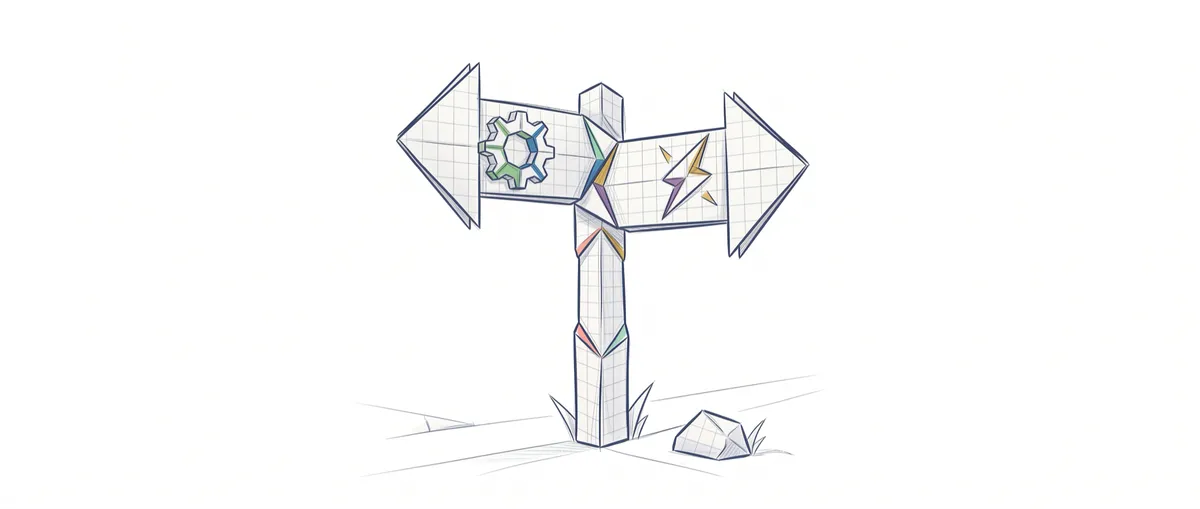
The question almost everyone shows up with is “should I do this with AI?”. It is the wrong question. The good one is “what kind of problem do I have in front of me?”. If the task demands an exact result, always the same, and one you can justify to the tax office or to a client, you want traditional software. If the task is about understanding language, deciding between cases that do not fit a clean rule, or digesting a volume no single person can cover, then AI starts to make sense.
Most real cases land in the middle. And that is where money is lost or won: when you push AI into the half that called for a normal program, or when you put ten people to do by hand what AI would read through in a while. Let’s set a rule so you don’t get it wrong.
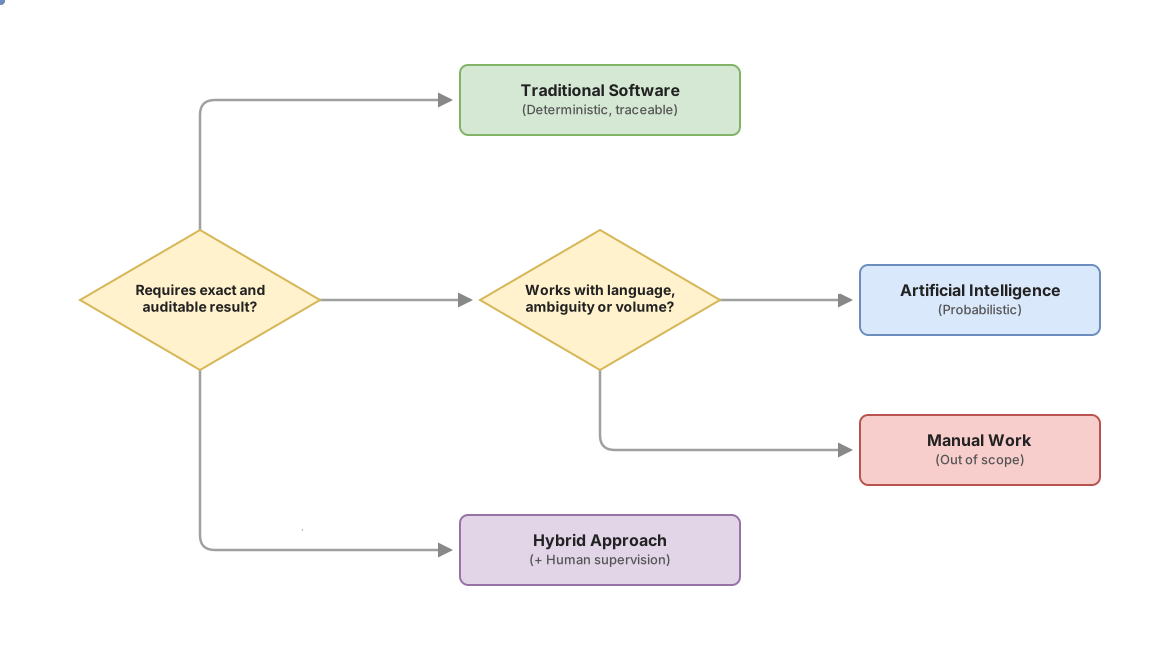
Traditional software is reliable because it is predictable
When we talk about “plain old” software we mean a program that follows rules written by a person. You give it an input, it applies the rules, and it returns an output. That is the whole trick, and it is an enormous trick.
What matters is a property that the jargon calls determinism: with the same input, the program always returns exactly the same output. The calculator on your phone does not have a good day or a bad day. Two plus two is four today, tomorrow, and at three in the morning. An invoicing program computes the same VAT for the same invoice the thousand times you ask it. If you want the detail on why this matters so much, I go into it in determinism in AI, explained.
That predictability brings very concrete advantages. You can audit it: each result is explained by the rule that produced it, step by step, and that is exactly what an inspection or a complaint asks of you. Once it works, it is cheap to run, because it does not “think” each time, it executes. And it only goes wrong if the rule was written badly, a locatable failure that gets fixed once and for all.
That is why payroll, accounting, stock control, or the rules of a tax are still done with traditional software. Not because nobody has tried AI there. Because in those tasks the correct answer is unique and you have to be able to prove it.
What AI does well and traditional software does terribly
Traditional software has a blind spot: it only knows how to do what someone managed to write a rule for. And there are problems nobody knows how to write a rule for. How do you write the exact rule that tells an angry review from an ironic one? Or the one that summarizes a forty-page contract? That is where the rules approach gives up.
Generative AI goes straight for that. A language model, what the jargon calls an LLM, does not follow fixed rules: it has seen a huge amount of text and, given what you ask, it predicts the most plausible continuation. It is closer to a brilliant intern who has read half the internet than to a calculator. If you want the mechanism from the inside without the hype, I cover it in how generative AI works.
That makes it very good in one specific territory: understanding and producing natural language, classifying things that do not fit a clean box, summarizing, pulling ordered data out of text that arrived as a mess, and handling a variety of cases that would blow up any list of rules. Where a person would spend hours reading, AI goes through it in minutes.
The price is two properties worth keeping in mind. One: it is not deterministic. Ask it the same question twice and it may give you two different answers, both reasonable. Two: it can be wrong with total apparent confidence. That failure is called a hallucination: the AI makes up a fact, a quote, or a figure and presents it with the same confident tone it uses when it gets things right. It does not warn you. What it does well and what it does badly, with more examples, is in what AI does well and badly.
The decision table
If you take a single thing from this article, let it be this table. It does not look at which technology is more modern. It looks at what your task demands.
| What your task demands | Traditional software fits | AI fits |
|---|---|---|
| Type of result | One exact and always the same | One plausible, that may vary |
| Does it need auditing and justifying? | Yes, step by step | Hard to justify in detail |
| Type of input | Ordered data (forms, numbers) | Language, images, messy text |
| What happens if it gets it wrong | The error is costly or irreversible | The error is tolerable or reviewed before acting |
| Is there a clear, stable rule? | Yes, it can be written | No, there are too many nuances |
| Volume and variety of cases | Few cases, very defined | Countless cases, all different |
Under that whole table there is a pocket rule that almost never fails. Think about whether an employee would do that task by following instructions to the letter, without thinking, or would need judgment to interpret each case. The first is traditional software territory. The second, if the error is bearable, is where AI adds value.
Almost anything good is a mix
The moment you look at a real business process, it is almost never all AI or all traditional software. It is a chain, and each link asks for a different thing.
The pattern that works best splits the work like this: AI reads and orders the fuzzy part, traditional software computes the part that demands exactness, and a person watches the decisions that cost money or have no way back.
An illustrative example, to see it. Picture supplier invoice entry at a small company. They arrive as PDFs, as photos, each supplier with its own format. Reading those papers and pulling out the supplier, the date, the line items, and the total is exactly what AI does well: language and formats that change all the time. But adding up the lines, checking that the total matches the VAT, and recording it in the accounts has to be exact and auditable, so that is handled by the same traditional software as always. And before paying an invoice for a high amount, a person approves it. AI proposes, the software computes, the person signs.
That split is also your safety net. When the AI fails, and it will fail at some point, the failure lands on the draft someone reviews, not on the payment that already went out. Designing that split well, where the machine comes in and where human control does, is pure judgment, and it is exactly what we work through with real cases in the AI without hype course: you take a process of your own and decide, stretch by stretch, what gets automated with rules, what with AI, and what stays untouched.
Signs you are putting AI where it does not belong
Before commissioning an AI project, run the task through this list. If you check several boxes, you are probably overpaying for something less reliable than a normal program.
- The result has to be exact and auditable. Money and taxes, any figure you will have to justify later. If every number has to be defended, the variability of AI works against you.
- A clear, stable rule already exists. If you know exactly how the decision is made, write it down. A program that follows that rule is cheaper and does not go wrong on its own.
- The error is costly and nobody reviews it. Automating an irreversible decision with AI and no supervision is the fastest way to have a bad time.
- You already have a cheap deterministic solution that works. Swapping it for AI “because it is the modern thing” adds cost and uncertainty in exchange for nothing.
- You cannot measure whether it gets it right. If you are not able to check when the AI is wrong, you will not be able to control it. And what you do not measure, you do not govern.
None of these signs says “AI is bad”. They say that this particular task called for a different tool. Choosing the right tool is half the job of a decision-maker working with these technologies.
Frequently asked questions
Is AI going to replace traditional software?
No. They solve different problems. Traditional software will keep doing everything that demands exactness and traceability, which is a lot. AI covers the ground that rule-based software never knew how to touch. What does change is that many solutions now combine the two.
Is AI always more expensive?
It depends on the task, and the bill has parts you do not see. On top of the cost per use, AI usually needs human review of its outputs, and that review costs too. For a task with a clear, stable rule, traditional software almost always ends up cheaper to run. For reading ten thousand different documents, doing it by hand costs far more than AI.
Can I trust AI for money or legal tasks?
To calculate or decide on its own, no. To read, order, and propose, with a person and a deterministic program checking afterwards, yes, it can help a lot. The rule is that AI should not be the last link before an irreversible consequence.
Do I need AI so I don’t fall behind?
You need to solve your business problems well. Sometimes that calls for AI and sometimes it calls for a plain old program you have been putting off for years. Adopting AI in a task that did not call for it does not put you ahead, it distracts you and it costs you.
Where do I start deciding in my company?
Take a concrete task, not “AI” in the abstract. Run it through the table above and the list of signs. If it comes out as traditional software, you already have your answer. If it comes out as AI or a mix, define who reviews the outputs and how you will measure whether it gets it right before spending a euro.
Related articles
How generative AI works, explained without the jargon
Generative AI doesn't look up truths: it predicts the most plausible word. That mental model explains why it hallucinates, why it changes, and where it fails.

AI Determinism: Why It Gives Different Answers
Traditional software returns the exact same result; generative AI does not. What determinism in AI means and where it fits in your business.
What Generative AI Does Well and What It Does Badly
A no-hype guide to deciding which tasks in your business to hand generative AI and which to distrust. Where it shines, where it fails, and how to classify each job.