
What Generative AI Does Well and What It Does Badly
A no-hype guide to deciding which tasks in your business to hand generative AI and which to distrust. Where it shines, where it fails, and how to classify each job.
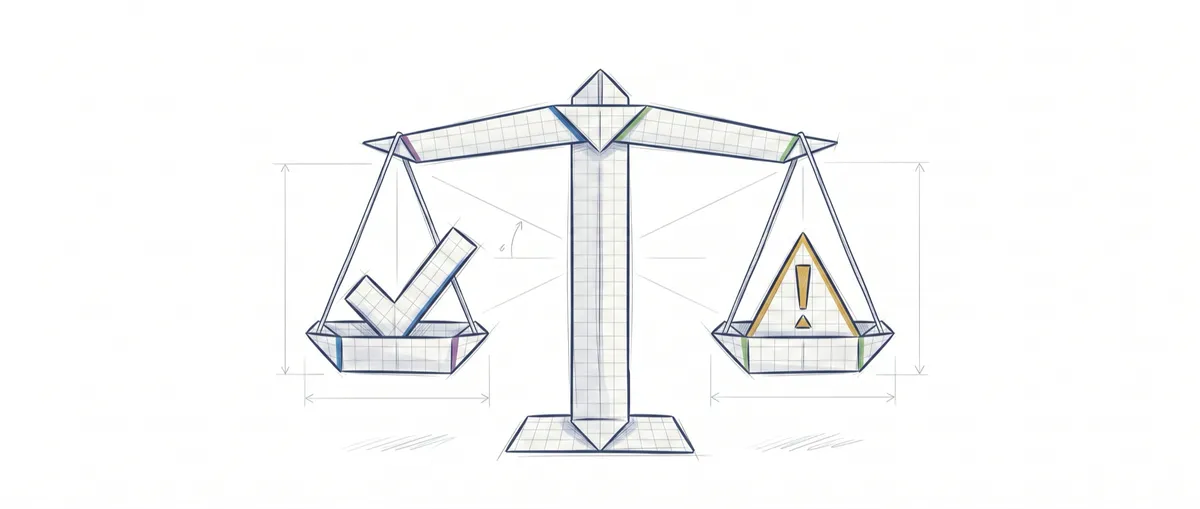
Generative AI is neither good nor bad in the abstract. It is excellent at one type of task and dangerous at another, and almost every disappointment I have seen in companies comes from asking it for the second while expecting the first. If you want a rule you can apply tomorrow: it shines when the job is about language and there is no single correct answer, and it fails when you need an exact, verifiable, always-the-same piece of data.
This article is for the person who has to decide, not the person who programs. If you run a company or a team and you have been told a thousand times to “use AI” without being told what for, here is the criterion: which tasks you can hand over with peace of mind, and which will land you in trouble if you leave it on its own.
What exactly is generative AI?
Generative AI is a program that produces text (or images, or audio) by predicting what comes next. The models behind tools like ChatGPT are called LLMs, short for “large language model”. Their only job is this: given a sequence of words, work out the most likely next word, then the next, and so on until a full answer takes shape.
That detail changes everything. The model does not consult a database of the truth. It does not know whether something is true. It has read enormous amounts of text and learned which combinations of words tend to go together. When you ask it something, it does not look for the correct answer: it generates the answer that sounds most plausible. If you want to understand the mechanism calmly, I explain it in detail in how generative AI works.
From that way of working come, at the same time, its greatest strengths and its worst flaws.
Where does generative AI shine?
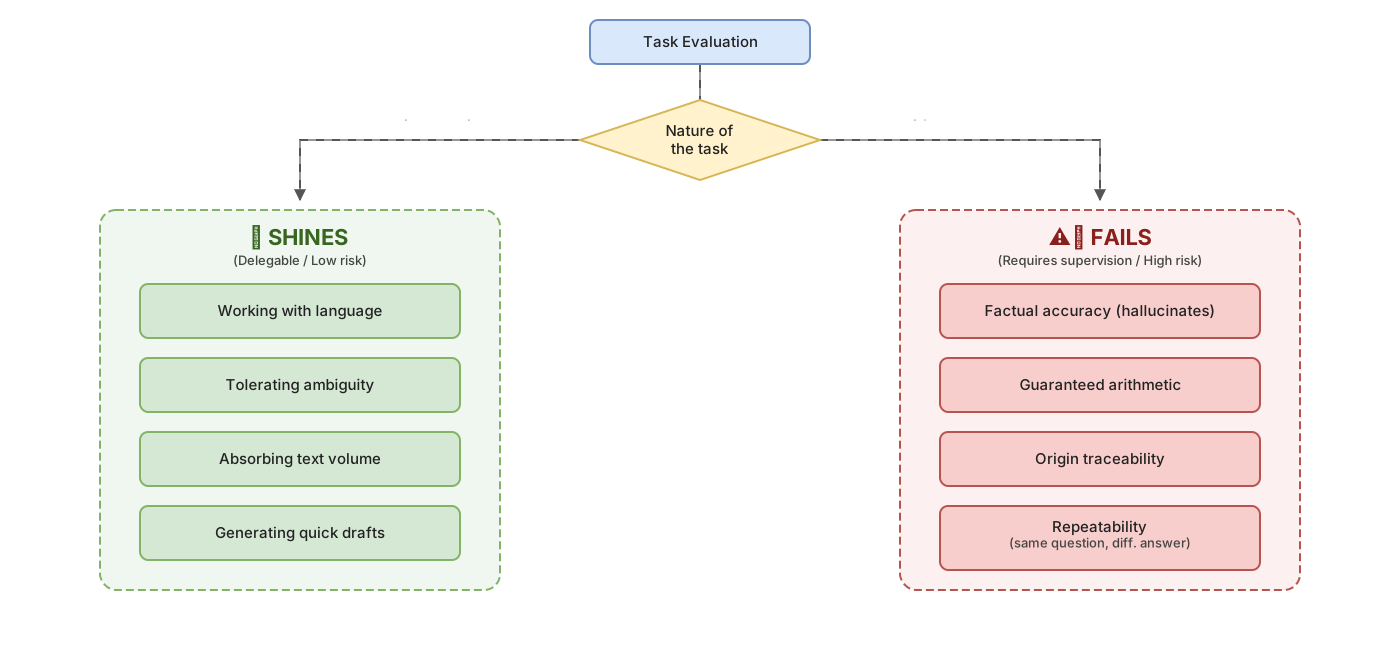
It shines at anything that means handling language with no single correct answer. There are four clear strengths.
It works with language better than any tool before it. Writing, rephrasing, summarizing, changing the tone of a text, translating. These tasks do not have one “correct” answer, they have many valid ones, and the model produces a perfectly acceptable one in seconds. Asking it for a first draft of a sales email, a summary of a long meeting, or a shorter version of a document is exactly its home ground.
It tolerates ambiguity. A traditional program needs exact instructions or it breaks. Generative AI understands vague requests and still does something useful. You can tell it “make this a bit more formal” or “trim the fluff from this text” without defining exactly what that means, and it responds reasonably. For a human that is natural. For traditional software it was impossible.
It absorbs volume. It can read forty resumes, two hundred customer reviews, or a long contract and give you a summary in minutes. It does not get tired or lose focus by review number one hundred and fifty. When the problem is “there is too much text and someone has to read all of it”, AI makes a first pass that would take a person a full day.
It generates quick drafts. Its greatest value is not in the finished work. It is in taking the blank page away. A video script, ten ideas for a campaign, the outline of a proposal. Starting is hard, and that is precisely the step AI solves for you. Then you review and correct, which is faster than creating from scratch.
Where does generative AI fail?
It fails at anything that demands verifiable accuracy. Here are the four weaknesses that cause the most trouble.
It does not guarantee factual accuracy. Because it generates the most plausible text instead of consulting the truth, it sometimes invents data that sounds perfect and is false. This is a hallucination: the model states, with total confidence, a figure, a date, a legal citation, or a name that does not exist. There is no warning that says “I am making this up”. It sounds just as convincing when it is right as when it is wrong, and that is the problem.
It does not do guaranteed arithmetic. It can solve a simple sum, but it is not a calculator. Because it treats numbers as text to predict, in multi-step calculations it gets things wrong without warning. For a payroll, an invoice, or any figure that has to add up, you cannot trust the direct result. It needs a spreadsheet or a program that does the real calculation.
It offers no traceability. When it gives you a piece of data, it usually cannot reliably tell you where it got it. And if you ask, it sometimes invents the source too. In a sector where you have to justify where every number comes from (finance, health, legal), an answer with no verifiable origin is worthless, however good it sounds.
It is not repeatable. Ask the same question twice and you may get two different answers. In traditional software that would be a serious bug: you feed in the same data and expect the same result every time. Generative AI works the other way round by design, and that variability is a serious problem when you need consistency. I develop this in AI versus traditional software, because it is the difference that most throws people coming from the classic software world.
How do I classify my company’s tasks?
The most practical way to decide is to put each task in one of two columns. Here are real examples so you can see the criterion in action.
| Business task | Hand it to AI | Supervise it or avoid it |
|---|---|---|
| Drafting a sales email | Yes, then you review it | |
| Summarizing forty resumes for a first screen | Yes, with a human review of the finalists | |
| Calculating a payroll or an invoice | Avoid it: use a calculation tool | |
| Quoting the exact clause of a contract | Supervise it: check the quote against the original | |
| Generating ten ideas for a campaign | Yes, this is its home ground | |
| Giving a customer the official price of a product | Supervise it: the price comes from your system, not the model | |
| Translating an internal document | Yes, with a review if it is sensitive | |
| Deciding on a dismissal or a hire | Avoid it: it is a decision with human responsibility |
Notice the pattern. The tasks on the left are about language, they admit several good answers, and the cost of a small error is low. The ones on the right demand an exact fact, have a single correct answer, or carry a responsibility you cannot delegate to a machine that sometimes makes things up.
Four questions to decide task by task
When you are in doubt about a specific task, ask yourself these four questions:
- Is this a language job or do I need an exact fact? Language, go ahead. Exact fact, be careful.
- Is there a single correct answer? If there is, AI is the wrong place to look for it on its own.
- Do I need to know where the result came from? If you have to justify the origin, do not trust whatever the model says without checking it.
- Does it matter if it answers differently twice? If you need total consistency, this tool will not give it to you by itself.
With a single answer that sets off the alarm, that task goes in the supervise column. In what the ideal task for AI looks like I go deeper into how to spot at a glance the jobs that fit.
The pattern that does work: AI proposes, you verify
The most expensive mistake is treating AI as if it were an employee you trust blindly. The use that works is different: AI does the heavy lifting and a person or a rule checks the result before it is used.
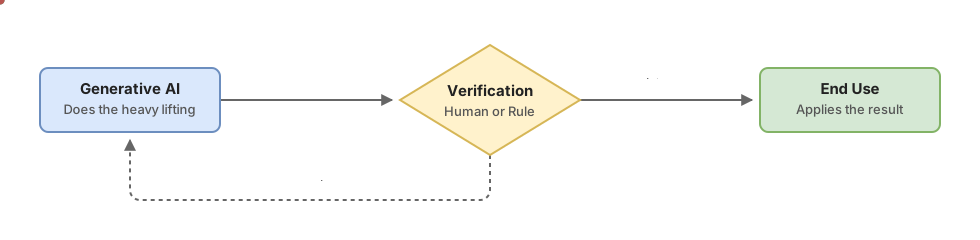
That review is not optional, it is the part that turns an unreliable tool into a reliable process. AI drafts the email and you read it before sending. AI summarizes the resumes and a person reviews the finalists. AI proposes the figures and a spreadsheet recalculates them. The result combines the best of both: the speed of the machine and the judgment of the person.
That judgment, knowing when AI is right and when it is slipping one past you, is exactly what you train with practice. It is the core of the AI without hype course, designed so you make these decisions with a clear head and without depending on someone selling you a dream.
Checklist for classifying a task
- I have identified whether the task is about language or exact data
- I have checked whether a single correct answer exists
- I have decided whether I need traceability of where the result came from
- I have weighed whether it matters if the answer varies between attempts
- I have defined who or what verifies the output before it is used
- I have put the task in the hand-over column or the supervise column
Frequently asked questions
So I should never trust generative AI?
You trust it for what it does well and not for what it does badly. It is an excellent tool for language tasks where several valid answers fit, and a bad choice for exact data, calculations that have to add up, or decisions with legal responsibility. Trust is decided task by task, not once and for all.
Why does it invent data if it is so advanced?
Because it does not consult the truth, it predicts the most likely text. A hallucination is information that sounds credible but is false, and it happens because the model generates the most plausible continuation instead of checking a fact. It is a direct consequence of how it works, not a bug that some update will fix.
Will this improve over time?
In writing quality and in many details, probably. But the underlying limitations (that it sometimes invents, that it does not guarantee the calculation, and that it can answer the same question differently) come from the way it works. It is worth making decisions with the tool you have today, not the one that might exist two years from now.
Will AI replace my team?
It replaces tasks, not people with judgment. It removes repetitive language work and drafts, and leaves untouched the decisions that demand judgment and responsibility. What changes is what you invest your team’s time in: less typing, more deciding and reviewing.
Related articles
How generative AI works, explained without the jargon
Generative AI doesn't look up truths: it predicts the most plausible word. That mental model explains why it hallucinates, why it changes, and where it fails.
AI vs traditional software: when you need each one
Do you solve your problem with AI or with a plain old program? A decision table, no hype, to choose by the type of task and not by the trend.
Ideal tasks for AI: the profile you should look for
Not every task fits AI. There is a four-trait profile and a simple way to score yours before you spend a single euro.