
Ideal tasks for AI: the profile you should look for
Not every task fits AI. There is a four-trait profile and a simple way to score yours before you spend a single euro.

Most AI projects that go nowhere fail before they start. Not because of a bad model or a lack of budget, but because someone chose the wrong task. They picked the most visible one, the one that looked good in the meeting, and asked AI to solve it. AI did not fit that task, and no later tweak fixes it.
The good news is that there is indeed a task profile that fits AI well. It is four traits, and all four have to hold at the same time. Once you know it, you can look at any process in your company and say, in two minutes, whether it is worth it or whether you are about to throw money away.
The profile in one sentence: four traits that must coincide
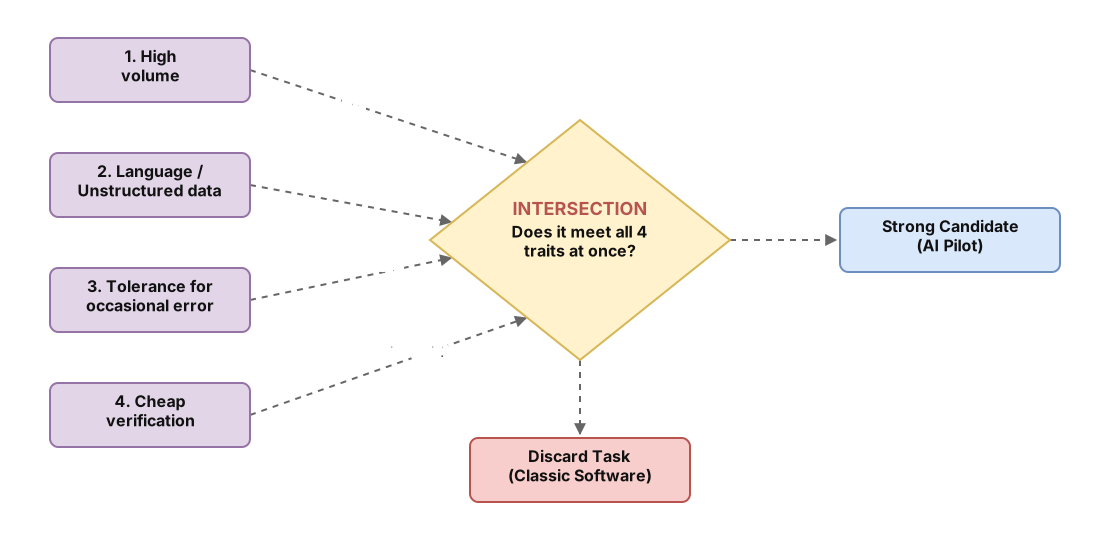
A task is a good candidate for AI when it brings together these four traits:
- High volume. It is done many times, not once a year.
- Language or unstructured data. It works with text, emails, documents or images, not with a table of fixed rules.
- Tolerance for an occasional error. A sporadic slip does not cause an irreversible disaster.
- Cheap verification. Checking whether the answer is correct costs much less than doing the task from scratch.
Notice the “at the same time”. A high-volume task where any error ends up in court is not a candidate. A task with free-form text that only happens once a quarter is not one either. The value shows up at the intersection, not in a single trait. Let us see why each one matters.
Trait 1: high volume
Setting AI up in a process takes work. You have to connect it, test it, tune how you ask it for things and, above all, watch that it does not drift. That fixed cost is paid once and then spread across all the times the task runs.
If the process runs thousands of times a month, the spread comes out cheap. Picture an inbox that receives hundreds of customer emails a day and someone has to sort them by topic and urgency. There the volume more than justifies the setup effort.
Now the other extreme: drafting the lease for the warehouse, something you do once every few years. Even if AI could help, the time you spend preparing and reviewing the system is greater than the time it saves you. For something that happens rarely, a good lawyer and a template win every time.
Volume alone does not make a task good. But without volume, almost no task is worth the effort of automating it with AI.
Trait 2: language and unstructured data
Here it helps to clarify what an LLM is, because it is the piece that makes today’s AI special. An LLM (large language model) is a program that predicts which text is the most likely to come next, trained on enormous amounts of human writing. It does not follow a list of rules someone programmed. It has learned patterns of language.
That is why it shines exactly where classic software gets stuck: nuance, synonyms, spelling mistakes, free formatting. An email that says “my order never arrived and I am furious” and another that says “query about the status of my shipment, still pending” mean almost the same thing, even though they do not share a single keyword. An LLM captures that equivalence. A rules program would need someone to anticipate every way of saying it, and one always slips through.
The flip side is important and many people overlook it. If your task already lives in a spreadsheet with clear rules (“if the amount exceeds X, send it to this department”), you do not need AI. You need normal software, which is also cheaper, faster and always gives the same result. Before bringing in AI, it helps to be clear about what AI does well and what it does badly compared with plain old automation.
Trait 3: tolerance for an occasional error
AI gets things wrong. Not once in a while because of a technical glitch, but because of how it works. Sometimes it produces an answer that sounds perfect, confident and well written, and that is simply false. In the field it is called a “hallucination”: the AI invents a plausible fact with total assurance. It does not warn you that it does not know.
This does not rule it out. What rules it out is using it where an occasional error is catastrophic. The question you have to ask is a concrete one: if this task gets it wrong one time in however many and nobody reviews it, what happens?
If the answer is “I misclassify an email and the customer waits half an hour longer”, you have plenty of margin. If the answer is “I file a tax return with a made-up figure” or “I promise a customer something we do not deliver and there is a contract involved”, then that task is not a candidate to run on its own. It can still be a candidate with a person reviewing every output, but that changes the maths, because you no longer save as much.
Trait 4: cheap verification
This is the trait almost nobody looks at, and the one that sinks the most projects. AI only saves you work if checking that it got it right costs much less than doing the task yourself.
Think about summarizing a forty-page report. The AI takes seconds, and you check the summary in a couple of minutes by skimming and cross-referencing the original. Dirt-cheap verification. Real saving.
Now think about asking it to compute a complex tax settlement. The AI spits out a number. How do you know it is correct? By redoing it yourself, which is exactly the work you wanted to avoid. If verifying costs the same as doing, you have gained nothing. You have added a step.
Cheap verification usually appears when the answer is easy to check at a glance, when there is a source to compare against, or when an error jumps out. When the answer is an isolated figure that can only be checked by repeating the calculation, be suspicious.
How to score your task
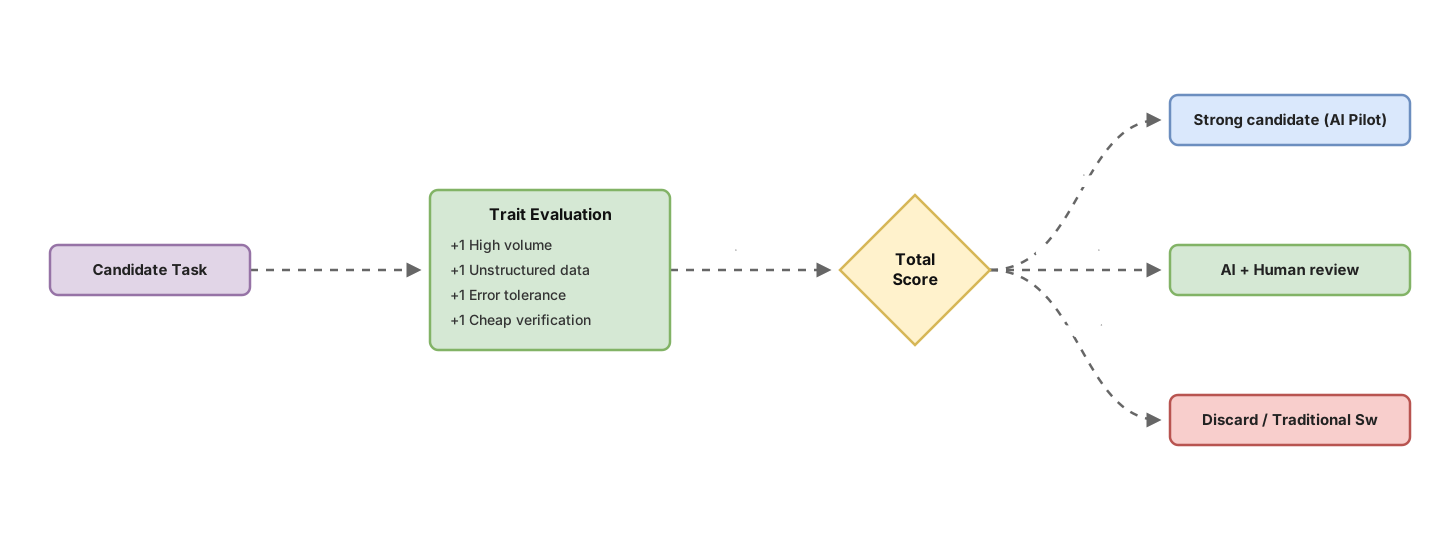
Take a concrete task from your company and give it a point for each trait it genuinely meets, not for each one you wish it met.
| Trait | Honest question | Point? |
|---|---|---|
| High volume | Is it done hundreds or thousands of times a month? | 0 / 1 |
| Unstructured | Does it work with text, emails, documents or images in free form? | 0 / 1 |
| Error tolerance | Is a stray slip fixed without serious consequences? | 0 / 1 |
| Cheap verification | Does checking the output cost quite a bit less than producing it? | 0 / 1 |
Add up the points:
- 4 points: strong candidate. Start with a small pilot and measure before scaling.
- 2 or 3 points: possible, but with conditions. It usually takes a person reviewing (a human in the loop) and a verification method designed on purpose. The maths has to be redone with that cost included.
- 0 or 1 point: do not force it. Either find another task with a better profile, or solve this one with traditional software, which for fixed rules is the better tool.
With this criterion you can review your list of ideas and rank it by profile in an afternoon. If you want to see the full map of where AI fits in a company and which families of tasks tend to score high, that guide gives you the overview. And once you have a clear candidate, the next step is how to automate a repetitive task with AI without setting up a giant project.
Traps when scoring
The system is simple, and that is why it is easy to cheat at solitaire. Four traps come up again and again.
The first is scoring by wishful thinking. You want the task to come out high, so you gift it the “error tolerance” point when in reality a slip there hurts. Be tough on your own answers.
The second is forgetting the cost of verification. It is the invisible trait. The demo worked, the result looked good, and nobody asked how much it will cost to check each answer when there are thousands a month instead of three in a meeting.
The third is confusing an impressive demo with reliability at scale. That the AI gets five hand-picked examples right says almost nothing about how it behaves with ten thousand real, messy, odd cases. The pilot exists precisely to measure that.
The fourth is choosing the most visible task instead of the one with the best profile. The task that impresses the committee is rarely the one that scores highest. Start with the boring one that scores a 4, not the flashy one that scores a 2.
That criterion (looking at the profile before the shine) is exactly what we work through calmly and with real examples in the AI without hype course, designed for people who make decisions without being technical.
Frequently asked questions
Does a task with 2 out of 4 never work? It does work, but with caveats. A 2 or a 3 means AI can help if you add a person to review and you design how to verify the outputs. What you cannot do is let it run alone and expect the same saving as on a task that scores 4.
Does this apply to generative AI and to classic automation too? The profile is meant for the AI that works with language and unstructured data. If your task scores low on the “unstructured” trait, what you have is probably not generative AI but plain old automation: cheaper, more predictable and with fewer surprises.
Where do I start if no task reaches 4? Lower the bar to the highest-scoring one and look at which trait it lacks. If it lacks volume, maybe you can group several similar tasks together. If it lacks cheap verification, think about whether there is a simple way to check the output that you had not considered. Sometimes a task that scores 3 turns into one that scores 4 with a small redesign.
Does the profile change with the size of the company? The four traits are the same for a small business and for a multinational. What changes is the volume threshold: what is “little” for a large company can be a lot for a small one. Score with your own numbers, not with those from a case at a different scale.
Related articles
AI Use Cases in Business: Which Ones to Prioritize
A framework for knowing which of your tasks are a good fit for AI and which ones are money down the drain: AI use cases in business, no hype.

What Generative AI Does Well and What It Does Badly
A no-hype guide to deciding which tasks in your business to hand generative AI and which to distrust. Where it shines, where it fails, and how to classify each job.
Automating repetitive tasks with AI: what actually works
Which repetitive tasks AI automates well in a company, which ones are better left to people, and how to pick your first one without taking on risk.