
LLMs Don't Understand Anything. And Yet They Work.
An LLM predicts the next most probable token. It doesn't understand. So how does it produce outputs that seem to require real comprehension?
Contributors: Carlos Hernandez Prieto, Ivan Garcia Villar

Something that doesn’t understand the meaning of any word it produces writes correct legal analyses, solves code that many developers wouldn’t solve, and explains scientific concepts with surprising precision. If that doesn’t make you slightly dizzy, you haven’t thought about it hard enough.
There’s no clean answer to this contradiction. But the mental framework does matter: it shapes every decision about when to trust the model’s output and when you need to verify.
What an LLM actually does
A Large Language Model is, at its core, a system trained to predict what the next most probable token is given a prior sequence of tokens. That’s it. No internal representation of the world, no semantic understanding, no intention.
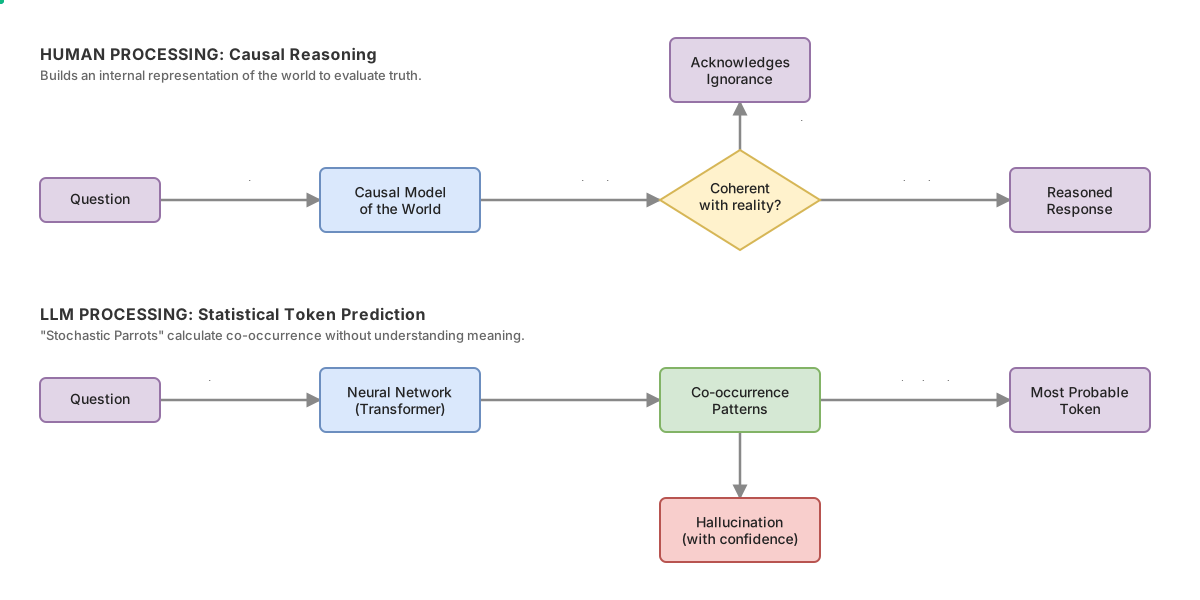
During training, the model processes massive amounts of human text and learns which words, phrases, and ideas tend to appear together. It doesn’t learn concepts. It learns statistical co-occurrence patterns in language, and the difference between the two is fundamental.
When a human learns that fire burns, they form a causal representation: they understand that heat transfers energy to tissue and damages it. If someone asks “what happens if you put your hand in a 300°C oven with an oven mitt?”, they can reason about the situation even though they’ve never lived it. They have a model of the world.
An LLM “knows” fire burns because it’s seen that association thousands of times in text. It predicts the correct continuation with high probability. But if the question breaks the pattern in a way the model hasn’t seen during training, the mechanism starts to fail.
Consider a more concrete example: ask an LLM to count how many words are in a specific sentence you just gave it. It can get it wrong, even with short sentences. Not because it’s arithmetically incapable, but because counting elements requires operating on the actual representation of the data, not predicting what text statistically follows. A human who has counted has the result. The LLM predicts what number seems most likely in that context.
The difference becomes clear in this breakdown:
| Aspect | Human Understanding | Statistical Prediction (LLM) |
|---|---|---|
| Model of the world | Causal representation, updatable | Doesn’t exist as internal structure |
| Type of error | Predictable from mental model | Hard to anticipate without execution |
| Generalization | Reasons about new situations using the model | Extrapolates text patterns from training |
| Uncertainty | Detects when it doesn’t know something | Produces confident text regardless |
| Coherence | Maintains stable beliefs over time | Each response depends on current context |
The debate with no winner (yet)
This is where it gets academically complicated. There are serious researchers on both sides, and they’ve been unable to resolve it for years.
One faction argues that scale produces something qualitatively different from mere statistics. That when you train a model on enough text, genuinely reasoning capabilities emerge, not just pattern retrieval. That modern LLMs show generalization that can’t be explained by memorization.
The other position has a name that’s become the most provocative term in the debate: stochastic parrots [1]. Emily Bender, Timnit Gebru, and collaborators coined it in 2021 for the FAccT conference. The core idea: LLMs are stochastic parrots, sophisticated sequence-completion machines that generate statistically plausible text without genuine understanding of meaning. A parrot can say “want a cracker?” without understanding what a cracker is, who you are, or what wanting something means. Scale doesn’t change that qualitatively. It just makes the illusion more convincing.
Science hasn’t declared a winner. Researchers actively continue debating what “understanding” means and whether LLMs exhibit any form of it. The honest thing is to acknowledge that instead of pretending there’s consensus.
The failures that reveal it
Where the abstract debate becomes concrete is in the types of errors LLMs make. These are errors a human with genuine understanding wouldn’t make systematically.
Arithmetic in non-standard contexts. An LLM can solve linear algebra equations fluently. But if you formulate a simple math problem in a way it hasn’t seen in training, it can fail. Not because the math changes, but because the model operates on text patterns, not on numbers as mathematical objects with real properties.
Hallucinations with complete confidence. This is the most revealing. An LLM can cite you a bibliographic source with perfectly formatted title, author, year, and DOI that simply doesn’t exist. It doesn’t do this as deliberate strategy. It does it because it’s optimized to produce the most plausible text continuation, and in the context of “give me an academic reference about X”, producing a well-formatted title is statistically plausible. There’s no mechanism of “am I sure about this?” because that mechanism would require something it doesn’t have: a representation of the world to compare against. The confidence of the generated text doesn’t reflect the system’s actual confidence.
Inconsistencies in the same conversation. Ask an LLM if a statement is true at the start of a session. Several messages later, phrase the same question differently. You can get contradictory answers. A human with understanding maintains their beliefs coherently because they have a mental model that persists. The LLM generates each response based on the context available in that moment, without a stable state of “beliefs”.
State tracking. Ask an LLM to trace a variable’s value through five nested transformations in code, step by step. In many cases it arrives at the correct result because it’s seen similar patterns in training. But if the code breaks the expected pattern in a non-standard way, it can lose the thread. Not because reasoning is abstractly difficult, but because maintaining state across steps requires an internal representation that the model doesn’t have: it only has the text context available in that moment.
These four types of failures have the same origin: no model of the world. Just prediction of plausible text.
Why it works anyway
The uncomfortable question: given all the above, why do LLMs work so well on so many tasks?
The most honest answer is that many tasks we believed required deep understanding turn out to work well with sophisticated pattern recognition. Writing a professional email, summarizing a document, explaining a concept, translating text: all have structure that, at sufficient scale, can be approximated statistically with useful results.
That doesn’t mean LLMs understand. It means our intuitions about what requires understanding were, in some cases, wrong.
And that opens something even more uncomfortable: if something that doesn’t understand can produce the same outputs as something that does, in certain contexts, what really distinguishes one from the other? Philosophers have had versions of this question for decades. LLMs have made it urgent.
What changes in practice
The concrete risk isn’t using LLMs. The risk is miscalibrating your confidence.
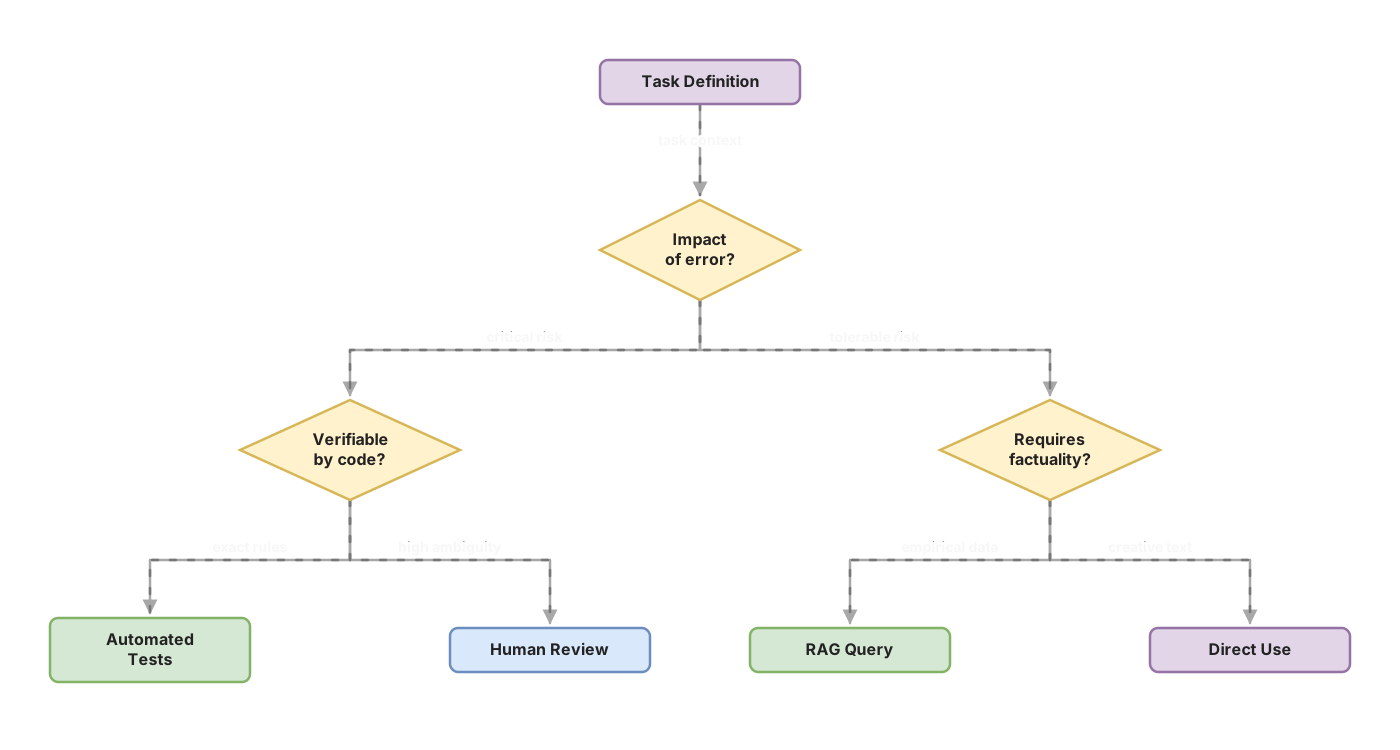
Using words like “understands”, “knows” or “reasons” to describe what an LLM does creates expectations the model can’t consistently meet. If you believe the model “understands” your code, you’ll use its output without verifying in contexts where that matters. If you believe it “knows” whether a source exists, you won’t verify it.
The model temperature directly affects this problem: higher temperature produces more creative text but also more prone to drifting from the statistically safest prediction, amplifying failures. Lower temperature doesn’t solve the lack of understanding, it just makes it more predictable.
In practice, the criterion I end up applying has nothing to do with how convincing the output sounds. It has to do with task type. For generation of structured text with known format, the LLM is reliable. For specific factual claims, bibliographic sources, or reasoning in domains with little representation in training, I verify before using. For decisions with real consequences, the human can’t be out of the loop.
Guardrails in AI agents exist precisely because predicting plausible text and taking correct action aren’t the same thing. An agent without guardrails can generate the action that “seems most probable” in its context, which isn’t necessarily what you need.
Calibration checklist
- For structured text outputs with known format: review the result, not the process
- For specific factual claims (dates, names, bibliographic sources): verify with an external source before using
- For code going to production: run the tests; don’t assume it works because it looks correct
- For reasoning in domains with little training context: question intermediate steps, not just the final result
- For decisions with real consequences: the human must review before executing
- Calibrate temperature based on task; higher temperature amplifies both creativity and failures
Sources
- On the Dangers of Stochastic Parrots: Can Language Models Be Too Big? — Bender et al., FAccT 2021. Origin of the term “stochastic parrot” and central argument about the absence of real semantic understanding in LLMs at scale.
Frequently Asked Questions
Do LLMs really reason?
It depends on what you mean by reasoning. If reasoning means following logical steps to reach a conclusion, LLMs do it approximately and often correctly. If reasoning means having a representation of the world to operate on, with guaranteed coherence and ability to detect when you don’t know something, the honest answer is no, at least not consistently. The academic debate remains open. What is clear is that the mechanism is functionally different from human reasoning, even though outputs are sometimes indistinguishable.
Why do they hallucinate with such confidence?
Because the generation mechanism doesn’t include a step of “am I sure about this?”. The model is trained to produce the most plausible text continuation. If the context asks for a bibliographic citation, producing a title and author with correct formatting is statistically plausible even though the source doesn’t exist. There’s no internal mechanism that compares the prediction against reality, because there’s no representation of reality to compare against. The confidence of the generated text doesn’t reflect the system’s actual level of certainty.
Are humans also statistical prediction machines?
Partially, yes. A significant amount of what we call intuition, pattern recognition, and social understanding works similarly: predicting what comes next based on prior experience. Neuroscientist Karl Friston has spent years arguing that the brain is fundamentally a predictive inference machine. It’s not a marginal idea.
The difference is in what surrounds that prediction. Humans have causal representations of the world, episodic memory that persists and updates, a body that generates direct experiences, and mechanisms to detect when something doesn’t fit what we know. An LLM has the predictive capacity without the rest. That’s why it can be right on patterns it knows and fail unpredictably when the pattern breaks.
But what makes this question uncomfortable isn’t the technical answer. It’s what it implies: if the distinction between “predicting sophisticatedly” and “genuinely understanding” isn’t as clear in humans as we assume, what are we really measuring when we say something understands? Philosophers have spent decades with that question. LLMs have made it urgent.
What practical difference does all this make for using an LLM every day?
Calibrate verification based on task type, not on how convincing the output sounds. The checklist above is the operational criterion: apply it.
Related articles

Temperature in LLMs: What It Is and What Value to Use for Your Case
What temperature is in language models, how it affects responses, and how to choose the right value for your task. Examples with the same prompt.

Prompt Engineering for Developers: 5 Patterns With Code
The 5 prompt engineering patterns: zero-shot, few-shot, CoT, role prompting, and structured output with real TypeScript code.

Guardrails for AI Agents: How to Implement Them (With Code)
Implement guardrails in your AI agent step by step: input/output validation, action limits, and loop control. Real, copy-ready code examples.