
AI vs RPA: when to use classic automation or generative AI
Generative AI vs classic automation (RPA) explained for decision-makers: what each one does, when to pick one over the other, and when to combine them without wasting money.
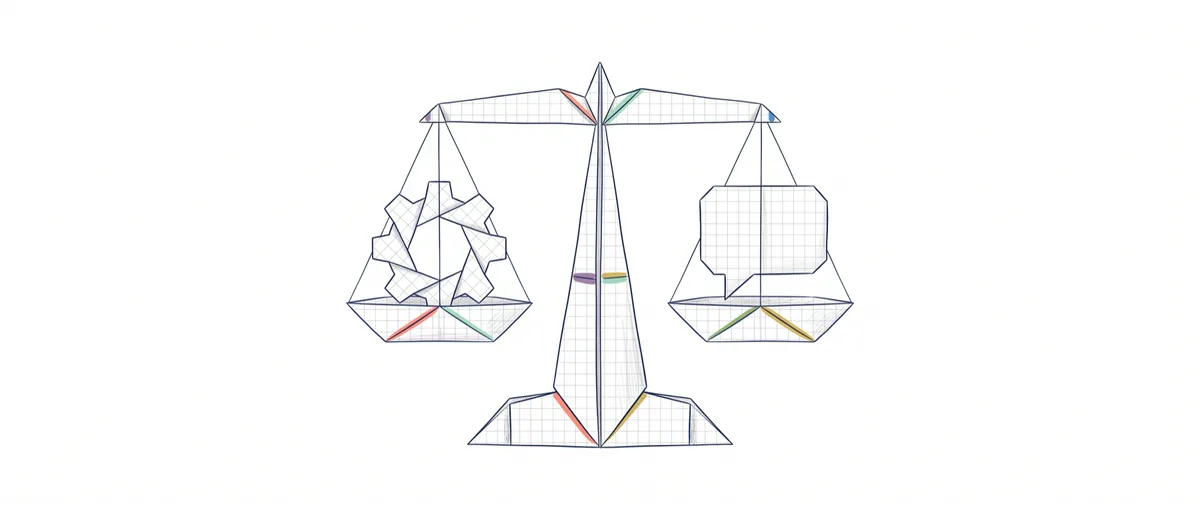
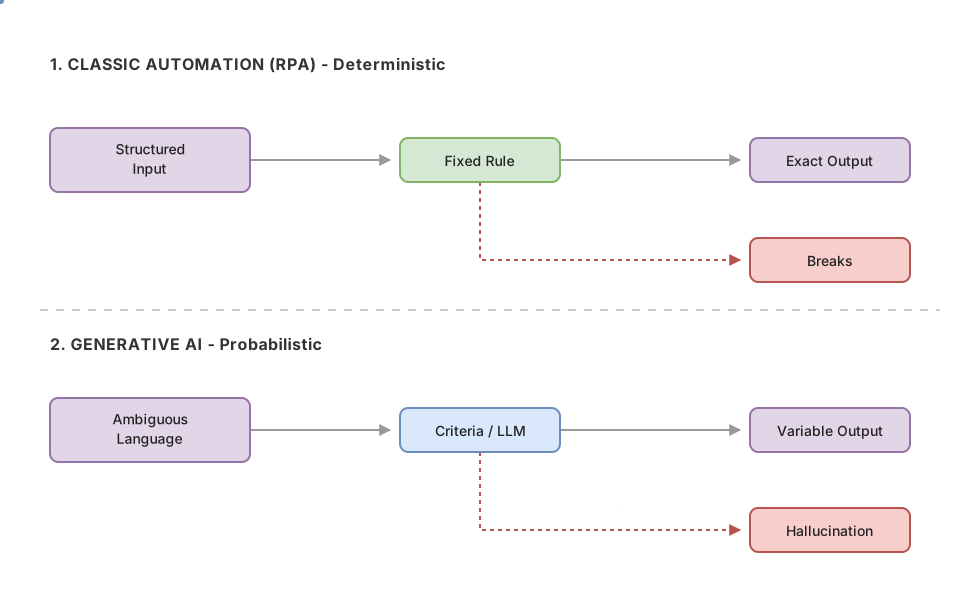
If someone sells you “AI” and “automation” as if they were the same thing, be suspicious. Classic automation, what the industry calls RPA, follows fixed rules written by a person and always gives the same exact result, but it breaks the moment something unforeseen shows up. Generative AI understands language and ambiguous situations, but it does not guarantee the same result twice. They do not compete for the same work. They solve different problems, and mixing them up is the fastest way to burn money on a project that does not work.
Here is the criteria to avoid choosing wrong, told without jargon and without guru promises.
What is classic automation (RPA) and why is it so reliable?
Classic automation is a software robot that repeats exactly the steps you taught it. RPA stands for Robotic Process Automation, and it describes programs that mimic what an employee would do clicking through screens: open an email, copy an invoice number, paste it into the ERP, hit save. Nothing more, nothing less.
The key word here is deterministic. A deterministic process, given the same input, always produces the same output. If you feed it the same invoice twice, it does exactly the same thing twice. It does not improvise, it does not have a bad day, it does not interpret. That total predictability is its greatest virtue. You can audit every step, you know why it did what it did, and if something goes wrong, the fault is in the rule, not in the program’s mood.
It has a clear Achilles heel: it is fragile. The rule works as long as the world behaves the way you expected. The day the supplier changes the invoice format, or moves the amount to another box, the robot does not “notice”. It keeps copying from where you told it, now it copies garbage, and it does so with the same blind obedience it used to do it right. Classic automation does not forgive the unexpected.
What is generative AI and why is it not exact?
Generative AI is a type of program that generates text, images, or answers from what you ask it in plain language. Under the hood it runs on an LLM, a language model trained on huge amounts of text that has learned to predict which word fits after another. When you ask it to summarize an email from an angry customer or to classify a complaint, it does not follow a rule someone wrote. It estimates the most likely answer based on everything it has seen before.
There is the uncomfortable difference: it is probabilistic. Given the same question, on two different days, it can give you two slightly different answers. It almost always gets right what it is good at, but “almost always” is not “always”, and that distinction changes everything when there is money or customers involved.
The specific risk has a name: hallucination. A hallucination is when generative AI states something with total confidence and it turns out to be false. It does not lie on purpose, it has no intent. It has simply calculated that the answer sounded plausible and has no internal mechanism telling it “you don’t actually know this, better keep quiet”. For a decision-maker, the practical lesson is simple: generative AI is brilliant at interpreting, and dangerous when you let it execute something that demands exactness on its own.
The difference that really matters: rule versus judgment
Everything above boils down to a single distinction. Classic automation applies rules. Generative AI applies judgment. A rule is “if the amount is over 5,000, send the email to the finance director”. Judgment is “read this complaint and decide whether the customer is asking for a refund or just venting”. The rule you can write out in full ahead of time. Judgment requires understanding context, and that is where language turns ambiguous and fixed rules fall short.
This is the table worth having in front of you before you sign off on any project:
| Axis | Classic automation (RPA) | Generative AI |
|---|---|---|
| How it decides | Follows fixed rules a person wrote | Estimates the most likely answer from what it learned |
| Repeatability | Identical every time, exact and auditable | Variable, can change between runs |
| What input it tolerates | Structured and predictable (forms, fields) | Natural language, free text, varied cases |
| Faced with the unexpected | Breaks or does something wrong without warning | Improvises an answer, sometimes right, sometimes hallucinated |
| Auditing why it did something | Direct: you read the rule | Hard: there is no rule to read |
| Where it shines | High volume, stable task, zero margin for error | Interpreting, classifying, drafting, summarizing |
When should you choose classic automation?
Choose RPA when the process is stable, the input arrives orderly, and there is no room for error. Payroll, invoice reconciliation, registering an order with all its fields filled in, moving data from one system to another. These are boring, repetitive tasks with a single correct answer. Exactly where an exact, auditable calculation is worth gold and where an “almost correct” answer would be a serious problem.
There is a question that settles the decision: could you write down on a sheet of paper, step by step, all the rules an employee follows to do this task? If the answer is yes, you do not need AI. You need classic automation, which will also be cheaper to run and far easier to audit.
When should you choose generative AI?
Choose generative AI when the input is human language, arrives messy, and the task is about “reading and deciding”. Classifying the emails coming into customer support, summarizing long contracts, drafting a first reply, extracting the key data from a scanned document that never has the same format. All of that is done by a human using judgment, not following a closed list of rules. And it is exactly the ground where classic automation crashes.
The nuance whoever wants to sell it to you will not mention: generative AI is fantastic for proposing and dangerous for deciding on its own anything irreversible. Let it draft the reply, sure. Let it send it without anyone looking, that depends heavily on what happens if it gets it wrong. This criteria, where to put a human to supervise and where not to, is exactly what we work on with real cases in the AI without hype course, because it is where most projects win or lose their result.
When should you combine them? The pattern that actually works
In practice, the best enterprise automations do not choose between one and the other. They use each for what it is good at and chain them: generative AI interprets the ambiguous part and proposes, while deterministic rules execute and validate what is critical. AI proposes, the rules dispose.
Think about the complaints coming in by email. Generative AI reads each message, understands what it is about, and classifies it: “this is a refund request for a small amount”. Up to here, judgment. From here on, rules: if the amount is below a certain threshold and the customer meets the conditions, a deterministic rule approves the refund in an exact, auditable way. If it exceeds that threshold, another rule sends it to a person. The AI did what it knows how to do, understand language, and it did not touch a single euro. The decision involving money was made by a rule you can audit line by line.
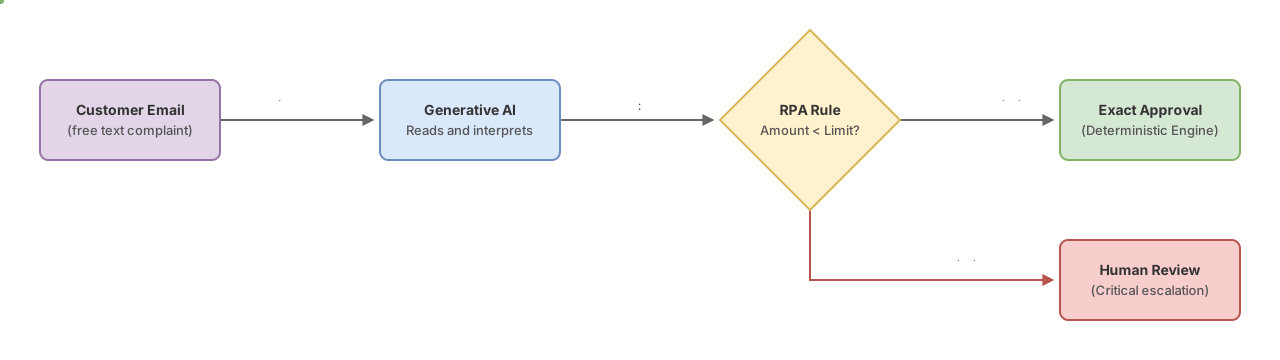
That is the healthy split. You let the AI absorb the chaos of real language, and you protect what matters behind fixed rules that do not hallucinate. Where to draw that line, and which processes are good candidates, is what I lay out in the guide to AI use cases in companies, which is the starting point for the rest of this block.
The expensive mistake: using the wrong tool
Almost every automation project that fails does so for the same underlying reason. They picked the tool by fashion, not by the problem.
Putting generative AI where a rule was enough
This is the mistake of the season. A billing calculation, which demands absolute exactness, is not handed to something probabilistic that could give you a different number tomorrow. If the task has a single correct answer and you can write it as a rule, putting generative AI on it is paying more for a less reliable result. The distinction between AI and the rule-based software we have always had is something I break down in AI versus traditional software.
Automating with fixed rules a process that changes every week
The symmetric failure. If the process mutates constantly, tying it to deterministic rules condemns you to rewriting them without end. Every supplier change, every new exception, is another patch. There, generative AI’s flexibility to tolerate variation makes up for its lack of exactness.
Believing the AI “learns on its own” from your process
It does not. Generative AI does not plug into your company and improve on its own with daily use. It responds according to its prior training and according to what you give it in each request. Without someone supervising the outputs at the start and correcting course, there is no magic learning. There is a project with no owner.
Automating the chaos
This one deserves a single sentence and a full stop: automating a process nobody has defined does not give you an automatic process, it gives you fast chaos. Sort it out first, automate later. The criteria for deciding which processes to touch and in what order is in when to automate with AI and when not to.
Checklist before deciding
- I have written down the steps of the process on paper: if they fit as closed rules, it points to classic automation
- I have identified whether the input arrives structured (forms) or as free language (emails, documents)
- I know what happens if the system gets it wrong once, and whether that error is tolerable or unacceptable
- I have decided where I demand auditable exactness and where I accept an “almost always correct” answer with supervision
- If I combine both, the AI interprets and proposes, and the rules execute whatever touches money or customers
- The process is already defined and sorted out before trying to automate it
Frequently asked questions
Does generative AI replace RPA?
No. They solve different problems. Classic automation wins on stable, exact tasks, and generative AI wins when you have to interpret ambiguous language. In many companies the best architecture combines them, with the AI interpreting and the rules executing what is critical. Framing it as “one kills the other” means not having understood what each one is for.
Is RPA or generative AI cheaper?
It depends on the process, and be suspicious of anyone who gives you a closed figure without knowing your case. As a rough guide: classic automation tends to be cheaper to run on repetitive, stable tasks because, once the rule is written, it costs little to execute. Generative AI adds value where a rule would not reach, and that value can justify its cost. The expensive mistake is not choosing the cheaper option, it is choosing the one that does not solve your problem.
Can I trust generative AI for critical tasks?
For interpreting and proposing, yes. For deciding on its own anything irreversible or that demands exactness, not without a safety net. The sensible setup is for generative AI to prepare the work and for a deterministic rule or a person to validate before executing what is critical. That way you take advantage of its judgment without exposing yourself to a hallucination at the worst moment.
What should I automate first?
Start with a boring, repetitive, well-defined process with clear rules. It is usually a candidate for classic automation and gives you a quick, low-risk win. Leave the processes that depend on interpreting language for when you have more mileage, because they need supervision and judgment so they do not fail where it matters.
Do I need a technical team for either of them?
To set them up well, yes, you need someone with technical judgment, though it does not have to be a huge headcount. What really makes the difference is that whoever decides understands which tool fits each problem, more than the number of people you have. That ability to decide with judgment is exactly what separates a project that saves money from one that burns it.
Related articles
AI Use Cases in Business: Which Ones to Prioritize
A framework for knowing which of your tasks are a good fit for AI and which ones are money down the drain: AI use cases in business, no hype.

AI vs traditional software: when you need each one
Do you solve your problem with AI or with a plain old program? A decision table, no hype, to choose by the type of task and not by the trend.

When to Automate with AI (and When Not To)
When it pays to automate with AI and when it does not: three business filters to decide without hype, on cost and risk.