
Agentic AI vs Generative AI: The Real Difference
Generative AI produces content from a prompt. Agentic AI adds a loop with memory and tools to complete multi-step tasks.
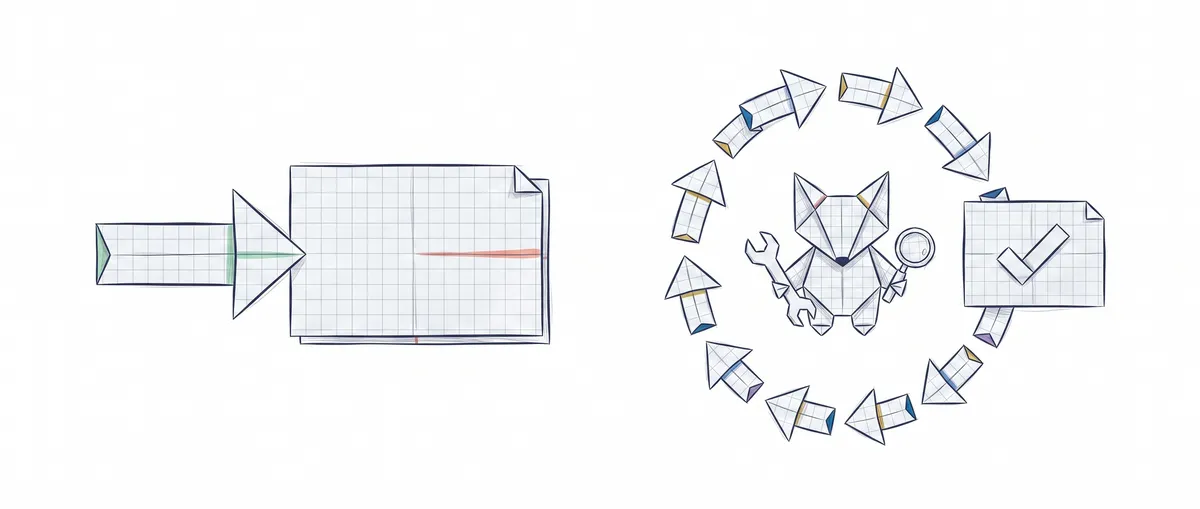
Generative AI is the technology: a model that predicts and generates content, whether a paragraph, an image, or a snippet of code, from a prompt. Agentic AI is the approach that wraps that model in a decision loop with memory and tools, capable of completing a multi-step goal without you stepping in at every turn.
Put that way, it sounds like two separate boxes. They aren’t. And mixing up that relationship is exactly why people use the two terms as if they were synonyms, or as if they were competing with each other.
At a glance: how they differ
| Generative AI | Agentic AI | |
|---|---|---|
| What it is | A capability: a model that predicts and generates content from an input | An approach: a system that wraps one or more generative models in a decision loop |
| What it produces | One output per input: text, image, audio, code | Actions with real effects: a file modified, an order processed, a goal completed |
| How many times it decides | Once, whatever it takes to generate that output | As many as it takes, repeating until the goal is met or a limit runs out |
| Memory | Only the context of that one call | Task memory: it keeps track of what it’s tried and the result of each step |
| Tools | None, unless the product bolts them on separately | This is what defines it: searching, running code, calling an API, reading a file |
| Example | Asking a generator for an image, or having a model summarize a text | Asking an agent to fix a bug: it reads the repo, edits, runs the tests, and repeats if it fails |
Look at the tools row. It carries the most weight of all.
When to use each
If the task is a one-off generation, where no step depends on the one before it, a direct generative model solves the problem. Asking for a piece of text, an image, or having it complete a code snippet doesn’t need any loop around it. Adding one there only adds latency and cost without gaining anything.
If the task has multiple steps where the result of one determines the next, an agentic system brings something a single call can’t: it iterates on its own, without you having to relaunch the request every time the result doesn’t hold up. Looking up a fact, checking it against another source, and only then drafting the final answer is already a chain that a pure generative model can’t complete on its own.
Why they aren’t rival camps
Every agentic system has a generative model underneath deciding what to do on each turn of the loop. Without that model, there’s nothing choosing the next step. What changes isn’t the model — it’s the wrapper you add around it. It needs something to act with, a record of what it’s already tried, and a clear signal that it’s done. I walk through that wrapper step by step in how an AI agent works: the loop explained step by step, and the pieces that complete the agent itself (what counts as a tool, how it decides when to stop) are covered in what is an AI agent.
And the reverse is true too: not every use of a generative model is agentic. The autocomplete suggestion your coding assistant gives you as you type is pure generation. It doesn’t verify anything, doesn’t keep memory of whether it got it right last time, doesn’t retry if the line it proposed breaks something. It generates and stops. If you want to understand that other half first, how a generative model works under the hood without the loop on top, that’s the topic of what is generative AI.
Common mistakes with these two terms
Calling any product with a chat interface “agentic”
If a product only responds to what you type, no matter how polished the interface, it’s still pure generative. What makes something agentic is whether it decides anything between one call to the model and the next, not how it looks or what it’s branded as.
Assuming agentic means “more advanced” and therefore always better
An agentic system multiplies the token cost on every turn of the loop and adds points where something can go wrong without you noticing right away. For a single-step task, it’s a worse tool than a direct call, not a better one.
Before you build an agentic system
- The task has more than one step and those steps depend on each other
- You can verify the result of each step, not just the final one
- You know which tools the system needs to touch and what happens if it gets them wrong
- You have a clear stopping condition, not just a retry limit “just in case”
When someone tells you they’ve built “an agent” because they wired a prompt to an API, the question that matters is whether that system decides anything between one call and the next, or whether it just generates once and stops there, not which model is inside it. If all four boxes above check out, that’s where it starts to make sense to design a real one, with the patterns I use in the course AI Agent Design Patterns.
Frequently Asked Questions
What’s the difference between agentic AI and generative AI?
Generative AI is the technology that predicts and generates content from an input: a text, an image, or code. Agentic AI is an approach built on top of that technology that adds a decision loop, task memory, and tools to complete a multi-step goal without you stepping in at every turn.
What is agentic AI?
It’s a way of building systems where a generative model doesn’t just respond once, but decides, acts using some tool, observes what happened, and repeats until it meets a goal or runs out of a safety limit. The name describes the approach, not a specific product or model.
Are “agentic AI” and “generative AI” the same thing?
These are the English terms for the same distinction made in Spanish: generative AI is the capability to generate content, agentic AI is the system that wraps that capability in a decision loop with tools. They’re not synonyms, and they’re not rival categories.
Does an AI agent use generative AI under the hood?
Yes, always. The generative model is the piece that decides what step to take next on every turn of the agent’s loop. Without it, there’d be nothing choosing anything.
Does agentic AI replace generative AI?
No, and it couldn’t. An agentic system depends on a generative model at every iteration of its loop. What’s changed is that generation became reliable enough to serve as a repeated decision engine, not that one thing replaced the other.
Related articles

How an AI Agent Works: The Loop Explained Step by Step
An AI agent doesn't respond in one shot: it works in a loop that repeats until the task is done. Here's how that loop works, jargon-free and step by step.

Why AI Agrees with You: Probability, Not Correctness
Why AI agrees with you even when you're wrong: how it predicts the next token, why your question changes the answer, and how to ask better.

What Generative AI Is (and What It Isn't)
What generative AI is in plain business terms: how it differs from the automation you already have, what it can NOT do, and what it's actually good for.