
Claude vs ChatGPT for Coding: The Differences That Matter
Claude and ChatGPT don't solve the same problem when you code: one is built for autonomous agentic development, the other covers more ground outside of code. Which to use and when.
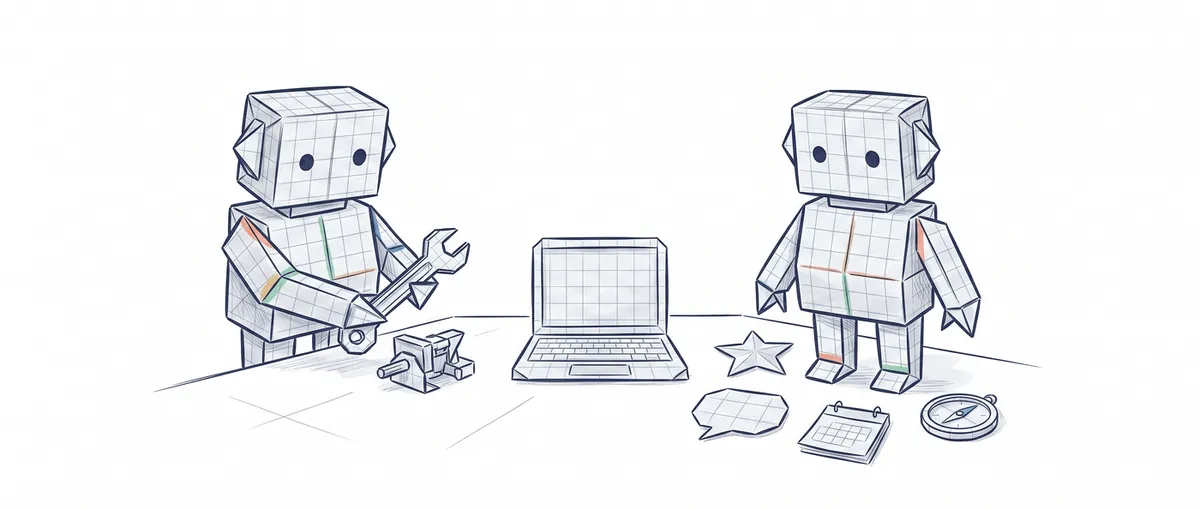
Claude and ChatGPT aren’t competing for the same job when you code. Claude, through Claude Code, is built for agentic development: you describe a goal and the agent plans, writes, and executes changes across your whole project, checking in with you at the points that matter. ChatGPT, with Codex, has its own agent mode for longer coding tasks, and it’s still also a general-purpose conversational assistant with a wider ecosystem outside of code. The right question isn’t “which one is better” — it’s “what do I need to get done today.”
Claude vs ChatGPT for coding, at a glance
| Claude (Claude Code) | ChatGPT (Codex + chat) | |
|---|---|---|
| Strength | Agentic development: whole projects, big refactors that touch several files | General-purpose conversation with its own agent mode (Codex) for longer coding tasks |
| How it works | Plans and executes changes across several files without you copy-pasting each step | Turn-by-turn conversation; Codex adds an agent mode for longer tasks within the same ecosystem |
| External tools | First-party MCP support built into Claude Code | Also supports MCP (developer mode, connectors), with a somewhat more recent integration |
| Extras beyond code | — | Generates images and offers Custom GPTs for specific tasks |
| Best fit | Big changes to a real repository, tasks that need several autonomous steps | One-off questions, quick prototypes, tasks that mix code with other formats |
When should you use Claude?
When the work is a real change to a project that already exists: a full feature, a refactor that touches several files, a migration. That’s where you feel the difference between “a model that suggests you a line” and “an agent that executes the whole change while you review the points that matter.” If you also need the agent to use external tools (an internal API, a database, a ticketing system), Claude Code ships with MCP support out of the box. What is Claude Code, with examples walks through the full mental model if you’re coming from chat-only use.
When should you use ChatGPT?
When what you need is an answer inside a conversation: explaining a specific error, generating a standalone function, iterating on an idea before deciding whether it’s worth building. Codex also covers longer coding tasks with its own agent mode, without leaving the ChatGPT ecosystem. And when the work goes beyond code: generating an image for documentation, or using one of the Custom GPTs your team already has set up for a specific task.
The most common mistake: judging both by the same yardstick
Comparing Claude and ChatGPT as if they were interchangeable leads to the wrong conclusion in both directions. Cramming a big agentic refactor into a plain conversation without using the dedicated mode feels slow, because that’s not what the turn-by-turn flow is optimized for — in either tool. And opening a full autonomous agent for “hey, give me a quick idea for this text” is more ceremony than a thirty-second question needs. The useful comparison isn’t “which one is smarter,” it’s “which one is built for the kind of task in front of me.”
Checklist for deciding
- Identify whether the task is an agentic change to a real project or a one-off question inside a chat
- If the agent needs to touch several files or run commands, prioritize an agentic tool like Claude Code or Codex’s agent mode
- If you need image generation or an already-configured Custom GPT, that’s currently only in ChatGPT
- If the work needs to connect external tools, check the state of MCP support in the tool you’re using before choosing
- Don’t decide out of habit: revisit this list whenever the nature of the task changes
Frequently Asked Questions
Can I use Claude and ChatGPT in the same workflow?
Yes, and it’s common. Many developers use Claude Code for agentic work inside the repository and ChatGPT for one-off questions, generating supporting images, or iterating on an idea before touching code. They aren’t mutually exclusive.
Which one is better for a developer just starting with AI?
It depends on the first problem you want to solve. If you want to learn to direct an agent that executes real changes on a project, Claude Code gives you that mental model from day one. If you’d rather start with a normal conversation and move to an agent mode when the task calls for it, Codex inside ChatGPT follows that same progression.
How autonomous is Codex compared to Claude Code?
As of today, many developers notice Claude Code can run longer stretches of work without asking for intervention, but both are evolving fast on this exact point — the best way to compare is to try the same real task on both tools and see where you have to step in more.
Do ChatGPT and Claude both support MCP?
Both do. MCP is an open protocol that Claude Code ships with built in, and that ChatGPT also supports through its developer mode and connectors. The practical difference today is more about how deep the integration goes in each tool than whether support exists at all.
Does switching tools mean losing my project context?
Not if you structure the project well: a good CLAUDE.md or a clear README for your team lets any assistant, whichever one you use, understand your repository’s conventions without you re-explaining them every time.
If the work in front of you is an agentic change to a real project, the natural next step is learning to direct it well: the course Design Patterns for AI Agents teaches the patterns that keep an agent from losing its way on big tasks.
Related articles
What Is Claude Code? Definition, Uses, and Examples
Claude Code is Anthropic's agent that reads your repository, edits files, and runs commands. What it is, what it's for, and how it differs from Copilot.

Traditional Chatbot vs LLM: The Differences That Actually Matter
How a chatbot with intent classification works, how one based on an LLM works, and when to choose each approach with concrete examples.

What Is an LLM, Explained Without Jargon
An LLM doesn't look up the truth: it predicts the next most plausible word. That mental model is enough to decide with good judgment where to use it in your company and where not to.