
Agentic Patterns: What They Are and the Ones to Know
Agentic patterns are reusable solutions for problems that keep coming up when you build AI agents. What they are and the 5 you'll use most.
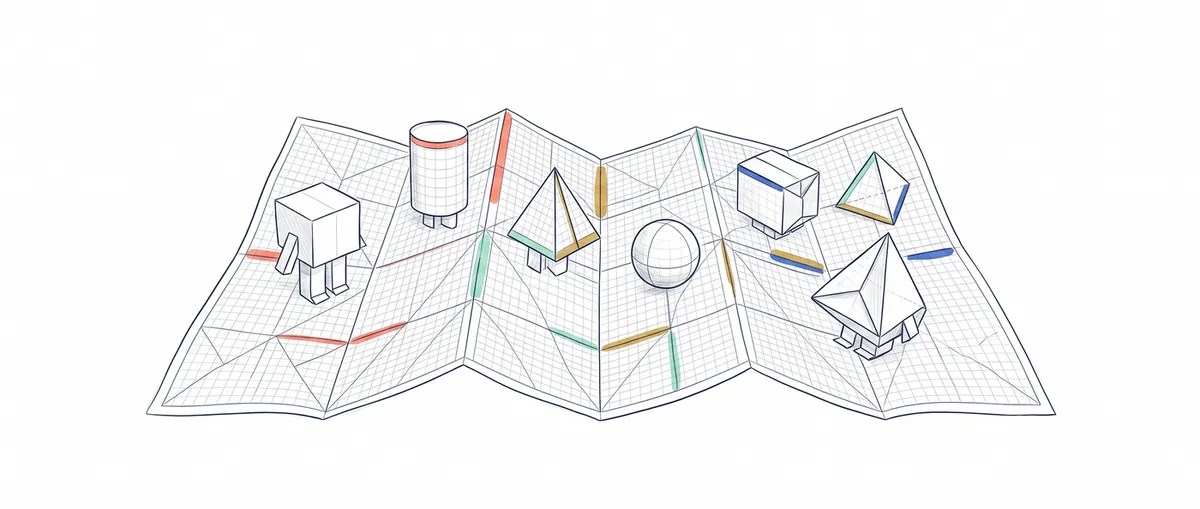
An agentic pattern is a proven solution to a problem that keeps showing up when you build AI agents: how to split a complex task, how to pick the right specialist for it, how to check that the result is actually good. These aren’t one-off prompt tricks — they’re pieces you combine. If you’ve programmed with classic design patterns (Factory, Observer, Command), this will feel familiar: it’s the same “don’t reinvent the wheel” instinct, applied to systems where the agent decides what to do at each step.
What problem do agentic patterns solve?
A loose agent that gets a goal and “does its best” fails in predictable ways: it loses the thread on long tasks, mixes planning with execution, or has no way to check whether its own output is actually correct. Agentic patterns exist because those failure modes have already shown up many times, and each one has a known fix.
The key to understanding them is that they don’t describe what the agent does — that’s your domain: writing code, answering tickets, analyzing data. They describe how the work gets organized between one or several agents so that “what it does” turns out well. It’s the same split that used to separate business logic from the architecture holding it up.
The most common agentic patterns
This table summarizes the ones you’ll run into in almost any real agentic system, with the specific problem each one solves:
| Pattern | Problem it solves | When to use it |
|---|---|---|
| Prompt chaining | A task is too complex for a single step | The task has clear phases and each one depends on the previous result |
| Routing (router) | Not every request needs the same treatment | There are several kinds of input and each one needs a different specialist |
| Parallelization | Several subtasks are independent of each other | You can split the work without one part depending on another |
| Reflection | The agent can make mistakes it would catch if it reviewed its own work | The task allows for a second, self-critical pass before delivering |
| Guardrails | Too much freedom can let an agent do something unwanted | The agent has access to actions with real consequences (files, money, production) |
Each pattern, in detail
Prompt chaining: divide and conquer
Instead of asking a model to solve everything in one call, you split the task into chained steps: the output of one feeds the next. It works because each individual step is easier to verify and correct than the whole task at once. You’ll find it explained with code in Prompt Chaining.
Routing: not every agent needs to be a generalist
A router classifies the incoming request and sends it to the right specialist, instead of one agent trying to handle everything. It’s the same principle as splitting microservices by responsibility: each specialist is simpler, cheaper to run, and easier to debug. The implementation details are in the Router pattern.
Parallelization: when subtasks don’t depend on each other
If you can split the work into independent pieces, running them in parallel cuts the total time, and the voting variant improves reliability by comparing several answers. Sectioning and voting, with code, in Parallelization in AI Agents.
Reflection: having the agent review its own work
Before delivering, the agent looks back at what it produced and asks whether it actually answers the goal. It’s not foolproof, but it catches a whole category of obvious mistakes that would otherwise reach the user. Self-reflection and cross-reflection explained in Reflection in AI Agents.
Guardrails: limiting what the agent can do
The more autonomy you give an agent, the more it matters to write down what it can NOT do without supervision. Guardrails are that explicit boundary — not a promise that the model “will behave.” How to implement them with code in Guardrails for AI Agents.
Agentic patterns or GoF patterns?
If you’ve been programming for a while, you already know the classic design patterns: Factory, Observer, Command, Mediator. The good news is you don’t throw them away — they transform. A Command becomes a tool call, a Mediator becomes the orchestrator that coordinates several agents. The full mapping, pattern by pattern and with code, is in GoF Patterns in AI Agents. This page you’re reading is the general map; that one is the line-by-line translation for anyone who already knows GoF.
How do I pick the right pattern?
There’s no “default” pattern. The question that actually helps you decide is: where’s the risk in this system? If the risk is that the task is too big for a single step, start with prompt chaining. If the risk is that a generalist agent won’t know everything, start with routing. If the risk is speed or reliability on independent subtasks, use parallelization. If the risk is the agent delivering half-finished work without noticing, add reflection. And if the risk is the agent doing something irreversible, use guardrails always, combined with any of the above.
Checklist before designing your agentic system
- You’ve identified the specific problem you need to solve, not just “I want an agent”
- You know whether the task splits into sequential steps or independent pieces
- You’ve decided whether you need one agent or several specialized ones
- You know which agent actions need guardrails before giving it real access
- You’ve built in a way for the system to review its own output before delivering
Frequently Asked Questions
Are agentic patterns the same as software design patterns?
Not exactly, but they come from the same idea. Classic design patterns organize how the code is structured; agentic patterns organize how an agent (or several) decides what to do step by step. Many classic patterns have a direct agentic equivalent, as you can see in the full GoF-to-agents mapping.
Do I need to use several patterns at once?
Almost always, yes. A real system usually combines routing (to pick the specialist) with guardrails (to limit what it can do) and, when the task allows it, parallelization or prompt chaining for the work itself. They aren’t mutually exclusive.
Where do I start if I’ve never built an agent?
With prompt chaining. It’s the easiest pattern to reason about: you split a task into steps, and each step is a model call you can test on its own. Once you’ve got the hang of it, adding routing or parallelization is a natural next step.
Isn’t a single generalist agent simpler than applying all these patterns?
At first it looks simpler, and for a small task it might be enough. The problem shows up as the task grows: a generalist agent trying to do everything becomes slow, unpredictable, and hard to debug because there’s no single point where you can isolate what went wrong.
Where can I practice this with guided exercises instead of just reading?
The course Design Patterns for AI Agents walks you through these patterns visually and interactively, with short exercises instead of just theory.
Related articles
GoF Patterns in AI Agents: The Complete Map
GoF patterns don't disappear in agentic systems—they transform. Command=tool call, Mediator=orchestrator, Adapter=MCP. The complete map with code.
Prompt Chaining: How to Break Down Complex Tasks Into Simple Steps
Learn how to divide difficult tasks into sequential LLM calls. With line-by-line commented TypeScript code and no external frameworks.
Guardrails for AI Agents: How to Implement Them (With Code)
Implement guardrails in your AI agent step by step: input/output validation, action limits, and loop control. Real, copy-ready code examples.