
The ROI of AI: How to Measure If It's Worth It
How to measure AI ROI without the hype: real total cost, a baseline before you start, and when it is NOT worth investing.

Every week someone tells you AI is going to save you a fortune. Almost no one explains how to check whether that is true in your company. The ROI of AI (the return on investment, what you earn or save minus what it actually costs you) is not measured by comparing a license invoice against a promise from the demo. It is measured by weighing the total cost of keeping it running against the real value it produces, and for that you need to measure your process before you touch anything. Most AI projects that “fail” never defined how they were going to know whether they worked.
This article does not give you a magic number. It gives you the method to calculate your own and to spot when someone is padding the bill.
What does the ROI of AI really mean?
ROI is a subtraction before it is a multiplication: the value the tool produces minus what it costs to keep it running. It sounds obvious, but almost all AI marketing breaks this subtraction on both sides. It inflates the value (using the best possible case, not the average) and hides the cost (showing you the license price and saying nothing about the rest).
An AI project is only worth it if that result is positive on a sustained basis, not in a one-afternoon test. And “positive” has to be defined by you before you start, with a concrete figure that matters to you: hours saved per month, orders processed without intervention, quotes sent the same day. If you cannot name that figure, you are not ready to approve the spend yet.
Before calculating anything, it helps to be clear on where AI fits into your operation. I go into that in where to apply AI in a company. Here we assume you already have a candidate process and want to know whether investing in it pays off.
The mistake of looking only at the license
The license invoice is the tip of the iceberg. It is the cost they show you because it is the lowest. Underneath there is a list of expenses that show up without fail and that decide whether the project pays off or not.
There is integration (connecting the AI with your current systems: your CRM, your email, your spreadsheet), data preparation (cleaning and organizing the information it will work with, which is almost never ready), team training (learning to use it well and to distrust it when needed), and maintenance (when your process changes, the tool has to be readjusted). And then there is the expense nobody puts in the proposal: the cost of living with its errors.
I break this down more slowly in how much it costs to implement AI. The idea that matters for ROI is simple: if you compare the value against the license, it will always look profitable. Compare it against the total cost and you will know the truth.
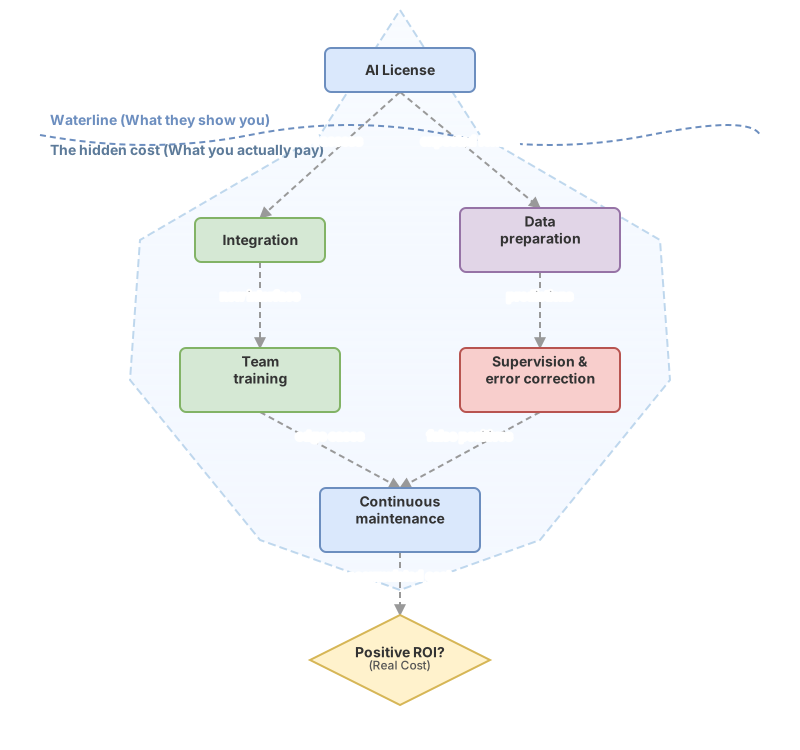
An example with purely illustrative figures, just to see the shape of the problem (these are not data from any real project):
| Item | Cost they show you | Real first-year cost |
|---|---|---|
| Tool license | €6,000 (illustrative) | €6,000 |
| Integration with your systems | not shown | variable, often the largest expense |
| Preparing and cleaning the data | not shown | depends on the state of your information |
| Team training | not shown | your people’s hours, not free |
| Supervision and correction | not shown | ongoing, does not disappear |
| Maintenance and readjustments | not shown | recurring every year |
I am not giving you a total because your total depends on your house. The message is that the left-hand column is what they sell you and the right-hand one is what you pay.
Define the baseline before you start
Without a baseline there is no ROI, there is opinion. The baseline is how much your process delivers today, without AI: how many hours your team spends on that task, how many errors it makes, how long an order takes to go out. If you do not measure it before installing anything, six months from now you will not be able to prove what changed, and you will end up deciding by gut feeling.
Measuring the baseline is boring work, and that is why almost no one does it. Take the process you want to improve and, over two or three weeks, write down what you already do: time per task, weekly volume, error rate, cost in your team’s hours. That field notebook is what later turns “it seems faster” into “we went from three hours to forty minutes per quote”. One is an anecdote. The other is a business decision.
This is where a small pilot is worth its weight in gold: it gives you a real measurement without committing the full budget. How to set up that pilot is something I cover in from idea to AI pilot.

Promised value versus real value
A demo does not prove ROI. The demo is designed to work: it uses a clean case, hand-picked data, and someone who knows exactly what to type. Your company does not run on clean cases. It runs on the customer who sends the order half-finished, the invoice with the name misspelled, and the exception only the person who has been there for fifteen years knows about.
Real value is the value that holds up under that daily wear for weeks. To separate it from the promise, measure on your actual work, not on the vendor’s example: put it into the real flow, let it run into your odd cases, and count how many times it gets it right on its own and how many it needs someone to rescue it. That number, not the one from the presentation, is what goes into your ROI subtraction.
Watch out for one specific trap: a system that is right almost always can look like a success and be a disaster if the part that fails is exactly the expensive cases, the ones that end in a complaint or a lost customer. The average hides where it hurts.
The cost of living with the system
AI does not eliminate work, it shifts it. Before, your team did the task. Now it reviews it, corrects what the tool gets wrong, and handles the cases it does not know how to manage. That supervision work is real, it is ongoing, and it almost never appears in the sales proposal.
An AI model (the engine that generates the answers from your data) sometimes makes things up with total confidence. That has a technical name, hallucination: when the system gives a false but convincing answer, like a price that does not exist or a condition nobody approved. It is not a rare glitch that gets fixed and disappears. It is a feature of how this technology works, and it means that in any process where an error is expensive you need a person reviewing. That reviewer is part of the cost, and it has to be added to the ROI for the entire life of the system, not just the first month.
The honest question is not “how much work does it eliminate?”. It is “how much new supervision work does it create, and does it still pay off for me after subtracting that?”.
Deciding this well is judgment, and judgment can be trained. It is exactly what we work through step by step in the AI without hype course: how to look at an AI proposal and know what to ask before you sign.
When is it NOT worth it?
Sometimes the right answer is not to invest, and recognizing that in time is as valuable as getting a good project right. There are four situations where ROI almost always comes out negative no matter how impressive the tool is.
When the volume is low: automating a task you do five times a month rarely offsets the cost of setting it up and maintaining it. When the process changes constantly: if you reorganize how you work every quarter, the tool falls out of date and maintenance eats the savings. When the cost of an error is too high: in sensitive medical, legal, or financial decisions, one convincing failure can cost more than everything you save the rest of the year. And when your data is a mess: AI learns from your information, and if it is incomplete or badly organized, it will multiply the mess instead of fixing it.
None of these four is solved with a better tool. They are solved by choosing a different process or by fixing the data first.
A simple method to decide
You do not need a consultancy to make this decision. You need to answer five questions honestly before approving the spend. If you are missing any answer, you are not ready to sign yet.
| Question | What you want | Warning sign |
|---|---|---|
| What metric do I want to move? | A concrete, measurable figure (hours, errors, response time) | “Being more efficient” with no number |
| What is my baseline today? | The current value of that metric, measured | Nobody has measured it |
| What result would count as success? | A threshold you set in advance | ”We’ll see if it improves” |
| What is the total cost, not the license? | Integration, data, training, supervision, maintenance | You only have the license price |
| What do I do if it does not work? | A spending limit and a date to decide | An open-ended “let’s give it more time” |
This method is slow on purpose. Haste is the ally of whoever is selling you smoke. An honest vendor has no problem with you measuring your baseline and setting a threshold, because they trust their product. The one who pressures you to sign before measuring is telling you something without meaning to.
Common mistakes when calculating the ROI of AI
Buying out of fear of falling behind
The argument “the competition already uses it” is not an ROI calculation, it is anxiety. Someone else investing does not mean it pays off for them, and it certainly says nothing about your process. The decision is made with your numbers, not with the noise of the industry.
Measuring with the demo instead of with your work
The demo uses the ideal case. If you approve the project based on how well the presentation went, you are buying the system’s best day and paying for the rest of the year.
Forgetting the cost of supervision
Counting the savings from the automated task and not subtracting the review hours is the mistake that most inflates an ROI on paper. The work of watching the tool is not optional, and it does not disappear over time.
Not setting a success threshold before you start
If you decide what “success” is after seeing the results, you will always find a way to call it a success. The threshold is set beforehand, when you do not yet have an ego invested in it going well.
Frequently asked questions
How long does it take to see the return on an AI investment?
It depends so much on the process that the honest answer is “I don’t know without seeing your case”, and be wary of anyone who gives you a fixed timeline without knowing it. What you can do is set a review date yourself before you start (three months, for example) and compare against your baseline. If by that date it is not getting close to the threshold you defined, you have data to stop instead of continuing out of inertia.
Do I need a technical expert to calculate the ROI of AI?
For the business calculation, no. The five questions of the method can be answered by any executive who knows their operation. It is worth getting an independent technical opinion to estimate the integration and maintenance cost, which is where the spend is most underestimated, but the decision about whether it is worth it is yours and is made with business judgment, not technical judgment.
And if the value of AI is qualitative and I cannot put a number on it?
Almost every qualitative value hides a measurable one if you chase it. “Better customer service” can be measured in response time or in complaints. “The team is less overloaded” can be measured in overtime or in turnover. If you genuinely cannot find any way to measure it even approximately, that is a sign you are not yet clear on what problem the investment solves.
Is the ROI of AI calculated differently from other software?
The method is the same as for any investment: value against total cost. The difference lies in two expenses that traditional software does not have so pronounced: data preparation and the permanent supervision required by the system’s errors. Normal software always does the same thing. An AI is right most of the time and fails now and then, and that “now and then” carries a monitoring cost that has to go into the account.
Related articles

AI Use Cases in Business: Which Ones to Prioritize
A framework for knowing which of your tasks are a good fit for AI and which ones are money down the drain: AI use cases in business, no hype.

How Much Does It Cost to Implement AI: Demo vs Production
How much it really costs to implement AI in your company. Why the demo is almost free and production costs far more, and which hidden line items eat the budget.

From idea to AI pilot: how to test it without betting the company
How to turn a use case into a bounded AI pilot: success metric set before you start, stopping criterion, limited scope and mitigations. No hype.