
An AI adoption plan for your company: the step-by-step roadmap
How to adopt AI in your company without burning through the budget: six ordered steps, from building judgment to scaling. A realistic roadmap, with no guru promises.

Almost every AI plan that fails does so for the same reason, and it is not the technology. It is the order. Someone decides “we have to do something with AI”, buys a tool they saw in a demo, and looks for somewhere to fit it. The problem comes backwards: first you choose the problem you want to solve, then you decide whether AI is the answer.
An AI adoption plan is an ordered sequence of six steps: build judgment, measure your digital maturity, identify candidates, prioritize them, run a small pilot, and scale only what works. It is not a year-long project and it does not require a data team to get started. It requires doing things in the right order and resisting the temptation to skip steps because the competition is “already on it”.
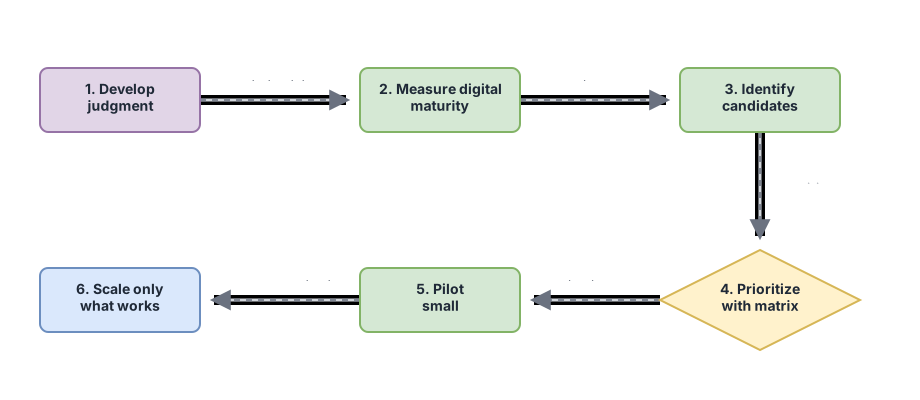
Why AI plans fail before they even start
The pressure is real. The board asks, competitors announce initiatives, and half your team is already using ChatGPT on their own without anyone deciding it. That pressure pushes toward the worst possible decision: buying fast so as “not to fall behind”.
When an AI project falls apart, it is usually for one of these four reasons. The wrong use case was chosen, almost always because it was the flashiest rather than the most useful. Something was promised that the technology does not deliver, and the result disappointed against inflated expectations. There was no organized data to work with. Or nobody had the judgment to tell a good result from a mediocre one, so the pilot was judged by enthusiasm instead of by numbers.
None of those causes is technical. They are about management. And all of them are prevented by a roadmap.
Step 1: build judgment before buying anything
Before spending a euro, someone with decision-making power has to understand what this technology is and what it is not. You do not need to learn to code. You do need to stop treating AI as magic.
Three ideas are enough to start. First: an LLM (large language model, the engine behind ChatGPT and similar tools) is a system that predicts likely text from what you give it. It does not “know” things the way a database does; it generates the most plausible answer based on its training. Second: that is why it sometimes hallucinates, meaning it produces an invented answer with total confidence that sounds correct. It is not an occasional glitch fixed by an update; it is how the tool works, and your plan has to account for it. Third: AI does not decide for you. It proposes, drafts, classifies, and summarizes. The responsibility still belongs to a person.
If you understand those three things, you can already tell a reasonable promise from a fairy tale. A vendor telling you “eliminate human error entirely” or “replace your department” is selling smoke. One telling you “cut the time on a repetitive task and leave the final review to your team” is describing something real.
That judgment is the first thing you train, and it is exactly what we work on in the IA sin hype course: truly understanding what the tool does so you neither buy on hype nor dismiss out of fear.
Step 2: measure your digital maturity honestly
AI works on top of your data and your processes. If they are messy, AI amplifies the mess. Before looking for use cases, take an honest look in the mirror with these questions.
Is your data accessible and reasonably organized, or scattered across emails, loose spreadsheets, and the heads of two people? Are your processes documented, or do they run because “María already knows how it’s done”? Do you have someone, even part-time, who can spend hours on a pilot without neglecting their own job?
You do not need top marks. You need to know where you stand. A company with documented processes and reasonably organized data can pilot in weeks. One dragging operational chaos has to tidy up first, and that groundwork, though less exciting, pays off more than any tool. If you run a small business and want the detail on where to start with limited resources, we develop it in the AI for small businesses guide.
Step 3: identify candidates where AI actually helps
With judgment and an honest picture of your maturity, you can now look for where to apply AI. The rule is simple: look for repetitive tasks, with plenty of text involved, and with some tolerance for error.
Repetitive, because value shows up when something is done many times. With text, because that is where these models shine: classifying incoming emails, summarizing long documents, drafting first versions, extracting data from invoices in different formats. And with tolerance for error, because AI gets things wrong, so the first candidate cannot be something where a mistake costs dearly with no way back.
Where not to look yet: critical decisions without supervision (approving a loan, a diagnosis), anything that depends on data you have not organized, and processes that are not even documented. Automating a process nobody has written down is automating chaos. The full catalog of where AI adds real value in a company is in this collection of use cases.
You come out of this step with a list. Ten, fifteen ideas. They all look good on paper, and that is exactly the danger point: doing them all at once, or starting with the flashiest one.
Step 4: prioritize with an effort and impact matrix
Not every idea on the list is worth the same. To order them without arguing in the abstract, place each one on a two-axis chart: how much effort it costs (money, time, complexity) against how much impact it has (savings, revenue, quality).
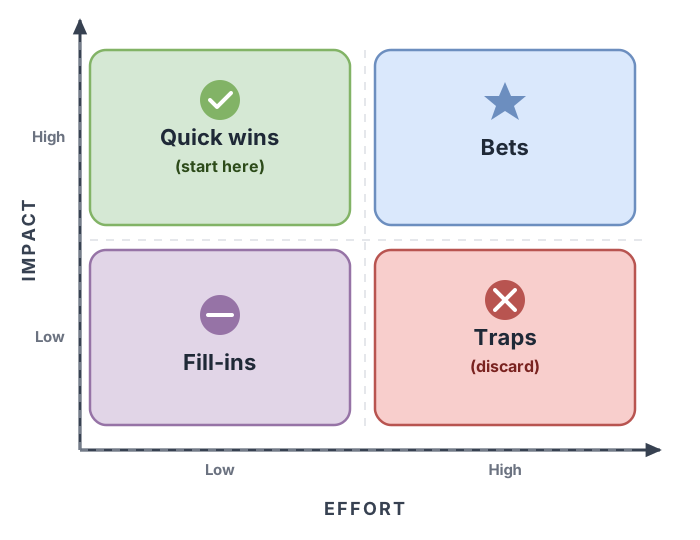
Four groups come out. High impact and low effort are your quick wins: that is always where you start. High impact and high effort are serious bets; note them down, but do not tackle them first. Low impact and low effort are fill-ins; do them if there is time to spare. And low impact with high effort are traps: discard them without regret, however modern they sound.
The discipline is starting with a single win from the first group. One. The temptation to launch three projects “because we have momentum” is exactly what turns the roadmap into smoke. A good first project is small and measurable, and hard to turn into a visible disaster.
Step 5: run a small pilot with a safety net
The pilot is where you check whether the idea survives contact with reality. And it has three conditions that are not negotiable.
A narrow scope. Not “automate customer support”, but “classify the incoming emails of one specific inbox for a month”. A success criterion defined before you start, not after: which number has to move and by how much to call it a success. If you define success at the end, you will always find a way to declare yourself the winner. And a person reviewing the results, because AI proposes and a human validates, especially at first.
The goal of the pilot is not for it to work. It is to learn quickly and cheaply whether scaling is worth it. A pilot that fails early and saves you an expensive rollout is a pilot that has done its job. So you do not forget any of these conditions when setting it up, there is an actionable list in the AI project checklist.
Step 6: scale only what works
Here comes the most human mistake of all: falling in love with the pilot. It took effort, it excited the team, and it is hard to admit the numbers do not add up. Scale guided by what the pilot measured, not by how attached you have grown to it.
Scaling also brings out costs that are invisible at small size. The per-use price of the tool multiplies with volume. Up come training the rest of the team and ongoing maintenance, plus integration with your systems. Account for it from the start and you will avoid the surprise of a cheap pilot that turns expensive when you actually roll it out.
And scaling brings legal obligations into play. In the European Union, the use of personal data is governed by the GDPR, and since 2024 the Artificial Intelligence Regulation (AI Act) classifies systems by risk level and imposes different obligations depending on that level. Not all uses weigh the same: classifying your own emails is not the same as a system that decides about people. Before scaling anything that touches customer data or sensitive decisions, check with whoever handles your legal advice. This is not legal advice, just the reminder that this step exists and is best not skipped.
Frequently asked questions
How much does it cost to get started with AI? Less than most people think for a first pilot, and more than it seems when scaling. Many tools have affordable or free entry plans to try. The real cost is not the license: it is the time of the people who set it up, review it, and maintain it.
Do I need a data team to get started? Not for the first step. You need reasonably organized data and someone who can spend hours on a narrow pilot. A data team becomes relevant when you scale several use cases at once, not before.
How long until you see a result? A well-scoped pilot gives signals in weeks, not months. If a vendor proposes a year-long project before you see anything, be wary: the scope is probably too big to learn quickly.
Is it legal to use AI with customer data? It depends on the use and how you handle that data. The GDPR and the AI Act set obligations according to risk. An internal use with anonymized data is very different from a system that decides about people. Check with your legal advisor before scaling.
Does my team already using ChatGPT count as AI adoption? It is a signal, not a plan. People using tools on their own shows there is demand, but also risk: sensitive data pasted into a public chat, results with no review. An adoption plan turns that scattered use into something with judgment and clear limits.
Related articles

AI Use Cases in Business: Which Ones to Prioritize
A framework for knowing which of your tasks are a good fit for AI and which ones are money down the drain: AI use cases in business, no hype.

AI for small businesses: where to start without burning your budget
A hype-free guide to AI for small businesses: start with a small problem, use tools that already exist before building, and measure before overspending.

Checklist before launching an AI project (7 checks)
A no-hype checklist to decide on an AI project: use case, real cost, risk, mitigations, metric, stopping criteria and owner.