
Generative AI vs machine learning: the real difference
Generative AI is machine learning, just a different paradigm. What each one trains on, what they produce, what predictive AI actually is, and which one you need.
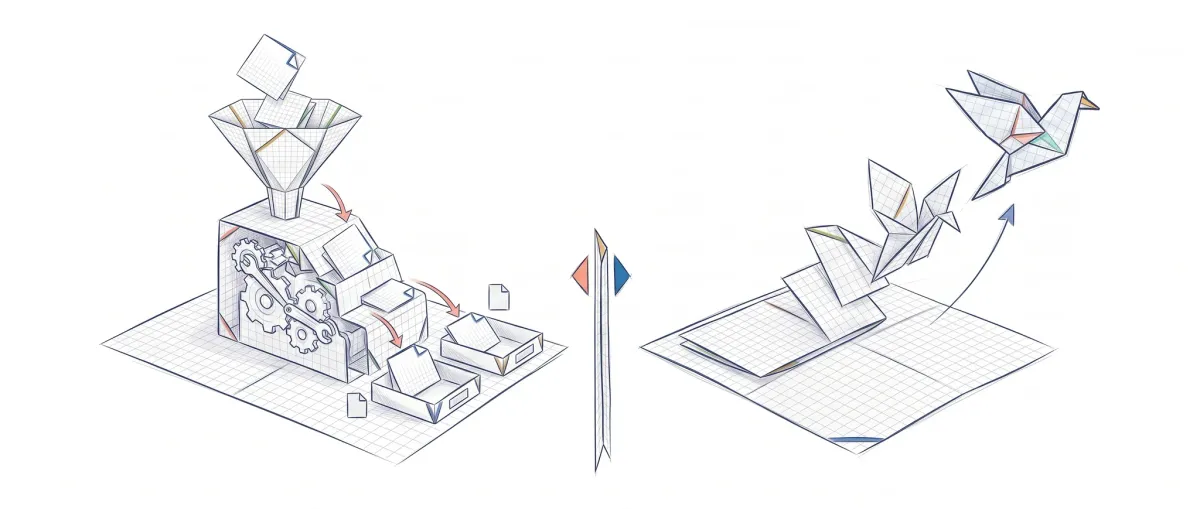
Generative AI is machine learning. It’s not a rival to it — it’s a branch that trains differently, for a different purpose. Classic machine learning learns from labeled data to nail one specific task. A generative model learns from a massive corpus to produce content that didn’t exist before.
That settles the question, but it doesn’t tell you which one to use next Monday. If the definition alone was what you were after, it is in what generative AI is. For that you need to see what changes at each step: what each one trains on, what it hands back, how you ask it to do the work, and how you check whether it got it right.
Generative AI vs machine learning: the difference in a table
| Classic machine learning | Generative AI | |
|---|---|---|
| What it trains on | Your own labeled data: historical rows with the correct answer attached (this transaction was fraud, this one wasn’t) | A general corpus of text, code, or images the provider already trained on. You don’t train it |
| What it produces | A number or a label from a list you define beforehand | Text, code, images, or audio that nobody wrote before |
| How you ask for the task | With an input vector. The task is fixed at training time and can’t change without retraining | In natural language. The same model summarizes, translates, or classifies depending on what you write |
| How you know it’s right | You compare against the historical data you held back. You get a percentage, and it’s objective | There’s no single correct answer to compare against, so you evaluate with human review or another model acting as judge |
| When you pick it | You have years of your own data and the answer fits in a spreadsheet cell | You don’t have your own data and the answer is content |
The row most people skip past is the third one. In classic machine learning, the task is part of the model: a spam classifier can’t do anything except decide whether an email is spam. In a generative model, the task lives in the prompt, and changing it costs nothing more than writing a different sentence.
What is traditional machine learning?
Traditional machine learning means training a model on historical examples that already carry the correct answer, so it can get that same answer right on new cases. You feed it thousands of transactions marked as fraud or legitimate, and the model learns which combinations of amount, country, and time tend to end in fraud.
The textbook cases are easy to spot because they’ve been running in production for decades. Payment fraud detection. Demand forecasting, to know how many units to order from the supplier next month. Email classification into spam or inbox. Product recommendations based on what similar users bought.
All four share something that makes them ideal for this paradigm: the correct answer is checkable. Next month you know whether demand matched your prediction. You know whether the transaction ended in a chargeback. That historical record is what trains the model, and it’s also what tells you whether it works.
The trade-off is the cost of entry. You need the data, you need it labeled, and you need enough of it. No history, no classic model — and that’s where generative AI comes in through a different door.
Generative AI or predictive AI? It’s a vocabulary problem
“Predictive AI” is the marketing name for classic machine learning when it’s used to predict. It’s not a third category — it’s training a model on your history to estimate something that hasn’t happened yet. The term caught on once generative AI showed up, because the old stuff needed a label too. Before that, a credit scoring model was just called a scoring model.
Predicting is one use of the classic paradigm, not the only one: classifying an email picks a category from a list, it doesn’t guess the future. Still, whenever you read “predictive AI,” you can mentally swap in “classic machine learning” and you’ll almost never be wrong.
Which one do I need for my problem?
The honest rule fits in two sentences. If the correct answer is a number or a label from a fixed list, and you have history where it already shows up, that’s classic machine learning. If the answer is text, code, or an image that didn’t exist before, that’s generative. By symptom:
- “How much will I sell in December.” A number, and you have previous Decembers. Classic.
- “Have the system write the description for every new product.” Content that doesn’t exist yet. Generative.
- “Flag the urgent tickets.” A label from a fixed list: with thousands of tickets already classified, classic; with nothing labeled, a generative model can classify from day one.
- “Detect whether a payment is fraudulent.” Classic, no question. You need a probability that’s stable, auditable, and cheap to compute millions of times a day.
A generative model can classify too, but it costs more, takes longer, and answers differently given the same input, because its output is the most probable continuation, not the correct one. In production it’s normal to run both: the classic model scores the transaction’s risk, and the generative model writes the alert the customer sees.
If the system you’re building is going to chain several model calls instead of making just one, this isn’t the comparison you need — that’s agentic AI vs generative AI. And if what you’re deciding is whether you need AI at all or plain old automation will do, that’s covered in AI vs RPA. In the agentic patterns course we build those systems step by step.
Frequently Asked Questions
Is generative AI machine learning?
Yes: there’s data, there’s training, and there’s a model with tuned parameters. What separates it from the classic kind is that it trains on a general, unlabeled corpus to produce new content, instead of on labeled data to nail one specific task.
What is predictive AI?
It’s classic machine learning used to estimate something that hasn’t happened yet: the units you’ll sell next month, or the probability that a customer churns. It isn’t a different technology — it’s a marketing label for the same old thing.
Is an LLM a machine learning model?
It is: it trains on text by predicting which word comes next, and that’s machine learning in the most literal sense of the term.
Can I use both at the same time?
It’s the norm once a system grows: the classic model makes the numeric decision, and the generative model writes the text the person sees. It also works the other way around, using a generative model to label the first few thousand examples you’ll use to train the classifier.
Do I need my own data to get started with generative AI?
Not for the first test, because the model answers from minute one without having seen anything of yours. If the answers depend on information that only exists inside your company, you’ll have to hand it over on every call, and that’s data work again even if you don’t call it training.
Related articles

What Generative AI Is (and What It Isn't)
What generative AI is in plain business terms: how it differs from the automation you already have, what it can NOT do, and what it's actually good for.
Agentic AI vs Generative AI: The Real Difference
Generative AI produces content from a prompt. Agentic AI adds a loop with memory and tools to complete multi-step tasks.

How generative AI works, explained without the jargon
Generative AI doesn't look up truths: it predicts the most plausible word. That mental model explains why it hallucinates, why it changes, and where it fails.