
MCP vs RAG: the differences and how they work together
MCP connects the model to live tools and data. RAG drops relevant text into the prompt. They do not compete: here is the difference and when to use both.
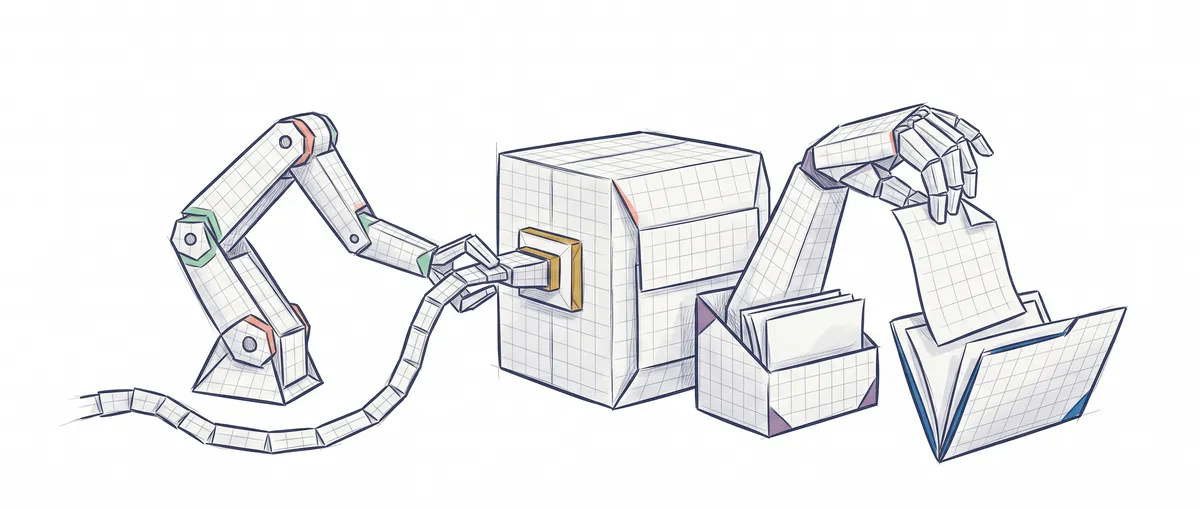
MCP is a protocol for connecting a model to live tools and data. RAG is a technique for finding relevant text and dropping it into the prompt before the model answers. They do not compete: they solve different problems, and in a real system they usually live side by side.
The two acronyms show up in the same conversation because both sound like the same thing, “giving the AI data it never saw during training”. Whether you search for it as MCP vs RAG or as RAG vs MCP, the practical question is not which one is better, it is which of the two you are missing right now. If you are coming in cold, I have an article on what MCP is and how it connects a model to tools and another on what RAG is and what it is for.
MCP vs RAG, side by side
| MCP | RAG | |
|---|---|---|
| What it is | An open protocol, released by Anthropic in November 2024, built on top of JSON-RPC, a message format that already existed | An information retrieval technique, described by Lewis et al. at NeurIPS 2020 |
| What problem it solves | The model cannot touch your systems | The model has not read your documents |
| What it adds to the model | The ability to act and to query live data | Knowledge: chunks of text inside the prompt |
| When it happens | While the agent runs: the client asks for the tool catalog, the model picks one and calls it | Before generating: an index is searched and whatever comes back is pasted into the prompt |
| What you have to build | A server that publishes tools with a name, a description and an inputSchema | An index over your documents, plus the code that searches and assembles the prompt |
| If the data changes | The next call already returns the new value | You have to re-index that document, or the model will keep quoting the old one |
| Who consumes it | Any client that speaks the protocol, not just yours | Your application, which is the one assembling the prompt |
The “if the data changes” row is the one that decides almost everything. An index is a photo of the past, and a tool is a question about the present.
When to use MCP or RAG
Picture an online store with an internal manual and an orders database.
If the question is “how many days do we have to accept a return?”, the answer is already written down in a document. You look for the chunks that talk about returns, you put them into the prompt, and the model writes the answer with them in front of it. That is RAG, and the full ingestion and indexing pipeline is in the enterprise RAG guide.
If the question is “what is the status of order 4821?”, there is no document that answers it. The data lives in a database and changes several times a day. What you need here is for the model to be able to do tool calling, that is, to ask for a tool to be run instead of trying to answer from memory (how an LLM reaches external tools), and MCP is the open protocol that standardizes how that tool is described and how it is run, whatever the client.
A nuance that gets lost in the simplified “RAG reads, MCP acts” version: an MCP server also exposes read-only resources, identified by a URI (an address like file:///manual.pdf), on top of tools. The real boundary runs somewhere else: text frozen in an index versus a query that is resolved on the spot.
How they combine in the same agent
Because they are different layers, you can put the RAG search inside an MCP tool.
// An MCP tool whose body, on the inside, does RAG
server.registerTool(
  "buscar_en_manual",
  {
    // The model reads this description to decide whether to call it
    description: "Searches the internal manual and returns the relevant chunks",
    inputSchema: z.object({ pregunta: z.string() }),
  },
  async ({ pregunta }) => {
    // This is RAG: find the chunks that look most like the question
    const fragmentos = await indice.buscar(pregunta, { top: 5 });
    // The text goes back into the model's context
    return { content: [{ type: "text", text: fragmentos.join("\n\n") }] };
  },
);
The model has no idea there is a document index in there. It sees a tool with a name and a description, the same way it sees consultar_pedido. And the index does not care who is asking. Each layer does its job without knowing about the other, which is exactly what you want the day you swap the index and would rather not touch the agent.
That separation is what turns a chat that answers questions into an agent that gets tasks done, and it is the pattern we work through step by step in the agentic patterns course.
Frequently Asked Questions
What is the difference between MCP and RAG?
MCP is a connection protocol and RAG is a retrieval technique. MCP defines how the model discovers and calls something that lives outside it; RAG decides what text ends up inside the prompt before the model writes a single word. One is the plumbing, the other is what you give it to read.
Does MCP replace RAG?
No, and you notice the attempt fast once you try it. If you answer “how many days do we have to accept a return?” with a tool call, you end up writing one tool for every question a customer might come up with. And if you do the opposite, indexing the orders table to save yourself the tool, the model will happily quote the status that order had on the day you indexed it.
Can I use MCP and RAG at the same time?
Yes, and the boundary is more concrete than it sounds: it runs inside the function that executes the tool. The MCP server publishes the name, the description and the inputSchema to the outside world; whatever happens inside that function, a SQL query or a search over an index, is your business and the model never sees it.
Is MCP the same as function calling?
No: function calling is the mechanism by which a model asks for a function to be run, and MCP is the protocol that standardizes how that tool catalog is published and discovered. I dig into that axis in MCP vs API.
If I already have MCP set up, do I need RAG?
It depends on where the answer lives. For structured data you look up by identifier, no: a tool that goes to the database is usually more precise and cheaper than a similarity search, which means searching by closeness of meaning and is exactly what RAG does. For natural language questions over a pile of unstructured text, yes, you are going to need it, even if you end up calling it from an MCP tool.
Which one do I learn first if I am just starting out?
MCP, because the payoff is immediate: you connect a client that already exists to a server that already exists and you watch the model use your tools the same afternoon. RAG has more moving parts of its own to build before anything works at all, and to understand what is failing inside it helps to have already seen how the model consumes context.
Related articles
What is MCP: the protocol connecting AI agents with tools
MCP (Model Context Protocol) standardizes how AI agents connect to external tools. Explanation with line-by-line commented Python examples.

What Is RAG in AI: A Simple Definition and What It's For
RAG means searching your documents and handing them to the model before it answers. What it is, what problem it solves, how it works, and when it isn't worth the trouble.

MCP vs API: differences and when to use each one
MCP doesn't replace your REST API: it wraps it so an agent can discover its tools on its own. Comparison and when to use MCP, API, RAG, or function calling.