
RAG vs grounding: how they differ and where they overlap
Grounding means an AI answer rests on checkable sources; RAG is one way to get there. The difference, with examples, and where the two meet.
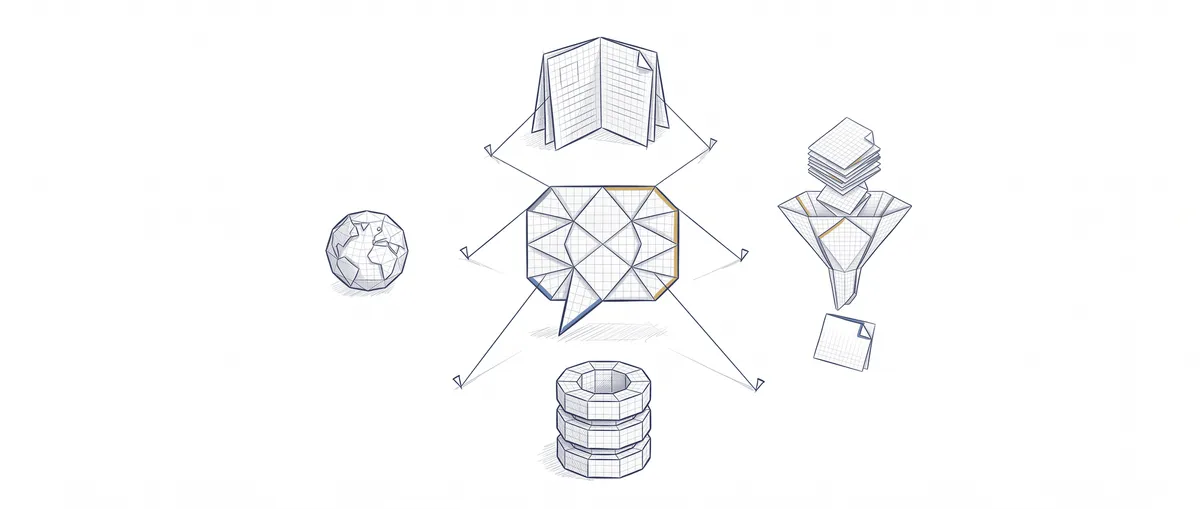
Grounding is the goal: getting a language model’s answer to rest on sources you can check, not just on what it memorized during training. RAG is one technique for getting there, and the most common one. Every RAG system is after grounding, but there is grounding without RAG, and RAG that never ends up grounded.
The mix-up is understandable, because the two words show up in the same sentence in almost every piece of documentation and look like synonyms. They aren’t, and they don’t compete: one is the what and the other is a how. The only thing you need to follow along is knowing what a hallucination is, when the model makes things up with total confidence, because both exist to fight it.
Grounding vs RAG, side by side
| Grounding | RAG | |
|---|---|---|
| What it is | A goal: a property the answer has (or doesn’t) | A specific technique, described by Lewis et al. at NeurIPS 2020 [1] |
| Question it answers | What is this claim from the model based on? | How do I get the text the model needs to answer? |
| Where the information comes from | Any verifiable source: your documents, the web, a database, a map | An index over your document collection |
| How you can tell | Every claim can be traced back to a source | Retrieved chunks go into the prompt (the text you send the model) ahead of the question |
| Named examples | Grounding with Google Search, Claude’s Citations | A search over your documents that runs before the model is called |
If you only keep one row, make it the first. Grounding describes the result and RAG describes a mechanism.
What grounding means in AI
Grounding means anchoring the model’s output to verifiable sources of information. Pretty much everyone just says grounding, the same way everyone says prompt. Google’s Vertex AI documentation defines it as the ability to connect model output to verifiable sources, and pitches it precisely as a way to reduce hallucinations and to audit where each piece of data comes from [2].
Think of the difference between a closed-book exam and an open-book one where you also have to write down the page each answer comes from. Same student. What changes is that now you can check what they say.
The interesting part is that, in that same documentation, Google lists several ways to achieve grounding: with Google Search, with Google Maps, with your own data, with your own search API, and one of them is literally called “Grounding responses using RAG” [2]. RAG shows up as one option on the list. That is the exact relationship between the two words.
Grounding without RAG: examples
You have grounding whenever the model answers with a verifiable source in front of it, whether or not an index of yours went looking for it. None of these four cases involves building your own RAG:
Pasting the document into the conversation. You hand over the whole contract and ask about the termination clause. No search, no index, and the answer is still anchored to a specific text. If the document fits in the context window, the maximum amount of text the model can read at once, this is often the most sensible option.
Web search with citations. With Grounding with Google Search, Gemini decides on its own whether it needs to search and, when it does, returns a groundingMetadata block with the queries it ran, the pages it used and which part of the answer rests on each one [3]. OpenAI’s web search tool does something similar with url_citation annotations that carry the URL and the position in the text [4]. Technically that is also retrieving and augmenting, and some people call it RAG over the web; the practical difference is that you don’t build or maintain the index.
Looking up live data. If the model calls a tool (a function in your code that the model can ask to have executed) that reads an order’s status from your database, the answer rests on that value, not on its memory. There are no documents to chunk. I cover the difference between pulling indexed text and querying live systems in MCP vs RAG.
Citations over documents you already provide. The Citations feature in Claude’s API doesn’t search for anything: you pass it the documents (plain text, PDF or custom content) and the answer comes back with the exact cited_text and its location, either a character range or a page range [5]. It’s a verification layer, and it fits just as well on top of a RAG pipeline as without one.
What about fine-tuning? It tends to sneak into these lists, and it doesn’t belong. Training the model on more examples changes what it knows, but the answer still comes from what the model learned during training: there is no source the reader can open to check it.
RAG that doesn’t end up grounded: where they overlap and where they don’t
They overlap in intent and part ways in the result. Doing RAG means the model has the chunks in front of it; grounding means what it answers is backed by them, and the first doesn’t guarantee the second. If the search brings back the wrong chunk, the model confidently writes an answer anchored to the wrong text. And if the chunk is right but incomplete, it sometimes fills the gap with what it remembers from training, which is exactly what you wanted to avoid. How retrieval works under the hood is covered in what RAG is and how it works step by step.
That’s why, when we build a RAG pipeline, what we really want to measure is grounding. A cheap check is to ask the model to cite the chunk each sentence relies on and verify that those citations exist:
// fragmentos: lo que devolvió tu búsqueda, cada uno con un id
const prompt = `Responde SOLO con estos fragmentos.
Tras cada frase, escribe entre corchetes el id del fragmento que la respalda.
${fragmentos.map((f) => `[${f.id}] ${f.texto}`).join("\n")}
Pregunta: ${pregunta}`;

const respuesta = await modelo.completar(prompt);

// Sacamos todos los ids que el modelo ha citado
const citados = [...respuesta.matchAll(/\[(\w+)\]/g)].map((m) => m[1]);
// Anclada = cita algo, y todo lo que cita existe de verdad
const ids = new Set(fragmentos.map((f) => f.id));
const anclada = citados.length > 0 && citados.every((id) => ids.has(id));
This check catches made-up citations and answers with no citation at all, which is already a lot. What it doesn’t catch is a real citation attached to a sentence the chunk doesn’t actually say. That check is more expensive, because someone, a person or another model, has to read both and compare them.
So the useful question when you look at a new system is never “does it use RAG?” but “can I check where each answer comes from?”. If you want to see how RAG, tools and these checks fit together inside a complete agent, the Design Patterns for AI Agents course walks through it with interactive exercises.
Sources
- Retrieval-Augmented Generation for Knowledge-Intensive NLP Tasks (Lewis et al., NeurIPS 2020): the original paper describing RAG.
- Grounding overview (Google Cloud, Vertex AI): definition of grounding and list of methods, including “Grounding responses using RAG”.
- Grounding with Google Search (Google, Firebase AI Logic): web search as grounding and the contents of
groundingMetadata. - Web search (OpenAI API): web search tool with
url_citationannotations. - Citations (Claude Platform Docs): citations over user-provided documents, with
cited_textand location.
Frequently Asked Questions
What is grounding in AI, in one sentence?
It’s getting a language model’s answer to rest on verifiable sources it receives at answer time, rather than only on what it learned during training.
What’s the difference between grounding and RAG?
Grounding is the goal and RAG is one of the techniques for reaching it. RAG searches your documents for chunks and puts them in the prompt; grounding is the property that the final answer is backed by a checkable source, whether that source comes from RAG or from somewhere else, like a web search.
Does a system with RAG automatically have grounding?
No. Having the chunks in the prompt doesn’t force the model to stick to them. If retrieval fails or the model fills in from memory, the answer can sound just as confident and not be backed by anything you gave it. You have to measure it, for example by requiring citations and checking them.
Does grounding eliminate hallucinations?
It reduces them, which is what it’s for, but it doesn’t eliminate them. Its real advantage is a different one: when the model gets something wrong, you can go to the source and see the error instead of having to take its word for it.
Do I need to build a RAG pipeline to get grounding?
Only if your information is private, large and doesn’t fit in a conversation. For a handful of documents, pasting them is enough, and for public, recent information a web search with citations usually does the job without you maintaining any index.
Related articles

What Is RAG in AI: A Simple Definition and What It's For
RAG means searching your documents and handing them to the model before it answers. What it is, what problem it solves, how it works, and when it isn't worth the trouble.

What Is an AI Hallucination and Why It Is Inevitable
What an AI hallucination is, why it comes from the model's own mechanism, and what it means for your business before you trust it with a task.
MCP vs RAG: the differences and how they work together
MCP connects the model to live tools and data. RAG drops relevant text into the prompt. They do not compete: here is the difference and when to use both.