
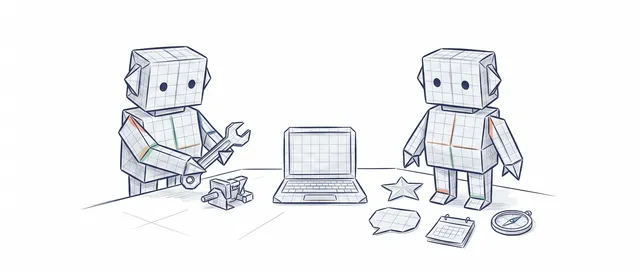
Claude vs ChatGPT for Coding: The Differences That Matter
Claude and ChatGPT don't solve the same problem when you code: one is built for autonomous agentic development, the other covers more ground outside of code. Which to use and when.
Library
Technical articles: agents, architecture, tools and design decisions.
Claude and ChatGPT don't solve the same problem when you code: one is built for autonomous agentic development, the other covers more ground outside of code. Which to use and when.
Agentic patterns are reusable solutions for problems that keep coming up when you build AI agents. What they are and the 5 you'll use most.
A comparison of Claude Code, Codex, and Cursor: where each agent lives, what each one does well, pricing as of August 2026, and when to use each tool.
What LLM-as-a-Verifier is, how it differs from model as judge, and what best-of-N really costs — the technique that took DeepSeek V4 Flash from 79% to 88%.

A comparison of three spec-driven development tools (OpenSpec, GitHub Spec Kit, and BMAD Method): what each one does, how much ceremony it imposes, and which to choose for your project.
Why AI agrees with you even when you're wrong: how it predicts the next token, why your question changes the answer, and how to ask better.
Claude Code is Anthropic's agent that reads your repository, edits files, and runs commands. What it is, what it's for, and how it differs from Copilot.
On August 14, 2026, auto mode becomes the default mode. The six modes, the deny → ask → allow precedence, and what each lever actually guarantees.
Spec-driven development (SDD) means writing a versioned spec that the agent reads before it codes. Definition, example, and when to use it.
Why AI agrees with you even when you're wrong: how it predicts the next token, why your question changes the answer, and how to ask better.
Shieldstral turns moderation into a yes-or-no question and returns a confidence score. How it works and when it's worth using.

An AI agent doesn't respond in one shot: it works in a loop that repeats until the task is done. Here's how that loop works, jargon-free and step by step.